







By The Headline Guardian News Desk
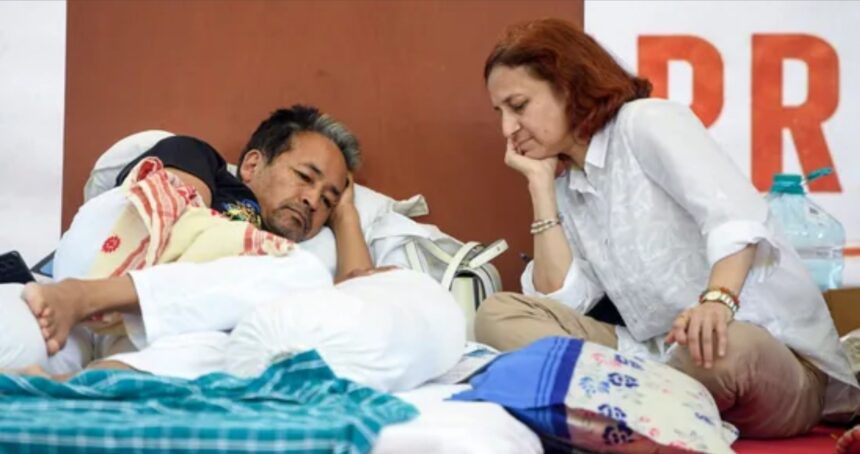
NEW DELHI — A fresh legal battle has emerged around the ongoing hunger strike of environmentalist and education reform advocate Sonam Wangchuk, after his wife, Gitanjali Agmo, moved the Delhi High Court seeking his transfer from Safdarjung Hospital to a private medical facility of the family’s choice.
The petition raises questions about medical transparency, patient autonomy, and the circumstances surrounding Wangchuk’s removal from his protest site at Jantar Mantar, where he had been on an indefinite hunger strike for more than three weeks.
The matter is expected to draw significant public and legal attention as debates continue over the balance between state intervention in medical emergencies and an individual’s constitutional rights.
See more of our coverage in your search results.
Add Hunterfly on GoogleWhat the Petition Seeks
Filed through advocate Bahuli Sharma, the petition requests that the court permit Wangchuk’s transfer to an independent hospital chosen by his family.
It also seeks judicial scrutiny of what the family describes as his continued confinement at Safdarjung Hospital, arguing that the circumstances surrounding his admission raise serious constitutional concerns.
According to the plea, Wangchuk was under ongoing medical observation at the protest site and there was no immediate emergency that justified his removal.
The petition contends that the intervention was abrupt, involuntary, and lacked adequate communication with family members.
Family Raises Concerns Over Medical Transparency
A key element of the petition concerns reported discrepancies in potassium-level readings.
See more of our coverage in your search results.
Add Hunterfly on GoogleAccording to court filings, hospital authorities informed Wangchuk’s wife that his potassium level had fallen to 2.9, a figure presented as requiring urgent medical intervention.
The petition states that family members requested copies of the medical reports but were allegedly not provided complete documentation.
Concerned by the reported reading, the family requested a blood sample for independent testing. According to the petition, the sample was released after several hours, and the subsequent test reportedly showed a potassium level of 3.6.
See more of our coverage in your search results.
Add Hunterfly on GoogleThe family argues that the difference between the two results warrants independent verification and greater transparency regarding Wangchuk’s medical condition.
It is important to note that these claims are part of the petition filed before the court and are yet to be judicially examined.
Hospital Says Medical Care Is Being Provided
Safdarjung Hospital has maintained that Wangchuk is receiving appropriate treatment and continuous medical monitoring.
Hospital officials stated that he is being provided the required medical intervention based on his health condition and that medical professionals are overseeing his care.
Authorities have emphasized that healthcare decisions are being guided by clinical assessments and the need to safeguard his well-being.
Police Action Sparks Political Debate
Wangchuk’s transfer to the hospital has also become a political flashpoint.
Delhi Police have said the move was undertaken to ensure his health could be monitored in accordance with legal and medical considerations after an extended period of fasting.
Supporters, however, alleged that he was forcibly removed from the protest site, triggering unrest among demonstrators.
Opposition leaders criticized the action, while the ruling Bharatiya Janata Party defended the decision as necessary to protect Wangchuk’s health and safety.
The developments have intensified debate over how authorities should respond when prolonged protests involve significant health risks.
Hunger Strike and Its Background
Wangchuk has been staging a hunger strike in connection with concerns regarding alleged irregularities in national examinations.
The protest has attracted widespread attention from student groups, civil society organizations, education activists, and political leaders.
Known internationally for his work on sustainable development, education reform, and environmental conservation, Wangchuk has often used peaceful advocacy campaigns to draw attention to public policy issues.
His latest protest has placed examination governance and institutional accountability at the center of national discussion.
Legal Questions Before the Court
The High Court may be required to examine several key issues:
- Whether Wangchuk’s transfer from the protest site was legally justified.
- Whether his continued stay at the hospital is voluntary or compelled.
- Whether the family should be allowed to move him to another healthcare institution.
- Whether sufficient medical information has been shared with family members.
- Whether any constitutional rights have been violated during the process.
Legal experts note that the case could have broader implications for future situations involving protesters receiving medical treatment while engaging in prolonged fasts.
Broader Debate on Rights and Medical Intervention
The dispute highlights a recurring constitutional question: how should authorities respond when an individual’s health deteriorates during a protest?
Courts have historically weighed personal liberty against the state’s responsibility to protect life and public order. Cases involving hunger strikes often require careful consideration of medical evidence, informed consent, and individual rights.
The outcome of this matter may help clarify the legal boundaries governing state intervention in similar situations.
What Happens Next?
The Delhi High Court is expected to consider the petition and hear submissions from all parties involved, including hospital authorities and government representatives.
Any decision could shape not only Wangchuk’s immediate medical future but also broader discussions about protest rights, healthcare transparency, and civil liberties in India.
Until then, attention remains focused on Wangchuk’s health condition and the legal proceedings unfolding in the national capital.