





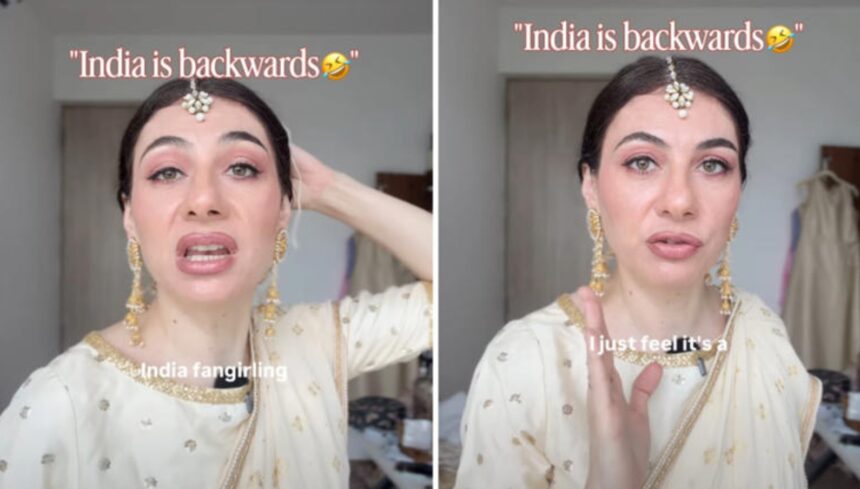
An Amsterdam woman living in Mumbai has sparked a conversation online after sharing her surprise at the speed of India’s delivery services.
In an Instagram video, the woman pushed back against the idea that India is a “backwards” country and pointed to a recent experience that impressed her: ordering flowers through a delivery app and receiving them within around 10 minutes.
Her comments quickly attracted attention on social media, with viewers debating India’s rapidly expanding delivery ecosystem and the differences in everyday services between countries.
‘What Do You Mean, India Is Backwards?’
The woman began her video by addressing people who describe India as backwards.
See more of our coverage in your search results.
Add Hunterfly on GoogleShe said she was surprised by how quickly she could order flowers for delivery in Mumbai and suggested that such convenience is available across many Indian cities.
She also compared her experience with the Netherlands, where she said similar services exist but may not be as widespread in the same way.
Her central argument was that India’s challenges should not automatically lead people to overlook areas in which the country has developed rapidly.
A 10-Minute Delivery Becomes Her Example
The flower delivery experience became the main example in her post.
According to the woman, she placed an order through a last-mile delivery platform and received the flowers within approximately 10 minutes. She described the experience as something she had not expected before living in India.
See more of our coverage in your search results.
Add Hunterfly on GoogleShe acknowledged that India has its own problems but argued that the country also offers levels of convenience that can compare favourably with services in other parts of the world.
Her comments reflect the growing visibility of India’s quick-commerce and last-mile delivery sector, particularly in large urban markets.
She Calls Out a One-Sided View of India
The woman also argued that repeatedly focusing only on India’s shortcomings can create an incomplete picture of the country.
See more of our coverage in your search results.
Add Hunterfly on GoogleShe described this as a form of “tunnel vision”, suggesting that people can overlook technological development, infrastructure improvements and the convenience offered by digital services when they approach India solely through negative stereotypes.
Her post was also framed as a response to people she believes hold strongly negative views about the country.
Social Media Users Join the Conversation
The video prompted a range of reactions from viewers.
Some users agreed with her observations and said India’s delivery platforms have made everyday purchases significantly more convenient.
One commenter wrote that they were impressed by how far delivery services in India have developed. Another said the experience demonstrated how much can be accomplished through India’s convenience-focused apps.
Others pointed out that perceptions of a country can depend heavily on individual experience, location and perspective.
One viewer summed up that sentiment by saying, “It’s all about perspective and one’s experience.”
Another commenter noted that even Indians can be surprised by the range of products that can now be delivered quickly.
India’s Quick-Commerce Boom Adds Context
The woman’s experience comes against the backdrop of India’s rapidly evolving digital commerce market.
In major cities, consumers can increasingly order groceries, food, medicines, household products and other items through app-based services, with some platforms offering deliveries within minutes.
However, the availability and speed of these services vary depending on the city, neighbourhood, product and platform. A 10-minute delivery should therefore be viewed as an example of the convenience available in parts of India’s urban delivery market rather than a universal experience across the country.
Why the Video Has Resonated
The discussion surrounding the video goes beyond flower delivery.
For some viewers, the woman’s experience highlights how quickly India’s consumer technology ecosystem has developed. For others, it is a reminder that comparisons between countries can become overly simplistic when they focus on a single measure of development.
India has significant challenges across areas such as infrastructure, public services and inequality, while simultaneously having highly developed digital services in several consumer markets.
That contrast is arguably what makes the woman’s observation interesting: a country can have serious challenges while also being highly innovative and convenient in particular areas.
Bottom Line
The Amsterdam woman’s viral post has sparked a wider discussion about how India is perceived by people from outside the country—and how those perceptions can change after experiencing everyday life here.
Her 10-minute flower delivery may be a small example, but it has opened up a much larger conversation about technology, convenience and the rapidly changing experience of living in India’s major cities.