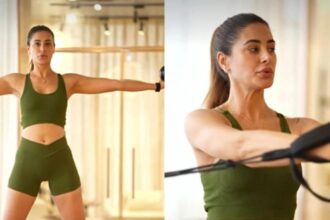









Rakul Preet Singh has spoken about “cycle syncing” and the idea of adjusting exercise according to how your body feels during different stages of the menstrual cycle. While the concept has gained popularity in the wellness space, experts caution against treating it as a rigid fitness formula.
Actor Rakul Preet Singh recently discussed menstrual health, exercise and the idea of working with the body’s changing needs during a conversation with Ranveer Allahbadia on The Ranveer Show.
Speaking about cycle syncing, Rakul encouraged women to pay attention to their hormones and how they may affect energy and physical performance.
“Be in sync with your hormones.”
Her comments have brought renewed attention to a wellness trend that encourages women to modify their exercise routines according to different stages of the menstrual cycle.
See more of our coverage in your search results.
Add Hunterfly on GoogleBut there is an important distinction between listening to your body and following a fixed workout plan based solely on the calendar.
What is cycle syncing?
Cycle syncing generally refers to adjusting aspects of exercise, nutrition or lifestyle according to the different phases of the menstrual cycle.
The menstrual cycle involves fluctuations in hormones, particularly estrogen and progesterone. These hormonal changes can be associated with differences in symptoms, mood, appetite, energy and recovery.
Some wellness programmes therefore recommend different types of exercise during different phases.
However, the scientific evidence does not establish that every woman needs a specific workout for each phase of her menstrual cycle.
See more of our coverage in your search results.
Add Hunterfly on GoogleIndividual experiences vary considerably. Sleep, stress, nutrition, fitness level, training history and menstrual symptoms can all influence how someone feels during a workout.
A more practical approach is to use the menstrual cycle as one piece of information while paying attention to your actual symptoms and performance.
Can you exercise during your period?
For most people, exercise during menstruation is safe.
See more of our coverage in your search results.
Add Hunterfly on GoogleLight or moderate physical activity may help some women manage period-related symptoms such as cramps, stress and low mood.
Walking, stretching, yoga, cycling and other comfortable forms of movement can be useful options when energy is lower.
There is also no universal rule that menstruation means you need to stop strength training or cardio.
If you feel well, you may be able to continue your normal routine.
On the other hand, significant pain, dizziness, unusual fatigue or other concerning symptoms are reasons to reduce intensity, rest or seek medical advice where appropriate.
Menstrual phase: Adjust according to symptoms
The menstrual phase begins on the first day of menstrual bleeding.
This is when estrogen and progesterone are relatively low, although hormone levels alone do not determine how a person will feel.
Some women experience cramps, headaches, fatigue or lower energy during this period.
If that is the case, gentler activities such as walking, mobility work, stretching or light yoga may feel more comfortable.
But there is no requirement to switch to gentle exercise simply because you are menstruating.
If you feel energetic and have no symptoms limiting you, you may be able to continue your usual training.
Follicular phase: Build intensity when you feel ready
The follicular phase begins with menstruation and continues until ovulation. Estrogen generally rises during this part of the cycle.
Some women report feeling more energetic as menstruation ends.
For those who feel stronger, this may be a suitable period to focus on challenging training, including resistance exercise, running, cardio or strength workouts.
The important point is that the calendar should not dictate your workout.
If your energy is low, there is no benefit in forcing an intense session simply because an app says you are in the follicular phase.
Ovulation: Higher energy is not guaranteed
Ovulation occurs around the middle of the cycle, although its timing varies from person to person and from cycle to cycle.
Some women may experience higher energy around this period and choose to undertake demanding sessions such as weight training, running or high-intensity workouts.
Others may notice no meaningful difference.
Some people can also experience discomfort around ovulation.
As with every stage of the cycle, the appropriate workout is ultimately the one that matches your individual condition.
Luteal phase: Recovery may become more important
After ovulation comes the luteal phase.
Progesterone rises during this phase, and some women experience premenstrual symptoms, including bloating, breast tenderness, mood changes, cramps or fatigue.
If these symptoms affect training, reducing intensity may make sense.
Walking, Pilates, yoga, mobility work, moderate cardio or a lighter strength session can be alternatives.
However, women who feel completely comfortable during the luteal phase do not necessarily need to reduce their training.
The goal is not to avoid challenging exercise but to recognise when recovery needs are changing.
Nutrition and hydration matter too
Exercise is only one part of managing energy throughout the menstrual cycle.
A balanced diet containing adequate protein, carbohydrates, healthy fats, fruits and vegetables can support overall nutrition and exercise recovery.
Hydration is also important, particularly during demanding workouts or hot weather.
People with heavy periods may also need to discuss iron status with a healthcare professional if they experience persistent fatigue or other symptoms that could indicate iron deficiency.
When should you speak to a doctor?
Period-related discomfort is common, but severe or disruptive symptoms should not simply be accepted as something you have to live with.
Consider speaking with a healthcare professional if you regularly experience:
- Severe menstrual pain
- Very heavy bleeding
- Persistent fatigue
- Dizziness or fainting
- Symptoms that consistently prevent exercise or normal activities
- A significant change in your usual menstrual pattern
These symptoms can sometimes have an underlying medical cause and may require evaluation.
The real lesson behind cycle syncing
Rakul Preet Singh’s comments highlight a useful principle: your workout does not have to look identical every day.
Cycle syncing can be viewed as a framework for becoming more aware of your body’s patterns rather than a strict timetable that tells you exactly what exercise to perform on a particular day.
For one woman, the first days of her period may be a good time for recovery. Another may feel completely capable of a normal strength session.
Similarly, one person may experience an energy boost around ovulation while another notices no difference.
The most useful approach is therefore flexible: track your symptoms, monitor your energy and recovery, and adjust your training when necessary.
The menstrual cycle can provide useful context, but it should not replace individual judgment, evidence-based training principles or professional medical advice when symptoms are concerning.