




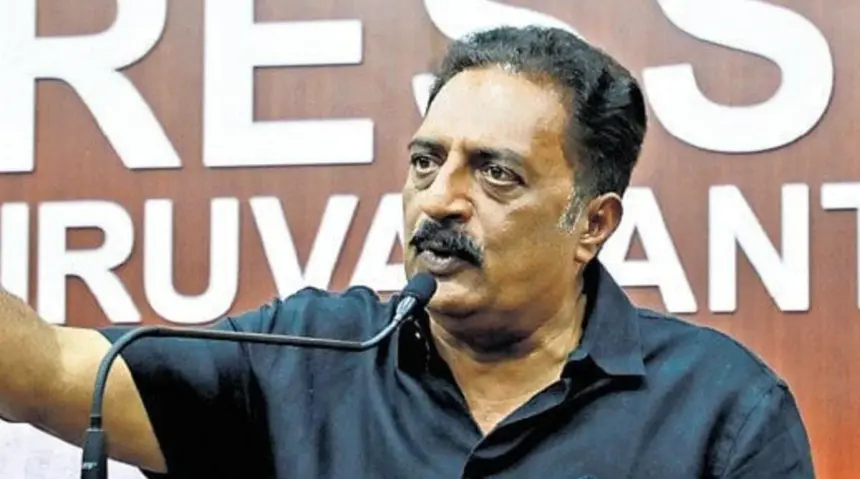
Actor Prakash Raj has expressed support for 16 suspended students of Sree Sankaracharya University of Sanskrit in Kerala, warning that he could join their hunger strike if authorities continue to prevent them from appearing for examinations. He has called for an investigation into the allegations against the students while urging officials to protect their academic interests.
Kalady, Kerala, November 7, 2026: Actor and social commentator Prakash Raj has stepped into a dispute involving 16 suspended students of Sree Sankaracharya University of Sanskrit in Kalady, near Kochi, expressing solidarity with their hunger strike and demanding that they be allowed to sit for their examinations.
Visiting the university on Saturday, Raj criticised the handling of the disciplinary proceedings and questioned why the students’ academic prospects should remain uncertain while allegations against them are being examined.
The students had reportedly been on hunger strike for six days when Raj visited the campus.
He urged the university administration and state authorities to resolve the disagreement, arguing that the students should be given an opportunity to appear for their examinations without necessarily bringing the disciplinary inquiry to an end.
Raj also warned that he was prepared to join the protest if the situation remained unresolved.
Prakash Raj Warns He Will Join Students’ Hunger Strike
During his visit to the university, Raj told the protesting students that he was willing to return and participate in their hunger strike if their demands continued to go unanswered.
“I have come here for a protest, but I promise that if this continues, I will come and sit with them here. I have no problem. I can stop everything and come and sit here,” he said.
His remarks were directed at the university’s decision to prevent the suspended students from taking their examinations.
Raj argued that disciplinary proceedings and examination eligibility should be considered separately, particularly when the allegations are still disputed.
He called for an approach that would allow the authorities to investigate the incident while avoiding unnecessary academic consequences for the students.
His intervention has brought wider public attention to the dispute, which has already involved proceedings before the Kerala High Court and the Supreme Court.
Why Were 16 Students Suspended From Sree Sankaracharya University?
The controversy dates back to August 13, when a protest led by the Students’ Federation of India (SFI) took place during a university syndicate meeting.
The demonstration reportedly concerned alleged shortcomings in campus infrastructure and other facilities available to students.
According to the allegations cited in the disciplinary action, the protesters staged a symbolic mock cremation involving Vice-Chancellor Ciza Thomas.
The students were also accused of manhandling the vice-chancellor and attempting to damage university property.
These allegations subsequently became central to the university’s action against the 16 students.
However, the accusations remain disputed, and they should not be treated as established findings merely because they formed the basis of disciplinary proceedings.
The university’s subsequent refusal to permit the students to appear for examinations intensified the disagreement.
For the students, the immediate concern was the possibility of losing an examination opportunity while the dispute continued.
What Happened in the Kerala High Court and Supreme Court?
The disagreement over the students’ examination eligibility eventually reached the courts.
According to the procedural history provided in the report, a single bench of the Kerala High Court initially directed the university to allow the suspended students to appear for their examinations.
The university challenged that direction, and a division bench subsequently stayed the single-bench order.
The students then approached the Supreme Court.
The Supreme Court reportedly directed the Kerala High Court’s single bench to decide the matter.
These developments left the examination dispute tied to further judicial consideration.
The distinction between an interim court direction and a final determination is important. The existence of an earlier order permitting examinations does not, by itself, establish that the students currently have permission to appear.
The exact operative court order and the status of the proceedings need to be checked before any conclusion is drawn about their present examination eligibility.
Prakash Raj Questions Allegations Against the Students
During his interaction at the university, Raj challenged the allegations that the students had physically assaulted or behaved inappropriately towards the vice-chancellor.
He asked the authorities to produce evidence supporting the accusations rather than rely on allegations to justify preventing the students from appearing for examinations.
“This is not done. You have to come and stand with the students, make them write the exams and conduct an investigation,” he said.
His position was that the university could investigate the allegations while also finding a way to protect the students’ immediate academic interests.
Raj further questioned the decision to continue litigation after the initial High Court direction had favoured allowing the students to take their examinations.
He alleged that legal procedures were being used in a manner that prolonged the students’ difficulties.
Those comments reflected Raj’s criticism of the university’s handling of the case. They do not independently establish that the authorities acted unlawfully or misused the judicial process.
Actor Criticises Political Leadership Over Campus Dispute
Raj also directed criticism at Kerala’s political and education leadership, urging officials to intervene rather than allow the dispute to continue.
He referred specifically to Roji M John and called for engagement with the protesting students.
The actor accused authorities of adopting an excessively restrictive approach towards young people who raise concerns about educational institutions.
“What is this anarchy, dictatorial behaviour of the university or the education minister of this state? How long will everybody become like Modi and the Central government to stop youngsters from protesting and asking questions,” he said.
His remarks drew a political comparison between the university’s disciplinary response and his wider concerns about the treatment of dissent.
The comments were part of Raj’s criticism of the authorities and should be understood as his political opinion rather than a judicial finding about the university’s conduct.
‘This Is the Constitution’: Prakash Raj Defends Students’ Right to Protest
In another strongly worded statement, Raj connected the students’ protest to broader questions about constitutional rights and democratic participation.
He argued that young people should not be expected to apologise simply for questioning institutional decisions or demanding improvements to campus facilities.
“This generation is not Savarkar’s to write sorry petitions. This generation protests with the strength of what Gandhi has taught them and asks questions with the rights Babasaheb Ambedkar has given them. This is not Manusmriti, this is the Constitution,” Raj said.
His remarks invoked Mahatma Gandhi and B. R. Ambedkar while emphasising the importance of dissent in democratic life.
The actor also criticised demands for apology letters, arguing that the students’ concerns should be addressed through discussion and an appropriate inquiry.
At the same time, the legal right to protest does not automatically prevent a university from examining specific allegations of misconduct.
The dispute therefore raises two separate questions: whether the disciplinary action was justified and whether the students should be permitted to take their examinations while the matter is considered.
Raj Thanks SFI, DYFI and Youth Organisations
Raj acknowledged the support extended to the suspended students by the Students’ Federation of India, the Democratic Youth Federation of India (DYFI) and other youth groups.
He thanked those who had supported the protest and helped draw attention to the students’ demands.
The SFI-led demonstration that preceded the suspensions had focused on complaints about facilities at the university.
The subsequent disciplinary action, however, shifted the controversy towards the conduct of the protest, the university’s response and the students’ examination rights.
Raj’s appearance has added a prominent public voice to the issue, though it remains unclear whether it will lead to a change in the university’s position.
What Is at Stake for the Suspended Students?
The immediate issue for the 16 students is their ability to continue their academic progress.
Missing scheduled examinations can create practical difficulties, including delays in completing courses, uncertainty about results and potential disruption to further studies.
Whether those consequences apply in this case will depend on the students’ programmes, examination rules and any relief ultimately granted by the university or courts.
The dispute also raises questions about how universities should respond when campus protests lead to serious allegations of misconduct.
Educational institutions have responsibilities to maintain safety, protect staff and students, and investigate complaints fairly.
Students, meanwhile, have legitimate interests in raising concerns about campus conditions and receiving a fair disciplinary process.
Finding a proportionate response requires consideration of both sets of responsibilities.
Allowing examinations to proceed, subject to appropriate legal directions, would not necessarily settle the allegations against the students.
Likewise, an ongoing inquiry does not automatically establish their guilt.
What Happens Next in the Kerala University Protest?
Raj has called for discussions between the students and the authorities, with examination permission remaining the central demand.
He has also urged officials to conduct a proper investigation into the allegations rather than allow the dispute to continue without resolution.
The students’ immediate academic future will depend on applicable university rules, administrative decisions and further court directions.
The university’s response to Raj’s intervention and any subsequent judicial developments will be important in determining how the dispute moves forward.
For now, the actor’s promise to join the hunger strike if necessary has increased attention on the suspended students and their demand to be allowed to take their examinations.
The larger question remains whether the university and students can reach a resolution that protects academic opportunities while ensuring a fair examination of the allegations arising from the campus protest.
Have a story tip or feedback? Write to [email protected].
© Hunterfly.in. Original editorial content.