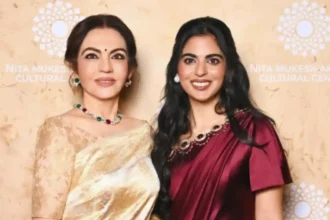







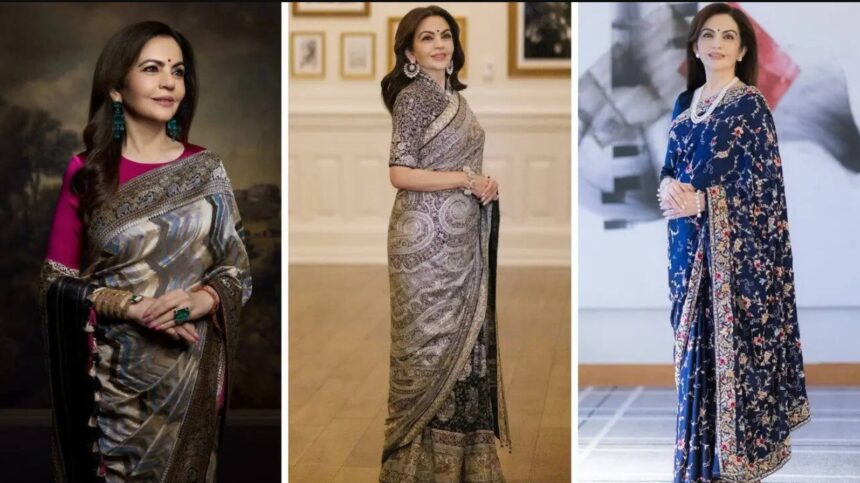
Throughout 2025, every saree worn by Nita Ambani served a larger purpose — to place India’s rich textile heritage firmly on the global stage. As Chairperson of the Reliance Foundation and founder of Swadesh, her sartorial choices became a living exhibition of India’s weaving traditions, many of which remain unfamiliar even to Indians themselves.
Her wardrobe this year was not merely fashion; it was cultural diplomacy in silk, cotton, zari and thread — a masterclass in the depth, diversity and history of Indian craftsmanship.
Here is a closer look at the saree moments of 2025 that transformed international red carpets and global forums into showcases of India’s weaving legacy.
Kanchipuram Silk Saree with 100 Temple Motifs
In January, Nita Ambani chose a custom-made Kanchipuram silk saree for the swearing-in ceremony of US President-elect Donald Trump in Washington DC.
The masterpiece was woven by National Award-winning artisan B. Krishnamoorthy.
See more of our coverage in your search results.
Add Hunterfly on GoogleCrafted in black silk, the saree carried 100 traditional motifs inspired by the ancient temples of Kanchipuram, Tamil Nadu. Each motif narrated centuries of South Indian architectural and spiritual symbolism, making the garment as historic as it was elegant.
The Jamawar Saree That Took 1,900 Hours
For a state dinner held in honour of President Trump, she wore a museum-worthy jamawar saree created by designer Tarun Tahiliani.
This exceptional piece combined classical aari embroidery, intricate hand knotting, and heritage jamawar shawls that were hand-painted, printed and embroidered in layers of craftsmanship.
The saree required 1,900 hours of artisan work, reflecting the extraordinary patience and skill preserved in India’s textile traditions.
Pachrangi Rangkat Weave with Banarasi Gold Zari
At the opening of the Bvlgari Serpenti Infinito exhibition in Mumbai, Nita Ambani appeared in a striking black-and-silver pachrangi rangkat weave saree from Swadesh.
The saree was edged with Banarasi gold zari and finished with a regal Shikargah pallu.
The Shikargah technique, executed through complex Kadwa weaving, features motifs inspired by forests, animals and royal hunts. These sarees are considered heirloom treasures, often passed down across generations.
See more of our coverage in your search results.
Add Hunterfly on GoogleThe Heirloom Parsi Gara Saree
At the Harvard India Conference in Boston, she introduced the world to the exquisite heritage of the Parsi Gara saree.
The piece had been revived by master revivalist Zenobia S. Davar and featured densely hand-embroidered floral motifs that require months of meticulous needlework. The Parsi Gara remains one of India’s most sophisticated embroidery traditions, merging Persian artistry with Indian craftsmanship.
Handwoven Madurai Gharchola Saree
Another unforgettable appearance featured a Madurai cotton Gharchola saree, handwoven over ten months by artisan Rajshrundar Rajkot.
See more of our coverage in your search results.
Add Hunterfly on GoogleThe saree was finished with real zari and richly hand-embroidered borders. It was paired with a phirozi silk Kirti kanchali blouse adorned with antique gold, old-world embroidery — a combination that celebrated both regional tradition and royal elegance.
A Cultural Statement Beyond Fashion
Nita Ambani’s sarees in 2025 did more than impress — they educated. Each ensemble brought forgotten weaves, endangered crafts and master artisans into international conversation. Through these carefully chosen garments, India’s textile heritage was not just displayed, but honoured, documented and elevated.