




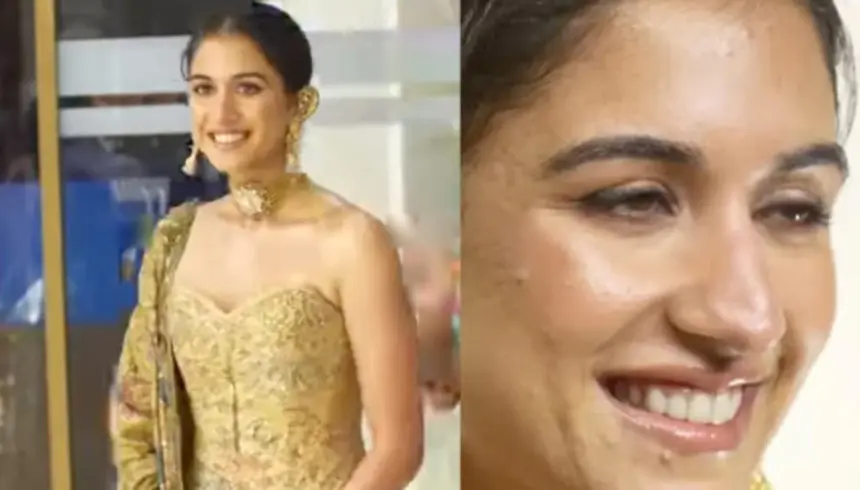
Radhika Merchant’s appearance at Swadesh’s first anniversary celebration in Mumbai prompted discussion on social media after close-up videos drew criticism of her skin texture. Several users pushed back against the remarks, highlighting the importance of accepting natural skin rather than expecting celebrities to look digitally polished at all times.
Radhika Merchant found herself at the centre of an online conversation about beauty standards after attending the first anniversary celebration of Swadesh at Eros on October 10, 2026. Photographs and videos from the event circulated on social media, drawing attention to her appearance and prompting contrasting reactions from viewers.
While some users posted critical remarks about her skin texture, others challenged the comments, arguing that visible pores and other natural skin details should not become reasons to ridicule someone.
The discussion has once again brought attention to the scrutiny public figures face over their appearance, particularly in close-up photographs and videos shared online.
Radhika Merchant’s Event Appearance Goes Viral
Photographer Arbaz Wahid Khan shared footage of Radhika on Instagram, where she could be seen smiling during the event. The video drew attention as viewers discussed her appearance in the comments section.
Rather than focusing on the occasion itself, some reactions centred on the texture of her skin. The remarks prompted criticism from other social media users, who questioned why a person’s natural appearance should invite public judgement.
The incident illustrates how quickly images from celebrity gatherings can become the subject of online commentary, with small details receiving disproportionate attention.
Skin-Related Comments Draw Backlash
Some users made disparaging remarks about Radhika’s complexion and skin texture. Among the comments quoted in the supplied report were “She needs a good facial” and remarks questioning why someone from a wealthy family would have visible skin texture.
Such comments reflect a familiar pattern in online celebrity culture: expectations that public figures should maintain a seemingly flawless appearance, even in unfiltered photographs or ordinary video footage.
However, visible skin texture is a normal feature of human skin. Lighting, camera distance, makeup and image processing can also affect how skin appears in photographs and videos.
A celebrity’s public profile does not make their appearance an appropriate target for personal attacks, and financial privilege does not eliminate normal variations in skin.
Fans Call for Greater Skin Positivity
Other social media users responded by defending Radhika and challenging the criticism. Their reactions centred on the idea that real skin does not need to resemble heavily edited photographs or beauty filters.
One supportive message highlighted that even celebrities have natural skin texture and that skin is not supposed to look airbrushed at every moment. Another called for people to embrace natural beauty and develop more realistic expectations of appearance.
These responses shifted attention from Radhika’s looks to the wider issue of how people discuss physical appearance online.
The support also reflects a broader conversation about skin positivity, which encourages people to recognise normal skin variations rather than treating every visible mark, pore or uneven area as a flaw.
The Pressure on Celebrities to Look Perfect
Public figures regularly appear before cameras at social events, premieres and private celebrations. Images can be captured from multiple angles and circulated without the lighting, preparation or editing associated with professional portraits.
As a result, the difference between a carefully produced photograph and a candid video can become a source of online scrutiny. Women in particular often face narrow beauty expectations, with commentary extending to their skin, weight, makeup and other aspects of their appearance.
Radhika’s experience highlights how these expectations can turn an otherwise ordinary public appearance into a debate about beauty standards.
The response from supporters offers a useful counterpoint: natural skin texture is not evidence of poor self-care, and a person’s worth should not be measured by how closely their appearance matches digitally enhanced images.
Why the Conversation Matters Beyond One Celebrity
The discussion surrounding Radhika Merchant is part of a wider online pattern in which public figures become subjects of appearance-based criticism. Although celebrity images are widely accessible, that visibility does not make every personal detail an invitation for ridicule.
Social media users can express opinions about public events without resorting to comments that shame people for normal physical characteristics. Supporting realistic beauty standards also means recognising the difference between discussing fashion or styling and targeting someone’s natural appearance.
As the conversation continues, the supportive reactions serve as a reminder that public discussion can be more constructive when it focuses on a person’s work, public appearances or broader issues rather than perceived physical imperfections.
Radhika’s appearance at Swadesh’s anniversary celebration has therefore become a talking point not only because of the footage itself, but also because of the contrasting responses it received. The incident underscores the importance of treating natural skin texture as normal and challenging unnecessary appearance-based criticism online.