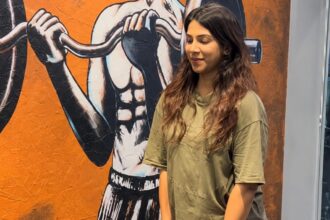






Actor Arti Singh’s latest fitness video highlights weighted wall sits, sled pushes with burpees and hanging knee raises. Here’s how these exercises work, their potential benefits and what beginners should know before trying them.
Actor Arti Singh has offered a glimpse into her fitness routine, sharing a gym workout that combines strength, conditioning and core exercises. The television actress, known for her work in Maayka, accompanied the video with a message about persistence, setbacks and the importance of continuing to work towards personal goals.
Rather than focusing on a single type of exercise, the workout features movements that challenge different aspects of physical fitness.
Among the exercises visible in the reported video are weighted wall sits, resisted sled pushes combined with burpees, and hanging knee raises performed using gymnastics rings.
Each movement places different demands on the body. While wall sits challenge lower-body muscular endurance, sled pushes and burpees combine strength with cardiovascular conditioning. Hanging knee raises, meanwhile, require abdominal control, grip strength and upper-body stability.
But does combining these exercises make for a balanced workout? And can beginners safely attempt them?
Understanding their purpose, technique and limitations is important before adding them to a fitness routine.
Arti Singh Shares a Message About Consistency and Progress
Alongside the workout video, Arti reflected on her experience with repeated setbacks.
“I failed many times… I promised myself and again failed. Failed again… then I started failing better,” she wrote in the caption shared in the supplied report.
Her message centred on learning from unsuccessful attempts and continuing to make progress.
Although motivation can play an important role in maintaining exercise habits, fitness progress rarely follows a perfectly consistent path.
Changes in strength, stamina and physical conditioning generally depend on several factors, including training frequency, recovery, exercise selection and individual health.
Missing a workout or struggling with an exercise does not necessarily mean a training programme has failed.
For most people, developing a manageable routine and progressing gradually is more useful than attempting difficult movements at maximum intensity from the beginning.
Is Arti Singh’s Workout a Good Fitness Routine?
The exercises shown in Arti’s workout reflect elements commonly associated with functional strength and conditioning.
According to comments attributed to consultant dietitian and fitness expert Garima Goyal in the supplied Indian Express report, the combination can challenge muscular strength, coordination, cardiovascular fitness and core control.
The potential benefit comes from using different movement patterns rather than relying exclusively on one exercise or muscle group.
However, three exercises alone do not automatically constitute a complete fitness programme.
An effective weekly routine should account for a person’s goals, experience, recovery needs and overall physical activity. It may also need additional exercises that train other movement patterns and muscle groups.
The intensity of the movements shown in the video may be unsuitable for people who are new to exercise or who have particular joint, cardiovascular or musculoskeletal conditions.
Here is a closer look at the three exercises.
1. Weighted Wall Sit: Building Lower-Body Strength and Endurance
A weighted wall sit is a static lower-body exercise in which the individual maintains a seated position against a wall while holding additional resistance.
Unlike a conventional squat, which involves repeated movement, a wall sit requires the muscles to maintain tension while the body remains largely stationary.
This is known as an isometric exercise.
Which muscles does a weighted wall sit work?
The primary demand falls on the quadriceps, the muscles at the front of the thighs that help extend the knee.
The glutes and other lower-body muscles also contribute to maintaining the position.
Adding a weight increases the difficulty, although the amount of resistance should be appropriate for the individual’s strength and experience.
How to perform a wall sit correctly
Start by standing with your back against a stable wall.
Move your feet slightly forward and slide down into a comfortable, supported position.
Keep your knees aligned with your feet and avoid allowing them to collapse inward.
A position near a 90-degree knee bend is commonly used, but beginners do not need to descend that far. A shallower bend may be more appropriate depending on comfort, mobility and physical limitations.
Keep your back supported and breathe naturally during the hold.
If using a weight plate, hold or position it securely according to appropriate coaching instructions, avoiding direct pressure on the kneecaps.
Return to standing in a controlled manner.
Common mistakes to avoid
- Allowing the knees to move inward.
- Using additional weight before mastering the unweighted version.
- Holding the breath throughout the exercise.
- Sliding into a depth that causes pain or loss of control.
- Continuing despite sharp knee or back pain.
Beginner-friendly alternative
Start with an unweighted wall sit at a comfortable knee angle.
Short, controlled holds may be sufficient initially. Duration can be increased as strength and tolerance improve.
People who experience knee discomfort should seek individual guidance rather than assuming that wall sits are appropriate for their condition.
2. Sled Pushes With Burpees: Combining Strength and Conditioning
The second exercise combination involves pushing a weighted sled and performing burpees.
Both movements can be physically demanding, but they challenge the body in different ways.
A sled push involves driving a resistance-loaded sled across a suitable surface, generally using the legs and hips to produce forward movement.
Burpees combine several movements, often including a squat or crouch, a transition into a plank position, and a return to standing. Some variations add a push-up or jump.
What are the potential benefits?
Sled pushes primarily challenge the lower body while requiring trunk stability and upper-body involvement.
The exercise can also elevate heart rate, particularly when performed repeatedly or with demanding resistance.
Burpees involve multiple major muscle groups and can create a substantial cardiovascular challenge.
Together, the movements may improve muscular conditioning and work capacity when programmed appropriately.
However, they do not necessarily develop agility in the strict athletic sense. Agility involves changing direction or speed in response to a stimulus, which these exercises may not specifically train.
How to approach a sled push
Choose a sled and resistance appropriate for your ability.
Maintain a stable trunk and keep the hands securely positioned on the handles.
Push through the legs with controlled steps, avoiding excessive rounding or twisting of the spine.
Begin with a manageable distance and resistance.
A qualified trainer can help determine an appropriate body angle, as technique varies with sled design and load.
How to modify burpees
Beginners can perform a low-impact version without jumping.
Instead of dropping quickly to the floor, bend the knees, place the hands on a stable surface and step the feet back one at a time.
Return to standing gradually.
A raised bench or sturdy platform can reduce the difficulty for those who are not yet comfortable performing the movement from the floor.
Important precautions
Combining sled pushes and burpees can increase fatigue rapidly.
As fatigue builds, movement quality may deteriorate.
Individuals should therefore prioritise proper technique, allow sufficient recovery and avoid attempting high-intensity combinations beyond their current conditioning.
People with cardiovascular symptoms, joint limitations or other relevant medical concerns may need professional advice before performing intense exercise.
3. Hanging Knee Raises: Training Core Control and Grip Strength
Hanging knee raises are a core exercise performed while suspending the body from a bar or gymnastics rings.
The individual raises the knees towards the torso while attempting to control swinging and maintain a stable upper body.
Although the movement is commonly described as an abdominal exercise, it also requires substantial grip and shoulder control.
Which muscles are involved?
The abdominal muscles help stabilise the trunk and control the pelvis.
Hip flexor muscles contribute to lifting the thighs.
The forearms and hands maintain the grip, while the shoulders and surrounding muscles help support the hanging position.
Using gymnastics rings can increase the stability demands because the rings move independently.
However, this does not mean rings are automatically better than a fixed bar. The appropriate equipment depends on the person’s strength, control and training goals.
How to perform hanging knee raises
Begin with a secure grip on an appropriate bar or set of rings.
Establish a controlled hanging position without excessive swinging.
Brace the abdominal muscles and gradually lift the knees.
Where comfortable, gently tilt the pelvis upward as the knees rise to increase abdominal involvement.
Lower the legs slowly rather than allowing them to drop.
Avoid using momentum to complete repetitions.
The movement should remain controlled throughout.
Beginner-friendly alternatives
Hanging knee raises can be difficult for people who lack sufficient grip or shoulder strength.
Suitable starting points may include:
- Supine bent-knee marches.
- Dead bugs performed with controlled breathing.
- Reverse crunches.
- Supported knee raises using appropriate gym equipment.
These exercises allow beginners to develop abdominal control without requiring full body-weight suspension.
Anyone with shoulder instability, painful gripping or relevant upper-body injuries should avoid unsupported hanging exercises until appropriately assessed.
Why Exercise Technique Matters More Than Intensity
One of the most useful lessons from a demanding celebrity workout is that exercise selection alone does not determine results.
Two individuals can perform the same exercise and experience very different levels of difficulty.
Factors such as resistance, repetitions, movement speed, rest intervals and previous training experience affect how challenging a workout becomes.
For example, a body-weight wall sit may already be demanding for a beginner, while an experienced trainee might use additional resistance.
Similarly, a short sled push with a light load differs substantially from repeated pushes using heavy resistance.
Increasing intensity too quickly can raise the likelihood of excessive fatigue, poor technique and injury.
Progressive training generally involves gradually changing one or more training variables while allowing the body time to adapt.
Consistency, appropriate progression and recovery are more important than copying a celebrity’s workout exactly.
Can These Three Exercises Help With Weight Loss?
The exercises in Arti Singh’s routine require energy and can contribute to a broader physical activity programme.
However, no particular exercise automatically produces weight loss.
Changes in body weight depend on several interacting factors, including total energy intake, physical activity, health conditions, medications and individual physiology.
Strength and conditioning exercises can support health and physical fitness even when body weight does not change.
For people seeking sustainable improvements in body composition, a balanced programme may include resistance training, aerobic activity, adequate nutrition, sleep and recovery.
A healthcare professional or appropriately qualified fitness practitioner can help adapt these principles to individual circumstances.
Who Should Be Cautious About Trying This Workout?
The exercises shown in the reported video may be demanding for people who are not accustomed to resistance training.
Weighted wall sits can place considerable demands on the knees and thigh muscles.
Burpees may be challenging for people with wrist, shoulder, knee or lower-back limitations.
Hanging exercises require sufficient grip and upper-body stability.
Those returning to exercise after a prolonged break should consider beginning with simpler variations.
People who are pregnant, recovering from surgery, managing cardiovascular disease or dealing with a significant injury may require individually tailored advice.
Pain, dizziness, chest discomfort or unusual shortness of breath should not be ignored.
There is no need to reproduce a celebrity’s workout intensity to benefit from regular physical activity.
What Arti Singh’s Workout Can Teach Fitness Beginners
Arti Singh’s gym video offers an example of how different exercises can be combined to challenge multiple physical abilities.
The weighted wall sit emphasises lower-body muscular endurance.
Sled pushes with burpees introduce a strength and conditioning component.
Hanging knee raises challenge abdominal control, gripping ability and shoulder stability.
The exercises can have a place in an appropriately designed training programme, but they should be adapted to each person’s ability rather than followed without modification.
Arti’s message about persistence offers another useful reminder: meaningful progress is often gradual.
Developing strength and fitness does not require completing every difficult movement immediately.
Learning the technique, choosing manageable challenges and continuing consistently can be a more sustainable approach.
Health disclaimer: This article provides general fitness information and is not a personalised exercise prescription. Consult a qualified healthcare professional or appropriately trained fitness practitioner before starting unfamiliar or intense exercise, particularly if you have an injury or medical condition.
Have a story tip or feedback? Write to [email protected].