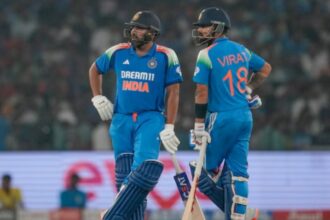





India’s eventual search for Virat Kohli’s successor at No. 3 has already begun, and former opener Wasim Jaffer believes Tilak Varma could be one of the strongest candidates for the role.
With Kohli having indicated that the 2027 ODI World Cup will be his final appearance in the tournament, questions about India’s next-generation batting order are becoming increasingly relevant.
Jaffer believes Tilak’s versatility, left-handed batting and first-class record could make him a particularly attractive option when the transition eventually arrives.
Wasim Jaffer Sees Tilak Varma as a Future No. 3
Tilak has already demonstrated that he can operate in several positions for India. In ODIs, the left-hander has batted at No. 3, No. 4 and No. 5, while his experience in T20 cricket has also required him to adjust his role depending on the team’s needs.
That flexibility is precisely what appears to have impressed Jaffer.
Speaking on his YouTube channel, the former India opener highlighted Tilak’s ability to adapt after previously producing a century at No. 3 and subsequently handling lower positions.
“It feels great to see his versatility. He previously scored a century at No. 3, and now he has adapted to the No. 5 and No. 6 positions so beautifully. This is an amazing quality,” Jaffer said.
For a player potentially being considered for a future top-order position, the ability to move around the batting order without losing effectiveness can be particularly valuable.
Tilak’s First-Class Record Adds to His Case
Jaffer also pointed to Tilak’s performances in first-class cricket, including his recent Duleep Trophy displays, as evidence that the youngster has the batting foundation required across formats.
The former opener believes Tilak’s record suggests he could eventually handle the demands of Test, ODI and T20 cricket.
“I feel there will be a left-handed batter in Virat’s place. He has that game; we saw the way he scored runs in the Duleep Trophy. His first-class average is around 55. So, he can fit into all three formats pretty easily,” Jaffer said.
The left-handed option is also significant because India’s top-order combination could change substantially once the current generation moves on.
Virat Kohli Has Confirmed 2027 Will Be His Last World Cup
Kohli’s own comments have intensified the conversation surrounding India’s future ODI batting order.
The former India captain has said that the 2027 World Cup will be his final World Cup for India, giving the next generation a clear timeframe in which to establish itself.
“For me, it’s the last World Cup I’m going to play for India,” Kohli said in an interview with broadcaster JioStar.
Kohli also described the tournament as a major motivation and said his objective would be to give everything he has in pursuit of another World Cup triumph.
The 2027 edition would be his fifth ODI World Cup, making it an important potential endpoint to his international tournament career.
Kohli Highlights the Intensity of a 50-Over World Cup
Kohli also underlined why the ODI World Cup remains such a demanding competition.
According to the former India captain, the intensity of a 50-over World Cup is greater than almost anything else because of the sustained pressure across the tournament.
“The intensity of a 50-over World Cup is greater than anything. Because now, it’s about 10 games at a Twenty20 level of intensity,” Kohli said.
His comments underline the importance of India’s preparation for the transition that will eventually follow.
Tilak Has Limited ODI Experience So Far
While Jaffer sees significant potential in Tilak, the youngster’s ODI career remains at an early stage.
According to the figures in the supplied report, Tilak has played four ODIs for India, scoring 68 runs at an average of 22.67.
He has batted twice at No. 3 and once each at No. 4 and No. 5.
His most recent ODI appearance came against South Africa in December 2025.
That relatively small sample means any discussion of Tilak as Kohli’s eventual successor should be treated as a projection rather than a settled selection decision.
Jaffer Also Praises Abhishek Sharma
Jaffer also discussed another young Indian batter during his assessment, Abhishek Sharma.
The former opener believes Abhishek has become more measured in his approach, particularly compared with his earlier tendency to attack immediately.
“It seems that Abhishek has matured a bit. He takes a little time, and the assurance is visible now, although this format doesn’t give you a lot of time,” Jaffer said.
He suggested that Abhishek has learned that attempting to hit a six from the first delivery is not always the best approach.
The observation reflects the broader development of India’s young batting group, where players are increasingly being asked to combine attacking intent with greater game awareness.
Tilak Is Not India’s Only No. 3 Option
Even if India eventually needs to replace Kohli at No. 3, Tilak is unlikely to be the only player considered.
Ruturaj Gaikwad could enter the discussion, while Shubman Gill is another player with the technical ability to move into a different position.
Gill has already demonstrated that he can adapt to changes in the batting order. He began his Test career as an opener before moving into the middle order following Kohli’s departure and producing strong performances in the new role.
India therefore has several potential pathways available.
Why Tilak’s Left-Handed Option Could Matter
One element that makes Tilak particularly interesting is his left-handed batting.
India’s future top order could benefit from greater variety in terms of batting styles and match-ups. A left-right combination can also create different challenges for opposition bowling attacks.
Jaffer’s comments suggest that he sees Tilak not simply as a talented young batter but as someone whose skill set could eventually suit a major role in India’s batting structure.
However, there is still considerable cricket to be played before the 2027 World Cup.
The No. 3 Succession Question Is Only Beginning
Kohli’s eventual departure from ODI cricket will leave a major gap in India’s batting order. Replacing a player who has spent years occupying one of the team’s most important positions will naturally require careful planning.
For now, there is no official indication that Tilak Varma has been designated as Kohli’s successor.
What Jaffer has provided is a strong endorsement of the young left-hander’s potential.
If Tilak continues to develop his game, maintains his first-class consistency and becomes more established in international cricket, he could make a compelling case for a prominent role in India’s post-Kohli ODI era.
For the moment, though, the succession race remains wide open.