








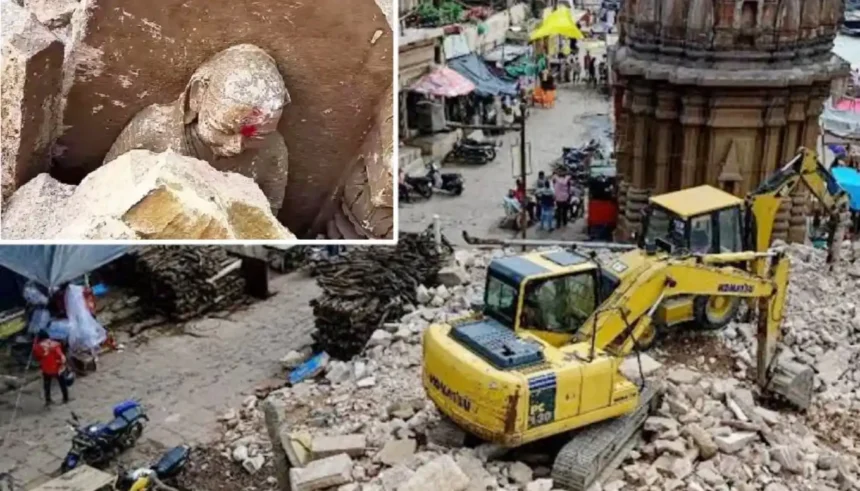
A controversy has erupted at Varanasi’s Manikarnika Ghat following the removal of a madhi (raised platform) as part of the ongoing Manikarnika Tirtha Corridor development project. Images showing a bulldozer at the site and idols lying near the dismantled structure triggered claims on social media that ancient temples and sacred idols were being demolished — similar to past concerns during the Kashi Vishwanath Corridor development.
Political and Administrative Responses
The controversy quickly drew political attention. Uttar Pradesh Chief Minister Yogi Adityanath visited the site personally, inspecting the cremation infrastructure being developed.
Opposition leaders, including UP Congress president Ajay Rai, alleged that the demolition endangered Kashi’s spiritual heritage, framing it as an attack on Sanatan traditions.
Rejecting these claims, CM Yogi Adityanath stated:
See more of our coverage in your search results.
Add Hunterfly on Google“No temple or idol has been demolished. Some viral images circulating online are misleading or AI-generated. Misinformation is being spread deliberately.”
Officials confirmed that only one madhi was removed during construction. While some idols placed on the platform fell during dismantling, they were safely preserved and moved to the Archaeology Department’s office, with plans to reinstall them once the development is complete.
Varanasi Mayor Ashok Tiwari echoed this, affirming that no temple structures at the ghat were harmed.
Ground Reality at Manikarnika Ghat
A site walkthrough shows that major temples — Masan Temple, Tarkeshwar Temple, and Ratneshwar Temple — remain intact. However, one madhi and certain auxiliary structures have been removed to facilitate redevelopment.
Some priests expressed concern over the use of heavy machinery, stating that public faith was attached to the madhi and its idols.
“We have no objection to the redevelopment, but heritage should have been handled more sensitively. The bulldozer caused unnecessary damage,” said priests Nimish Dwivedi and Deepak Acharya.
Why the Manikarnika Tirtha Project Is Being Built
The Manikarnika Tirtha redevelopment covers an initial 3,000 sq. metres, eventually expanding to 39,350 sq. metres, making it the largest dedicated cremation facility at the ghat. Once completed in four phases, it will allow 19 cremations simultaneously, along with improved public amenities, seating, and ritual spaces.
See more of our coverage in your search results.
Add Hunterfly on GoogleThe project was initiated after Vishwanath Chaudhary, the Dom Raja of Manikarnika, requested modernization to address congestion, narrow lanes, and poor sanitation at the ghat. Prime Minister Narendra Modi laid the foundation stone in 2023. The project is funded through the Shri Kashi Vishwanath Temple Trust’s SIR fund and implemented by the Roop Foundation.
Project visuals show a multi-level platform, designed to streamline cremation rituals while preserving the spiritual character of the ghat, similar to the Kashi Corridor extension.
Protests and Assurances
The controversy intensified after Ahilyabai Holkar family members and the Pal community claimed their idols were affected, with opposition parties amplifying the concerns.
See more of our coverage in your search results.
Add Hunterfly on GoogleThe Chief Minister reiterated that all religious artefacts are safe and will be reinstalled respectfully post-construction.
As work continues, the Manikarnika Tirtha project highlights the delicate balance between heritage preservation, urban redevelopment, and faith, a challenge the administration insists it is committed to navigating.