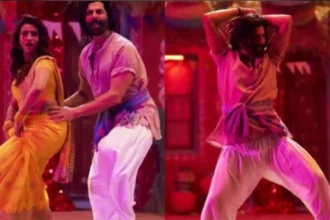






Actor Benedict Garrett, who stars in Toxic: A Fairy Tale for Grown-Ups, has responded to criticism surrounding his earlier comments about the film and its Ladies & Ladies teaser. His remarks had sparked debate online after some social-media users questioned the film’s portrayal of women and raised concerns about sexual innuendo, adult themes and possible objectification.
Addressing the backlash in a video shared on his Instagram account, Garrett said his comments were intended to highlight what he sees as a difference in the way audiences react to violence and sexuality in cinema.
According to the actor, films containing significant levels of violence often attract less public criticism than films featuring sexual themes. Garrett argued that this difference in audience reaction was the central point of his earlier remarks.
“What I find living here in India, but also just being a theatre-goer all around the world, is that films with a lot of violence really do not raise many eyebrows, but the moment they add any kind of sexuality or sex action into a film, then there’s a big problem,” Garrett said.
His response has once again brought the conversation around Toxic into focus, with discussions now extending beyond the film’s teaser to broader questions about censorship, audience sensibilities, violence, sexuality and the representation of women in mainstream cinema.
See more of our coverage in your search results.
Add Hunterfly on GoogleBenedict Garrett responds after ‘sex over violence’ remark sparks debate
Garrett’s earlier comments about Toxic had generated criticism and debate on social media. Responding to the reaction, the actor said he had not personally gone through all the comments and feedback directed at him but believed much of the criticism may have been connected to the teaser’s sexual references and adult-oriented themes.
In his latest response, Garrett sought to clarify his position. He said his argument was not that Toxic was a film without violence, nor was he attempting to compare one type of content as inherently more acceptable than another.
Instead, he focused on what he described as a difference in public reaction.
According to Garrett, action films featuring graphic violence are often accepted by a wide range of audiences, while scenes involving sexuality can prompt stronger objections and debates.
His comments touched on a long-running discussion in cinema: whether audiences, critics and certification systems apply different standards to violence and sexual content.
See more of our coverage in your search results.
Add Hunterfly on GoogleThe debate is particularly relevant in India, where major commercial films frequently attract audiences across different age groups and where questions about content suitability often emerge around theatrical releases.
‘You take them to see violence, but sexuality crosses the line?’
Garrett further expanded on his argument by describing a conversation about whether children should watch a film containing sexual content.
He said someone had previously asked him whether a child should be taken to a film because of its adult themes. In response, Garrett questioned why graphic violence in cinema can sometimes be treated differently from sexual content.
See more of our coverage in your search results.
Add Hunterfly on Google“In India, lots of people take their kids to see films with a lot of violence. Someone asked me before this, ‘Because of the sexual content, should I take my child?’ My answer to them was, ‘Well, you take them to see Yash chainsawing someone’s head off, but not having sex with a woman? That would be crossing the line?'”
The statement quickly became one of the most widely discussed aspects of his response.
Garrett’s remarks do not necessarily settle the larger debate. Different viewers may have very different opinions about what type of content is appropriate for children and whether comparisons between violent and sexual material are useful.
Film certification, parental guidance and personal choices about age-appropriate viewing all remain important parts of the conversation.
However, the actor’s comments have highlighted an issue that frequently resurfaces whenever mainstream cinema pushes into more mature territory: why do audiences often react differently to fictional violence and consensual adult sexuality?
Criticism over portrayal of female characters
The controversy surrounding Toxic also includes criticism from some viewers who have questioned whether promotional material associated with the film objectifies its female characters.
The debate gained traction after the Ladies & Ladies teaser prompted conversations about how women were being presented and whether the promotional material relied too heavily on sexualisation.
Responding to those concerns, Garrett suggested that audiences should consider the possibility that the film’s title itself may point toward the themes it intends to explore.
“Here’s the irony: The film is called Toxic; maybe that’s what the film is addressing: toxic masculinity and themes around it.”
His statement is significant because it frames Toxic not simply as a film using controversial imagery, but potentially as a story examining problematic behaviour and masculinity.
However, Garrett’s remarks should not automatically be taken as a complete explanation of the film’s themes unless those themes are explicitly confirmed by the filmmakers or fully established by the finished movie.
A film can portray problematic behaviour without endorsing it, but the way such behaviour is presented, contextualised and resolved remains important. For critics and audiences, those distinctions often become clearer only after viewing the complete film rather than isolated promotional scenes.
Can a film portray toxicity without endorsing it?
Garrett’s response raises a broader question that frequently appears in discussions about film and television: does depicting problematic behaviour amount to endorsing it?
The answer often depends on context.
Films can explore violence, sexism, toxic masculinity and other difficult subjects as part of a critical narrative. At the same time, critics may still question whether the storytelling gives those issues enough context or whether certain scenes are presented primarily for entertainment.
This is why promotional material can sometimes produce a different reaction from the finished film.
A teaser has only a limited amount of time to communicate tone, characters and conflict. Without the larger narrative, audiences may interpret individual images or scenes differently from the way they would after seeing the complete story.
The response to the Ladies & Ladies teaser reflects that challenge. Some viewers focused on concerns about objectification, while Garrett suggested that the film itself may be engaging with the very idea of toxic masculinity.
Ultimately, the complete film provides the strongest basis for evaluating how successfully it handles those themes.
Violence and sexuality remain a complicated cinematic debate
The comparison between violence and sexuality is not unique to Toxic. Filmmakers, critics and audiences across the world have debated for decades why depictions of violence can sometimes be considered more acceptable in mainstream entertainment than depictions of sexuality.
The issue becomes even more complex when questions of age classification are involved.
Violence and sexual content can affect viewers differently depending on how they are depicted, the age of the audience and the context of the story. A brief reference, implied scene or mature discussion may be treated differently from graphic or prolonged content.
This means the question is rarely as simple as deciding that one category of content is always more acceptable than another.
Garrett’s comments, however, have drawn attention to a genuine cultural conversation: audiences may be more accustomed to seeing fictional violence in large-scale commercial entertainment than they are to seeing sexuality openly represented.
That difference in comfort levels can shape everything from audience reactions and social-media debates to certification discussions and parental decisions.
Toxic continues to generate conversation
Toxic: A Fairy Tale for Grown-Ups has remained one of the most talked-about films associated with Yash, particularly because of the attention surrounding his return to the big screen following the KGF franchise.
The project has generated curiosity not only because of its cast but also because of its creative direction and promotional material.
Directed by Geetu Mohandas, the film brings together an ensemble that includes Yash, Kiara Advani, Nayanthara, Huma Qureshi, Tara Sutaria and Rukmini Vasanth.
The presence of a large ensemble and the attention around the film’s promotional campaign have ensured that even individual statements from cast members can become major points of online discussion.
Garrett’s response is the latest example.
What began as criticism of a comment about sexuality and violence has now developed into a broader conversation involving audience expectations, the portrayal of women and the possible thematic meaning behind the title Toxic.
A debate that may continue beyond the teaser
The reaction to Garrett’s comments demonstrates how quickly a discussion around a film can move beyond the film itself.
The initial controversy focused on his remarks and the promotional material. His response, however, shifted the conversation toward larger questions about cultural attitudes to sex and violence in entertainment.
The actor’s suggestion that Toxic may deal with toxic masculinity has added another layer to the debate. If that theme is central to the finished narrative, audiences and critics may evaluate the promotional material differently after seeing the story in full context.
At the same time, criticism of representation and objectification remains a legitimate subject for audience discussion. Viewers do not have to agree on whether a film’s imagery is provocative, critical, exploitative or narratively justified.
Such debates are part of the broader relationship between cinema and its audience.
What Benedict Garrett’s response means for the conversation around Toxic
Garrett’s comments do not end the debate surrounding Toxic. Instead, they have broadened it.
His central argument is that audiences often respond more strongly to sexuality than to violence. His additional suggestion that the film may explore toxic masculinity provides a possible framework for understanding some of the concerns surrounding the promotional material.
Whether audiences agree with his position will remain a matter of individual interpretation.
For some viewers, his comments may raise valid questions about inconsistent cultural attitudes towards fictional content. Others may argue that violence, sexuality and the objectification of characters should each be evaluated on their own terms rather than directly compared.
That disagreement is likely to continue as Toxic approaches and reaches audiences.
What remains clear is that the film has already generated significant discussion about more than its cast and visual scale. The conversation now includes questions about representation, mature themes, audience expectations and the responsibility of filmmakers when dealing with controversial subjects.
As the debate continues, the complete context of the film—and statements directly from its filmmakers—will be important in determining how its themes are ultimately understood.
For now, Benedict Garrett’s response has ensured that Toxic: A Fairy Tale for Grown-Ups remains at the centre of a wider conversation about what audiences accept on screen, what they object to and why the boundaries between violence and sexuality continue to provoke strong reactions.