



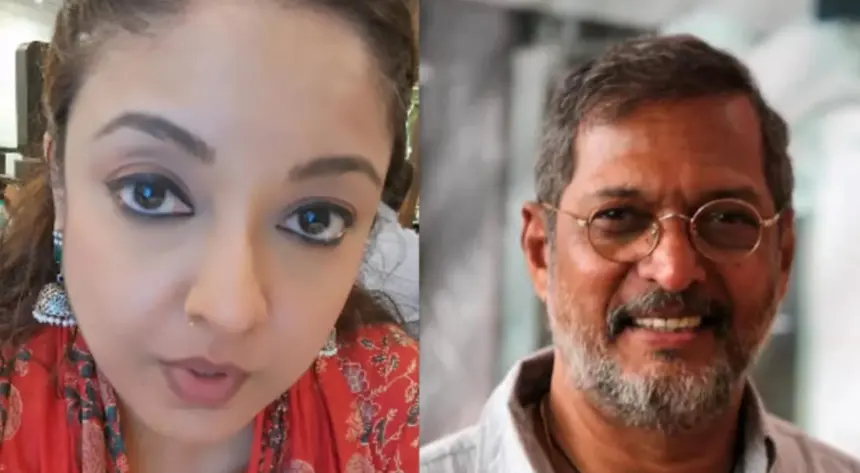
Tanushree Dutta has defended her controversial “evil dead” remark about veteran actor Nana Patekar, asking people to understand the situation from her perspective. Her comments reportedly came amid criticism on social media following news of Patekar’s death.
According to the supplied report, Dutta addressed the controversy while speaking to the media in Mumbai. She referred to the difficulties she says she has faced over the past several years following the allegations she raised during India’s #MeToo movement.
The actress maintained that people should consider her experience before judging her reaction. Her remarks have renewed attention on the dispute between the two actors, which became widely discussed in 2018.
Tanushree Dutta Explains Her ‘Evil Dead’ Comment
Dutta reportedly reiterated her position while speaking to the media, saying that Patekar would remain “evil” from her perspective because of what she says she experienced.
“Mere liye toh evil dead hi hai,” she was quoted as saying, explaining that she had been troubled over the past five years and had faced pressure in connection with her case.
She also urged people to look at the matter from her point of view. Dutta alleged that she had been pressured to withdraw her complaint and claimed that inducements had been offered to persuade her to do so. These are her allegations and should be understood as such.
Her comments drew attention because they came in the context of public discussion surrounding Patekar’s reported death. Some social media users criticised her language, while the actress maintained that her own experience was central to her reaction.
What Tanushree Dutta Said in Her Initial Video
In an Instagram video described in the report, Dutta said she had learned the news while travelling to Lucknow for a professional event.
She explained that she had planned to focus on her work and social media content that day but was concerned that questions about Patekar and her past controversy would dominate media coverage.
Dutta described the timing as an unusual situation and said she wanted to work out how to respond before giving a fuller reaction. She also expressed condolences to the family.
Her initial comments subsequently became a subject of online debate, particularly the phrase “evil dead”, which drew criticism for its timing and wording.
Tanushree Dutta and Nana Patekar’s #MeToo Controversy
Dutta and Patekar became the focus of a widely discussed controversy during India’s #MeToo movement in 2018.
Dutta accused Patekar of inappropriate behaviour and sexual harassment during the filming of a song for the 2008 film Horn ‘Ok’ Pleassss. Patekar denied the allegations.
According to the supplied report, Mumbai Police filed a B-summary report in June 2019 in connection with Dutta’s complaint. The report was described as stating that the complaint could have been malicious or motivated by revenge.
That police outcome is an important part of the case’s history. Dutta’s allegations and her subsequent statements should be distinguished from the findings recorded by the authorities. Any description of the legal status of the matter should be checked against the original police report and reliable contemporary coverage.
Why Tanushree Dutta’s Remarks Have Sparked Debate
The reaction to Dutta’s comments highlights the difficult conversations that can arise when longstanding allegations resurface following a public figure’s death.
Some people view her language as insensitive in the circumstances, while her explanation centres on the distress and pressure she says she experienced after speaking out.
The controversy also demonstrates how public reactions to high-profile allegations can remain polarised years after the original events. Separating verified facts, official findings, personal accounts and social media opinion is essential to understanding the dispute fairly.
Dutta’s latest remarks have brought her long-running dispute with Patekar back into public discussion. The controversy continues to raise questions about how personal experiences, legal outcomes and public expectations intersect in high-profile #MeToo cases.