




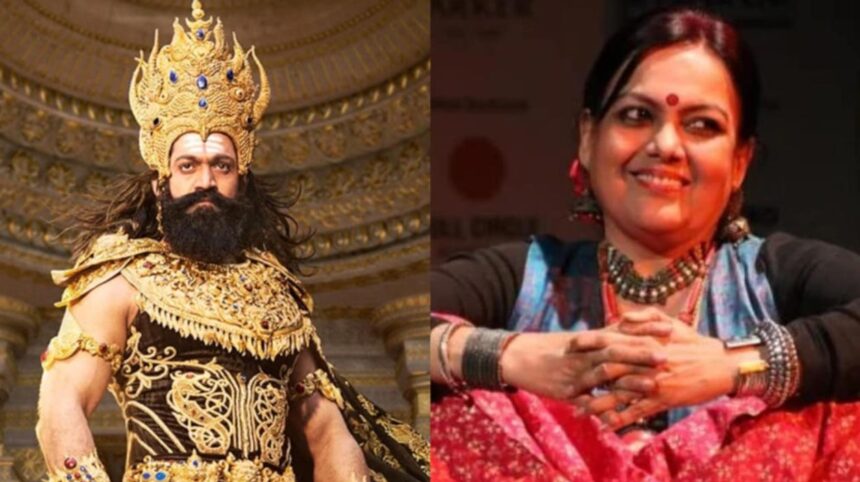
Veteran actress Susmita Mukherjee has shared her perspective on the portrayal of Ravana in Ramayana adaptations, the cultural importance of Indian epics, the debate over casting Ranbir Kapoor and Sai Pallavi, and her experience working with Yami Gautam.
The portrayal of Ravana in Indian cinema has long generated discussion about mythology, morality and the artistic interpretation of familiar characters. With Nitesh Tiwari’s Ramayana attracting considerable attention, questions about whether the antagonist should be portrayed as a complex individual or a representation of evil have returned to public debate.
Veteran actress Susmita Mukherjee has offered her perspective on the subject, suggesting that Ravana’s significance extends beyond the actions of a single mythological character.
In the interview account provided, the actress described Ravana as a symbolic reflection of negative qualities that human beings must learn to recognize within themselves.
Her comments also explored why Indian audiences feel such a strong emotional connection to epics like the Ramayana and Mahabharata, and why cinematic interpretations often attract intense scrutiny.
Susmita Mukherjee Explains Why Ravana Represents Human Weaknesses
Discussing the ongoing debate surrounding Ravana’s portrayal, Susmita suggested that mythological characters serve different purposes within the larger narrative of life.
She described Ravana as a representation of negative human tendencies, connecting the character’s traditional ten-headed imagery with the weaknesses and shortcomings people encounter within themselves.
According to the supplied interview, she said:
“He’s only there as a mirror to show us evil.”
Her interpretation places emphasis on the lessons audiences may draw from the character rather than on whether the antagonist should be admired or condemned.
In many traditional readings of the Ramayana, Ravana is depicted as an immensely powerful and knowledgeable figure whose conduct ultimately brings him into conflict with Rama.
The contrast between admirable abilities and destructive decisions is part of what makes him a subject of continuing interpretation.
For Susmita, the character’s broader value appears to lie in helping people examine moral choices and recognize negative impulses.
Is Ravana Being Glorified in Modern Ramayana Adaptations?
The question of whether Ravana is being glorified has emerged repeatedly in discussions surrounding contemporary mythological storytelling.
Different adaptations may highlight his scholarship, devotion, political authority or personal relationships while also depicting the actions that lead to his downfall.
Some audiences see these additional dimensions as important to understanding a complicated character.
Others are concerned that focusing too heavily on his achievements could diminish the moral significance of his actions within the epic.
Susmita’s remarks offer another way of understanding the debate.
Rather than focusing exclusively on whether Ravana possesses admirable characteristics, she suggests considering the symbolic purpose he serves within the narrative.
Her comments underline the distinction between explaining a character’s motivations and justifying that character’s conduct.
A layered portrayal does not necessarily require audiences to overlook wrongdoing.
Likewise, a character who represents destructive tendencies can still be written and performed with emotional complexity.
Why Ramayana Continues to Inspire Indian Filmmakers
The Ramayana occupies an important place in India’s literary, cultural and religious traditions.
Its stories have been retold through classical literature, regional performance traditions, television, cinema, theatre and oral storytelling.
Different versions often emphasise different characters, events and philosophical questions.
For filmmakers, adapting the epic involves balancing storytelling choices with the expectations of audiences who may have known the narrative since childhood.
Characters such as Rama, Sita, Lakshmana, Hanuman and Ravana carry meanings that extend beyond an individual production.
This makes cinematic interpretation particularly sensitive.
A new portrayal may introduce viewers to unfamiliar dimensions of a character, but it may also challenge the images audiences have developed through earlier adaptations.
Susmita’s comments suggest that these stories remain relevant because they invite reflection on moral values and human behaviour across generations.
Susmita Mukherjee on the Cultural Importance of Indian Epics
Beyond the Ravana debate, Susmita expressed appreciation for the emotional attachment people have to the Ramayana and Mahabharata.
She described the epics as important carriers of cultural knowledge, values and collective memory.
According to the interview account, she welcomed the fact that audiences continue to maintain strong connections with traditional narratives.
Her perspective highlights the role storytelling plays in transmitting ideas between generations.
Epics are not experienced only through reading. They are also encountered through family conversations, religious observances, performances, festivals and artistic adaptations.
These experiences can shape how individuals interpret characters and moral conflicts.
Susmita also suggested that the relevance of such stories extends beyond intellectual discussion, touching deeper questions about consciousness, values and personal understanding.
That interpretation reflects her personal perspective on the continuing significance of India’s epic traditions.
Why Ramayana Casting Choices Attract Strong Reactions
Nitesh Tiwari’s Ramayana has generated extensive interest in its casting, particularly the reported portrayals of Rama, Sita and Ravana.
Ranbir Kapoor, Sai Pallavi and Yash are associated with the central characters in the supplied account.
The selection of performers for such roles often attracts attention because viewers carry strong expectations about how these characters should appear and behave.
Physical appearance, performance style, language and emotional expression may all become subjects of discussion.
However, audiences can disagree about casting choices without making personal attacks against the performers.
The distinction is important because criticism of an artistic interpretation should not become harassment directed at an actor.
For filmmakers, the challenge is to create performances that serve the narrative while acknowledging the cultural significance of the characters.
Susmita Mukherjee Responds to the Yami Gautam and Sai Pallavi Comparison
Another subject discussed in the supplied interview was the online suggestion that Yami Gautam could have portrayed Sita.
Social media comparisons between performers can emerge when a major mythological film attracts attention.
However, Susmita reportedly declined to make a direct comparison between Yami and Sai Pallavi.
She explained that she had not watched Nitesh Tiwari’s Ramayana at the time of the conversation and therefore did not consider it appropriate to judge the performances.
Her response recognised that audiences will naturally hold different opinions about casting.
At the same time, she spoke positively about Sai Pallavi’s association with the role.
The comments demonstrate a measured approach to a discussion that can easily become focused on appearance rather than acting.
Without viewing the complete film, it would be premature to evaluate how any performer interprets a character.
Susmita Mukherjee Praises Yami Gautam’s Professionalism
While Susmita avoided comparing the actresses, she spoke warmly about her experience working with Yami Gautam.
The two are associated in the supplied report with a project titled Nayyi Navelli, which is described as combining domestic comedy with mythological elements.
Reflecting on their professional interactions, Susmita characterised Yami as balanced, clear-minded, humble and professional.
She reportedly recalled that Yami made a positive impression during an early script reading by openly inviting assistance whenever she needed it.
For Susmita, that willingness to collaborate appeared to be a meaningful quality.
Her observations focused on Yami’s conduct as a colleague rather than making claims about how she would perform in a different production.
The comments also highlight the importance of teamwork in filmmaking, where performers rely on directors, writers and fellow actors to develop scenes.
What Is Nayyi Navelli About?
According to the supplied synopsis, Nayyi Navelli begins with elements of domestic comedy before introducing a mythological storyline.
The narrative reportedly involves an object called the Kaal Sheel stone, which is connected within the film’s fictional mythology to the Treta Yuga and the larger Rama-Ravana tradition.
The story is described as gradually developing into a conflict involving moral choices and the struggle between good and evil.
Susmita portrays the grandmother of the Awasthi household, bringing humour and generational perspective to the family setting.
The premise suggests an attempt to combine contemporary family interactions with mythological storytelling.
However, the film’s official title, cast, release status and detailed synopsis require verification before these descriptions can be presented as independently confirmed production information.
How Mythology Can Work Within Contemporary Stories
Indian filmmakers have frequently drawn upon mythology to explore familiar questions in new environments.
Themes involving duty, loyalty, temptation, pride, sacrifice and moral responsibility can be adapted to different periods and genres.
A contemporary family story, for example, may use mythological symbolism to explore disagreements between relatives or the consequences of personal ambition.
Such storytelling can make traditional ideas accessible to audiences who engage with the original epics in different ways.
However, the success of these adaptations depends on how effectively their mythological elements contribute to the narrative.
Simply introducing a symbolic object or familiar reference does not guarantee a meaningful connection with the source material.
The strongest adaptations generally establish why the mythology matters to the characters and conflicts being presented.
Susmita Mukherjee’s Career Across Television and Cinema
Susmita Mukherjee has worked across Indian television, theatre and cinema, developing a reputation for her versatility.
She is particularly remembered for playing Kitty in the television series Karamchand, a role that introduced her to a wide audience.
Over the years, she has portrayed characters in comedy, drama and family-oriented productions.
Her acting experience has allowed her to explore different emotional tones, from humorous exchanges to more serious interpersonal conflicts.
The reported role in Nayyi Navelli would continue her involvement in character-driven storytelling.
Her comments about the Ramayana also offer insight into how an experienced performer interprets the relationship between traditional narratives and contemporary entertainment.
Ramayana Box Office Claims Require Confirmation
The supplied account describes Nitesh Tiwari’s Ramayana as having opened in theatres on November 5, 2026.
It also reports that the film crossed ₹100 crore in India and ₹200 crore worldwide within its first two days.
Those figures have not been independently verified for this article.
Box-office reporting can differ depending on whether a figure represents gross collections, net collections, estimates or official producer disclosures.
Before publication, the release date and financial claims should be checked against reliable trade reporting and production statements.
The cultural debate surrounding the film can be discussed separately from its commercial performance.
Why Susmita’s Remarks Add Another Perspective to the Ravana Debate
Susmita Mukherjee’s interpretation shifts attention away from judging Ravana only as a historical or fictional personality.
Instead, she focuses on what the character may reveal about human behaviour.
Her comments suggest that stories about moral conflict can encourage people to examine their own choices rather than simply identify heroes and villains.
This does not mean that every interpretation of the Ramayana carries the same meaning or that all viewers must agree.
The epic has numerous retellings, and its characters are understood differently across literary and cultural traditions.
However, the continuing discussion demonstrates why these stories remain influential.
They provide a framework through which audiences can explore difficult questions about power, responsibility, virtue and wrongdoing.
The Bigger Message Behind Susmita Mukherjee’s Comments
As filmmakers continue adapting Indian epics, debates about casting, authenticity and character interpretation are likely to remain part of the conversation.
Susmita’s remarks offer a reminder that mythological storytelling can be understood at more than one level.
For some viewers, the central importance of the Ramayana lies in religious devotion.
For others, it also provides literary, philosophical and cultural insights.
Her interpretation of Ravana as a reflection of negative human qualities belongs within that wider discussion.
Rather than treating the antagonist’s complexity as an automatic justification of his actions, she encourages audiences to consider the lessons represented by the character.
Have a story tip or feedback? Write to [email protected].
© Hunterfly.in. Original editorial content.