








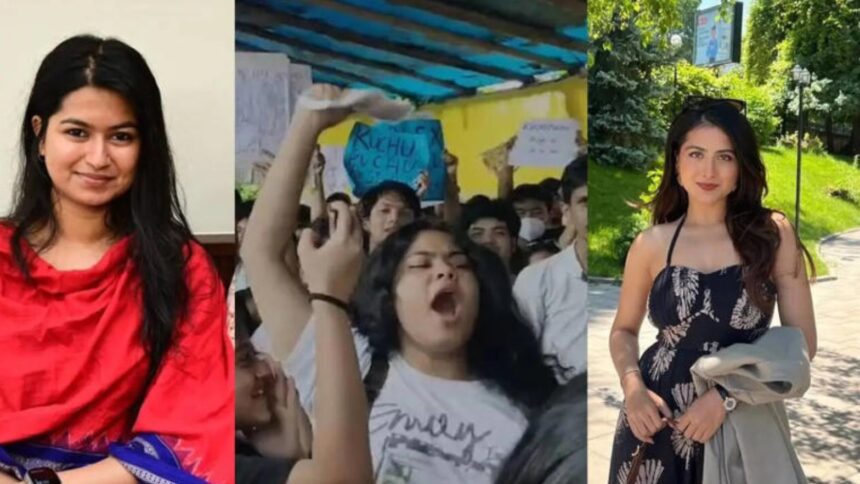
The recent wave of student protests over examination-related concerns has attracted participants from diverse backgrounds, including young people whose families are associated with leaders from parties within the National Democratic Alliance (NDA). Their participation has drawn public attention to how younger generations are increasingly expressing independent political views, even when those views differ from those of their families.
While the demonstrations have primarily focused on examination transparency, accountability, and student welfare, the involvement of individuals connected to prominent political figures has become a topic of wider discussion.
Participation Beyond Political Affiliations
Among those who attended demonstrations were Dibisa Mahanta, daughter of Assam Cabinet Minister and Asom Gana Parishad (AGP) leader Keshab Mahanta; Archita Sachin Rahar, daughter of BJP MP Aparajita Sarangi from Odisha; and Yashaswinee Raje Singh, daughter of former BJP MLA Vikram Singh from Uttar Pradesh.
Their participation has been widely discussed on social media, where many observers have pointed to the growing willingness of younger citizens to publicly express opinions on national issues regardless of family political affiliations.
See more of our coverage in your search results.
Add Hunterfly on GoogleAssam Chief Minister Responds
Following questions from the media regarding Dibisa Mahanta’s participation in protests, Assam Chief Minister Himanta Biswa Sarma said adult children should be viewed as independent individuals whose views should not automatically be associated with their parents.
He stated that while he personally disagreed with some of the slogans reportedly raised during the demonstration, parents should not be held responsible for the political opinions or actions of their adult children.
His remarks highlighted the broader principle that political differences within families are not uncommon in a democratic society.
Social Media Posts Spark Discussion
In Odisha, social media activity by Archita Sachin Rahar also attracted attention after she shared posts related to recent political developments surrounding education issues.
The posts were later removed. Responding to media queries, MP Aparajita Sarangi said the post had been shared inadvertently and was subsequently deleted after discussions within the family.
See more of our coverage in your search results.
Add Hunterfly on GoogleThe incident generated debate online about the role of personal social media accounts in political discourse, particularly among younger users.
Growing Political Engagement Among Young Citizens
Yashaswinee Raje Singh has also used social media to comment on education-related developments and student protests. Her online posts have reflected support for greater accountability and discussions around examination-related concerns.
Her comments, like those of many other young social media users, illustrate how digital platforms have become important spaces for political participation and civic engagement.
See more of our coverage in your search results.
Add Hunterfly on GoogleEducation Continues to Dominate Public Debate
The demonstrations have largely centred on demands for stronger safeguards in competitive examinations, quicker investigations into alleged irregularities, and increased transparency in recruitment and admission processes.
Student organisations, civil society groups, and political parties have all raised concerns over examination governance, although they differ in their approaches and proposed solutions.
The issue has remained a prominent topic in Parliament, political campaigns, and public discussions across several states.
Independent Voices Within Political Families
Political analysts note that differences of opinion between generations are increasingly visible in India’s digital era. With social media providing direct platforms for public expression, younger members of political families are often seen sharing perspectives that differ from those of their parents.
Such instances underscore the diversity of political opinion within families and reflect broader trends of civic participation among young voters.