






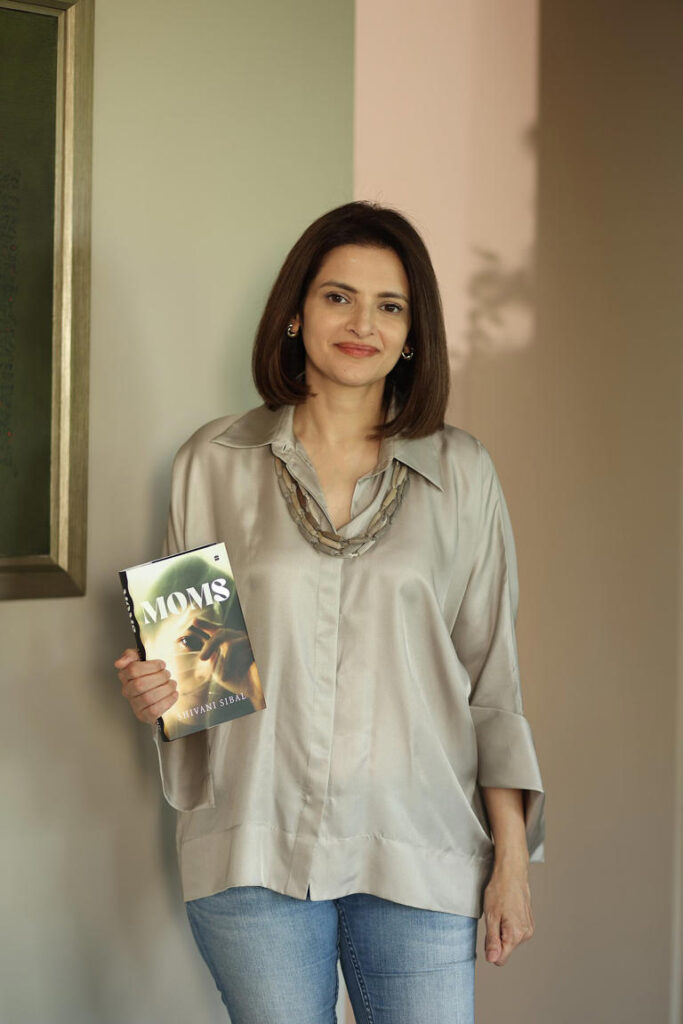
Luxury can make life comfortable, but it cannot necessarily make it fulfilling. That tension sits at the heart of Shivani Sibal’s second novel, Moms, which explores the emotional lives of women living within Delhi’s affluent social circles.
Published by HarperCollins, the novel moves beyond designer clothes, expensive homes and social status to examine what can exist behind an apparently perfect lifestyle. Through its central character Radhika Khanna, Sibal explores motherhood, marriage, loneliness, privilege and the different forms that control can take.
Radhika Khanna’s Life Behind the Luxury
Radhika is a privileged Delhi housewife married to Manik, a successful lawyer. Her life includes a luxurious home in Jor Bagh, designer clothing and the financial security associated with an influential family.
From the outside, it appears to be an enviable existence.
Inside the marriage, however, Radhika’s circumstances are considerably more complicated. She marries Manik when she is 23 and becomes a mother soon afterwards. By her 30s, her life is closely connected to her daughter Samara, her circle of school mothers and the rules governing her relationship with her husband.
The novel also brings Radhika into contact with women including Tara, Naina and Parul, allowing Sibal to explore different experiences of motherhood and relationships within the same social environment.
Sibal’s familiarity with Delhi’s legal circles also influenced the setting. Having married into a lawyer family herself, she says she approached the world she was writing about from a “fly-on-the-wall perspective.”
“Though I am consumed by my characters, I am not them,” she says.
Why Shivani Sibal Wanted to Write About Mothers
Interestingly, Sibal says the title Moms came to her before the novel itself fully developed.
“I wanted to write about an ecosystem, not a particular person’s experience,” she explains.
That idea is reflected in the novel’s broader cast of mothers. The story does not limit motherhood to Radhika’s relationship with Samara; it also considers her friendships and her relationships with older generations, including her own mother and mother-in-law.
Sibal says she wanted to challenge the narrow ways in which motherhood is often represented.
“I wanted to break away from the narrow tunnel through which motherhood is perceived, to explore different facets of motherhood, both positive and negative,” she says.
Motherhood Is Not One-Dimensional
Sibal worked on Moms over a period of roughly three years, with her own experience of motherhood informing her understanding of the emotional world she was creating.
She describes motherhood as exposing her to a range of feelings and behaviours, including constant vigilance, intense protectiveness, love and even the repetitive boredom that can accompany caring for young children.
Those seemingly contradictory emotions appear in Radhika’s relationship with Samara.
After Samara’s birth, Radhika becomes deeply invested in her daughter’s life. Once the girl begins school, her mother becomes heavily involved in parent-teacher meetings and extracurricular activities, taking an increasingly active role in shaping her daughter’s experiences.
Yet the relationship also contains moments of emotional distance.
Samara notices the difference between her mother’s involvement and the everyday care provided by her nanny. Radhika can therefore be deeply attentive while simultaneously failing to meet her daughter’s emotional expectations in certain ways.
It is this contradiction that makes Sibal’s portrayal of motherhood more complex.
“Once a woman becomes a mother, that is the parameter on which she is admired, judged and remembered, no matter what she does in other spheres of life,” Sibal says.
She adds that mothers and motherhood are often represented too simply, without sufficiently examining their competing emotions and responsibilities.
Sibal Returns to Delhi’s Elite World
Moms follows Sibal’s 2021 debut novel, Equations, which was also set against the backdrop of Delhi’s privileged circles.
However, her interest is not simply in documenting wealth or glamour. Instead, she uses that environment to examine how power influences personal relationships.
“Power — who holds it, and what it has over us as people and as a society — is something which I have explored through both my novels,” she says.
For Radhika, wealth provides material security but does not automatically create emotional freedom.
Her designer wardrobe, luxury home and access to expensive possessions establish the visible side of her life. Her relationship with Manik reveals the less visible boundaries within which she lives.
As Sibal puts it, “Glamour can be a bright light, but it is not a balm for loneliness, pain and disappointment.”

How Moms Looks at Misogyny
The novel also considers the ways women can experience gendered control in very different circumstances.
Sibal argues that misogyny does not necessarily look the same everywhere. Its language and presentation can change depending on the environment, even when the underlying dynamics remain similar.
“Misogyny changes its language based on its setting, but the underlying architecture of control persists,” she says.
The novel illustrates this through several characters.
Tara, for instance, encounters dismissive treatment from the police in circumstances involving her much older, bedridden husband. Elsewhere, controlling behaviour can appear less overtly hostile and instead be framed as protection, responsibility, love or concern.
Sibal says she did not want to reduce these experiences to a simple class-based issue. Instead, she wanted to explore misogyny as something capable of changing its appearance across social and economic settings.
What Moms Says About Privilege
The world of Moms is filled with the visible markers of wealth, but the novel repeatedly questions whether those comforts can solve deeper personal problems.
Radhika has access to things many people aspire to, yet her marriage and emotional life demonstrate the limitations of material privilege.
The contrast between her public image and private circumstances becomes one of the novel’s defining themes.
Rather than portraying wealth as either entirely desirable or entirely empty, Sibal uses it to ask a more complicated question: what happens when someone has financial security but lacks control over important parts of their own life?
Shivani Sibal’s Moms: A Closer Look at Women’s Lives
At its core, Moms is less interested in the glamour of Delhi’s elite than in what that glamour can conceal.
Through Radhika and the women around her, Shivani Sibal examines the pressures attached to motherhood, the complexities of marriage and the ways power can operate within relationships.
The novel also challenges the idea that motherhood can be reduced to unconditional devotion. Its women experience love, frustration, responsibility, boredom, ambition and vulnerability simultaneously.
By placing those experiences inside a world of wealth and social privilege, Moms asks readers to look beyond appearances and consider the emotional realities that may exist behind an enviable life.