






Sanjana Ganesan’s latest Pilates session highlights a demanding resistance-based movement that challenges several muscle groups at once. Here’s how the exercise works, its potential benefits and why proper technique matters.
Television presenter Sanjana Ganesan has offered a glimpse into her fitness routine, showcasing an advanced Pilates exercise that demands considerable upper-body strength, core control and full-body coordination.
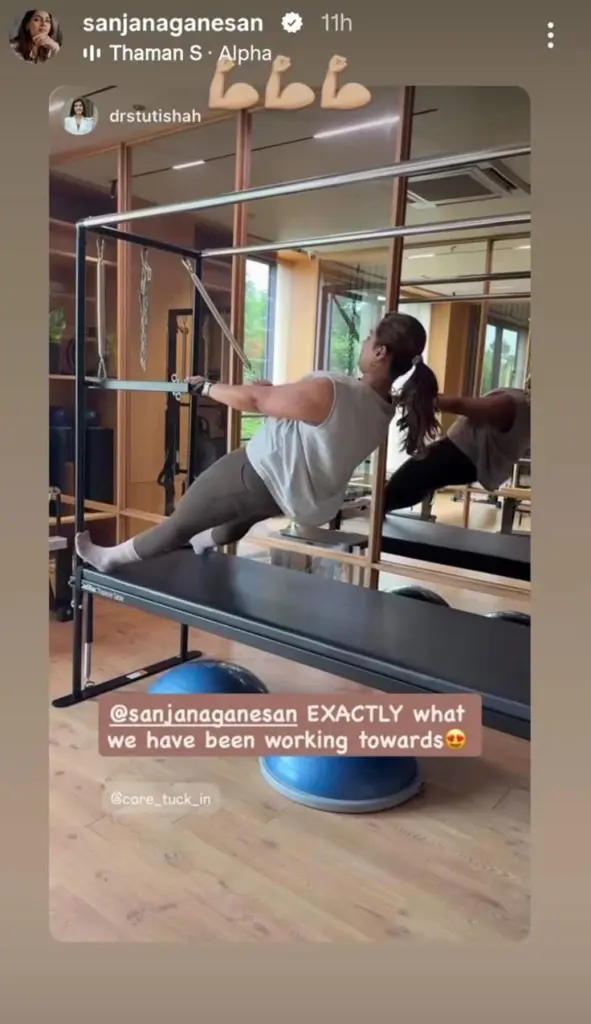
In an Instagram Story originally shared by physiotherapist Dr Stuti Shah and reposted by Ganesan, the presenter can be seen performing a challenging movement on Pilates studio equipment, combining a reverse plank position with a resistance-based rowing action.
The workout attracted attention not simply because of its difficulty, but because it demonstrates how Pilates can go beyond conventional stretching and flexibility exercises to incorporate demanding strength training.
Dr Shah accompanied the clip with the caption, “This is what we have been working towards,” suggesting that the movement represents progress in Ganesan’s training.
Ganesan responded to the post with flexed-biceps emojis, acknowledging the achievement.
While the short video captures only one part of her workout, the exercise provides an interesting example of how advanced Pilates movements combine muscular strength, stability and controlled movement.
What Pilates Exercise Is Sanjana Ganesan Performing?
The movement shown in Ganesan’s workout resembles an advanced reverse plank rowing variation performed with spring resistance on a Pilates Cadillac apparatus.
The Cadillac, sometimes called a trapeze table, is a specialised piece of Pilates equipment featuring a raised frame, adjustable springs, straps and bars. Unlike the more familiar reformer, which uses a moving carriage, the Cadillac allows practitioners to perform a wide range of supported and resistance-based movements.
In this particular exercise, the body is held in an elevated position resembling a reverse plank while the arms perform a controlled rowing action against resistance springs.
Maintaining this position requires the hips to remain lifted, the trunk to stay stable and the shoulders to control the pulling movement.
The combination makes the exercise considerably more demanding than a standard seated row or a basic reverse plank performed separately.
Rather than relying on one muscle group, the body must coordinate several areas simultaneously.
Which Muscles Does This Pilates Workout Target?
The reverse plank row challenges multiple muscle groups, particularly those responsible for stabilising the spine, controlling the shoulders and supporting the hips.
According to fitness expert and consultant dietitian Garima Goyal, who was quoted in the original report, the movement engages the deep core muscles, back, shoulders, arms, glutes and hamstrings.
Each muscle group contributes differently to the exercise.
1. Core Muscles Support Stability
The abdominal muscles help prevent excessive movement through the trunk as the arms pull against spring resistance.
This demands more than simply tightening the stomach. The practitioner must maintain coordinated control over the pelvis, rib cage and spine while the upper body moves.
Such exercises can develop muscular endurance and improve the ability to maintain stable positioning during other physical activities.
2. Back Muscles Assist the Rowing Movement
The rowing component involves muscles of the upper and middle back, including those responsible for pulling the arms backward and controlling the shoulder blades.
The latissimus dorsi, rhomboids and trapezius can contribute to the movement, depending on the exact body position and direction of resistance.
Strengthening these muscles may support everyday pulling movements and upper-body conditioning.
3. Glutes and Hamstrings Help Maintain the Lifted Position
Holding a reverse plank requires the muscles around the hips to work against gravity.
The gluteal muscles help maintain hip extension, while the hamstrings may contribute to supporting the elevated posture.
This makes the exercise a combination of dynamic upper-body movement and sustained lower-body muscular effort.
4. Shoulders and Arms Control the Resistance
The shoulders and arms must manage the pulling action without allowing the rest of the body to lose alignment.
The elbow flexors assist with rowing, while muscles around the shoulder joint and shoulder blades contribute to stability.
The exact loading depends on spring tension, hand position and movement technique.
Why Spring Resistance Makes Pilates Different
One distinctive feature of equipment-based Pilates is the use of springs to create resistance.
Unlike a conventional dumbbell, whose mass remains constant, a Pilates spring typically generates greater force as it stretches farther.
That means the resistance changes through the movement, although the precise loading pattern depends on the equipment setup and direction of pull.
During an exercise such as the reverse plank row, the practitioner must control both the pulling phase and the return phase.
This requires muscular effort alongside coordination and positional awareness.
Spring resistance can be useful for strength and endurance training, but it is not automatically superior to free weights or other forms of resistance exercise.
The most appropriate method depends on training goals, exercise selection, individual ability and progressive overload.
Five Potential Benefits of Advanced Pilates Training
Improved Core Control
Maintaining a steady trunk while the arms move against resistance challenges the muscles that help stabilise the spine.
With appropriate progression, such training can improve core strength and the ability to control body position during movement.
Greater Muscular Endurance
The exercise requires several muscles to remain active simultaneously.
Repeated, controlled sets may improve local muscular endurance, particularly in the shoulders, back, hips and trunk.
Better Body Awareness and Coordination
Pilates places considerable emphasis on precise positioning and controlled transitions.
Practising coordinated movements can improve awareness of how different body segments move together.
Functional Strength Development
Combining a sustained hip lift with an upper-body pulling action develops strength across multiple regions.
This may complement everyday activities involving posture, lifting and controlled movement, although improvements depend on the overall training programme.
Improved Shoulder and Hip Control
The exercise requires active control around both the shoulder and hip joints.
Appropriately selected resistance exercises may help develop strength and movement control in these areas.
However, this particular movement is not necessarily suitable for people with existing shoulder, wrist, neck or lower-back problems.
Can This Pilates Exercise Improve Posture?
Pilates training is often associated with better posture, but the relationship is more complex than performing a single exercise.
Good postural control involves muscular strength, mobility, coordination and the ability to tolerate different positions comfortably.
The reverse plank row challenges several muscles involved in supporting the trunk and shoulder girdle.
Over time, a well-designed training programme may contribute to improved postural endurance and movement control.
However, no single exercise can permanently correct posture, and maintaining one supposedly ideal position throughout the day is neither necessary nor realistic.
Regular movement, appropriate strength training and adjustments to prolonged sedentary habits remain important components of musculoskeletal health.
Is Advanced Pilates Better Than Traditional Strength Training?
Advanced Pilates and conventional resistance training share several principles, including muscular loading, exercise progression and the importance of technique.
However, they are not interchangeable in every situation.
Traditional resistance training with dumbbells, barbells or machines can provide straightforward ways to progressively increase external load and develop maximal strength.
Equipment-based Pilates often incorporates resistance alongside sustained positional control and coordinated movement.
Both approaches can support muscular fitness when exercises are appropriately selected and progressed.
For someone seeking greater overall strength, combining different forms of resistance training may be useful.
The best programme is one that matches the individual’s goals, physical capacity and ability to train consistently.
Why Beginners Should Not Copy Sanjana Ganesan’s Workout Immediately
Although the movement may appear smooth when performed by a trained practitioner, it places substantial demands on shoulder strength, hip control and trunk stability.
Attempting it without preparation can increase the likelihood of losing alignment or placing unnecessary stress on vulnerable joints.
Beginners are generally better served by developing foundational movements before progressing to complex spring-resistance combinations.
A gradual training progression might include basic glute bridges, supported rowing exercises, modified reverse planks and simpler Pilates movements.
These exercises can help build strength and familiarity with the movement patterns involved.
Advanced equipment-based Pilates should ideally be practised under the supervision of a suitably qualified instructor who can assess technique, adjust resistance and modify exercises where necessary.
People recovering from injuries or managing persistent pain should seek individual guidance from an appropriate healthcare professional before attempting demanding variations.
How Often Should Someone Practise Pilates?
The ideal frequency depends on the type of Pilates, exercise intensity, training experience and overall fitness routine.
For general muscular fitness, adults can use Pilates as part of a broader activity programme that includes resistance exercise and aerobic movement.
The World Health Organization recommends that adults undertake muscle-strengthening activities involving major muscle groups on at least two days each week.
It also recommends 150–300 minutes of moderate-intensity aerobic physical activity, or 75–150 minutes of vigorous-intensity activity, per week for substantial health benefits.
Pilates sessions can contribute to these goals, but not every Pilates class provides sufficient cardiovascular stimulus or strength-training intensity to meet every recommendation.
Recovery, progression and consistency matter more than attempting highly advanced movements every day.
What Sanjana Ganesan’s Pilates Session Shows About Fitness Progress
One noteworthy element of Ganesan’s workout is the sense of progression reflected in Dr Shah’s caption.
Advanced exercises are generally built on repeated practice, gradually increasing capacity and developing confidence with simpler movements.
The demanding reverse plank rowing variation illustrates how strength, balance and coordination can be integrated into a single exercise.
It also highlights an important distinction between performing an impressive movement and building a sustainable fitness routine.
For most people, long-term progress comes from selecting suitable exercises, increasing difficulty gradually and maintaining consistent training habits.
Ganesan’s Pilates session offers an example of advanced movement control, but its greatest practical takeaway is the importance of developing foundational strength before pursuing complex exercises.
Health disclaimer: This article provides general fitness information and is not intended as personalised medical advice. Exercise suitability varies according to individual health, injury history and fitness level. Consult a qualified healthcare professional or appropriately trained instructor before attempting advanced Pilates exercises.