




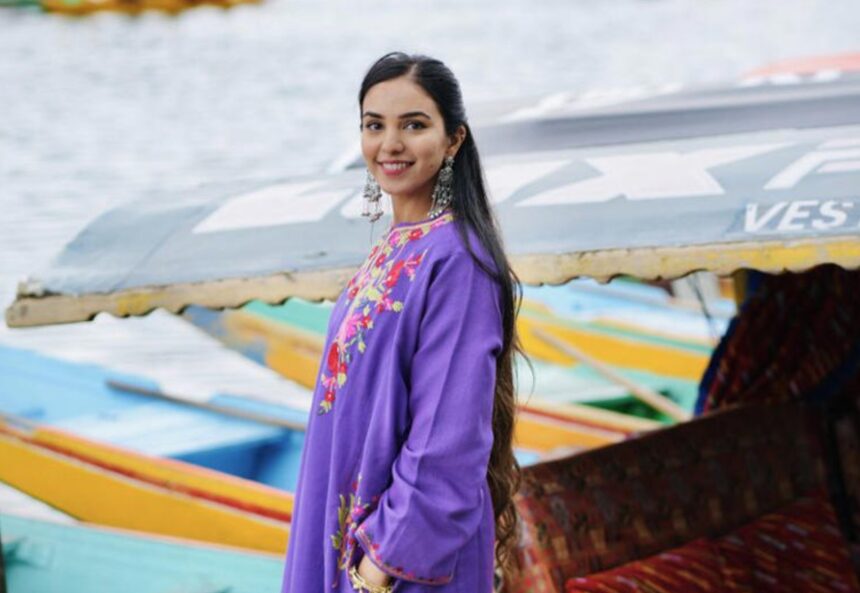
Independent Punjabi singer-songwriter Ravneet Rabab brings together love, longing and a powerful message about humanity in her latest single Sajjna Ve, with Kashmir serving as more than just a scenic backdrop.
Kashmir has long been a favourite setting for romantic music videos, often appearing as an idyllic landscape behind stories of love and separation. Ravneet Rabab’s latest Punjabi single, Sajjna Ve, takes a different approach.
For the independent singer-songwriter, Kashmir is not simply a beautiful location. It becomes an important part of the song’s emotional language, helping tell a story that moves beyond romance to explore vulnerability, loss and human compassion.
The song is also notable for being narrated through a woman’s emotional perspective, giving the love story a distinctly personal quality.
See more of our coverage in your search results.
Add Hunterfly on GoogleRavneet Rabab found music after studying clinical psychology
Ravneet’s journey into music was not a conventional one.
She holds a master’s degree in Clinical Psychology and had once considered building a professional career in the field. Music, however, gradually became impossible to treat as simply an interest.
Looking back, she says she realised how deeply music mattered to her when she was willing to give up sleep for it.
That realisation eventually convinced her that music was more than a hobby and something she wanted to pursue professionally.
Her transition from psychology to music reflects the less predictable paths often taken by independent artists, who build careers around creative interests that may initially exist alongside more conventional professional ambitions.
See more of our coverage in your search results.
Add Hunterfly on GoogleHer mother’s influence shaped Ravneet’s musical foundation
Ravneet’s relationship with music began at an early age through performances and competitions at school and college.
Her mother played a particularly important role in shaping that journey.
She encouraged Ravneet to learn Gurbani Kirtan. Although Ravneet was initially not particularly interested, the experience gradually changed her relationship with music.
See more of our coverage in your search results.
Add Hunterfly on GoogleOver time, she developed a deep connection with the form, and the musical foundation she gained through it continues to influence her artistic identity.
Ravneet later expanded her musical skills by learning guitar through a combination of formal instruction and self-study.
She also turned to YouTube to develop her playing and eventually began sharing cover songs online.
Those covers helped her move towards writing and recording original material, ultimately leading to the release of her own music.
Why Kashmir became the setting for Sajjna Ve
Once Sajjna Ve was completed, Ravneet felt that its visual treatment needed to match the warmth and innocence she heard in the song.
Kashmir became the natural choice.
She felt the region’s landscapes could complement the emotional quality of the music while allowing the video to create an atmosphere that went beyond a conventional romantic setting.
But the final visual narrative does not rely solely on Kashmir’s natural beauty.
The story takes a more serious turn towards its conclusion, introducing a message about the fragility of life and the importance of humanity during moments of crisis.
The real-life story that inspired the ending
The ending of the Sajjna Ve music video was inspired by the story of Syed Adil Hussain Shah, a pony guide who lost his life while reportedly trying to save a tourist during the Pahalgam attack.
Ravneet wanted that moment in the video to carry a meaning beyond the central love story.
The decision reflects her intention to present Kashmir not merely as a romantic destination but as a place inhabited by people whose experiences, kindness and resilience deserve attention.
For her, the story became a reminder that compassion can emerge even in extremely difficult circumstances.
Ravneet says Kashmir left a personal impression
The experience of filming in Kashmir also affected Ravneet personally.
She recalls being struck by the warmth and hospitality she encountered from local people.
That interaction appears to have reinforced the idea behind the music video’s broader message: that the region cannot be reduced to its landscapes alone.
For Ravneet, the people she met became as important to her experience as the scenery captured for the song.
Life as an independent musician
Creating and releasing music independently requires considerably more than performing or recording songs.
Ravneet describes independent artistry as a process in which musicians frequently have to manage multiple aspects of their careers themselves.
That can include writing and producing music, planning releases, managing social media, marketing songs and developing an audience.
The rise of digital platforms has made it easier for independent artists to reach listeners without relying entirely on traditional music-industry structures.
At the same time, it has created another set of responsibilities.
Artists now have to think about short-form videos, editing, promotional content and the first few seconds of a social-media post, in addition to the music itself.
For Ravneet, navigating those demands has become part of being an independent musician.
Social media has changed the work of emerging artists
For independent singers, social media can function as both a promotional platform and a direct connection with listeners.
But maintaining visibility requires consistency.
Ravneet points out that musicians are increasingly expected to create content around their songs rather than simply release the music and wait for audiences to discover it.
The pressure to create engaging clips, identify effective social-media hooks and remain relevant can be demanding, particularly for artists who are already handling most aspects of their careers themselves.
Still, these platforms have also opened opportunities that were considerably harder to access for emerging musicians in previous eras.
Gurbani remains central to Ravneet’s musical identity
Despite her growing focus on original Punjabi music, Ravneet says Gurbani will continue to occupy an important place in her life.
She credits Gurbani Kirtan with helping her fall in love with music in the first place.
The connection has remained strong even as her professional journey has expanded into songwriting, independent releases and live performances.
For Ravneet, continuing that musical tradition is not separate from her artistic career. It is part of the foundation on which the career was built.
What comes next for Ravneet Rabab?
With Sajjna Ve, Ravneet is continuing to establish herself as an independent Punjabi artist with an emphasis on storytelling and emotional authenticity.
The song combines a romantic narrative with a wider reflection on humanity, while its Kashmir setting gives the music video an additional cultural and emotional dimension.
As she continues releasing original music and performing live, Ravneet’s journey remains rooted in the musical influence that first drew her towards the art form.
For an artist who once imagined a future in clinical psychology, music has ultimately become the path she was unwilling to give up.