








Nupur Sanon has come out in support of her sister Kriti Sanon after the actress faced criticism over a Raksha Bandhan advertisement and her choice of outfit in the campaign.
The controversy began after Kriti appeared in a jewellery brand’s Raksha Bandhan campaign, in which she celebrates the festival with her brother and also ties a Rakhi to her pet dog. Some social media users objected to the outfit she wore in the advertisement, arguing that it was inappropriate for a traditional festival.
Kriti subsequently responded to the criticism, questioning why women’s clothing continues to become a measure of their respect for culture and tradition.
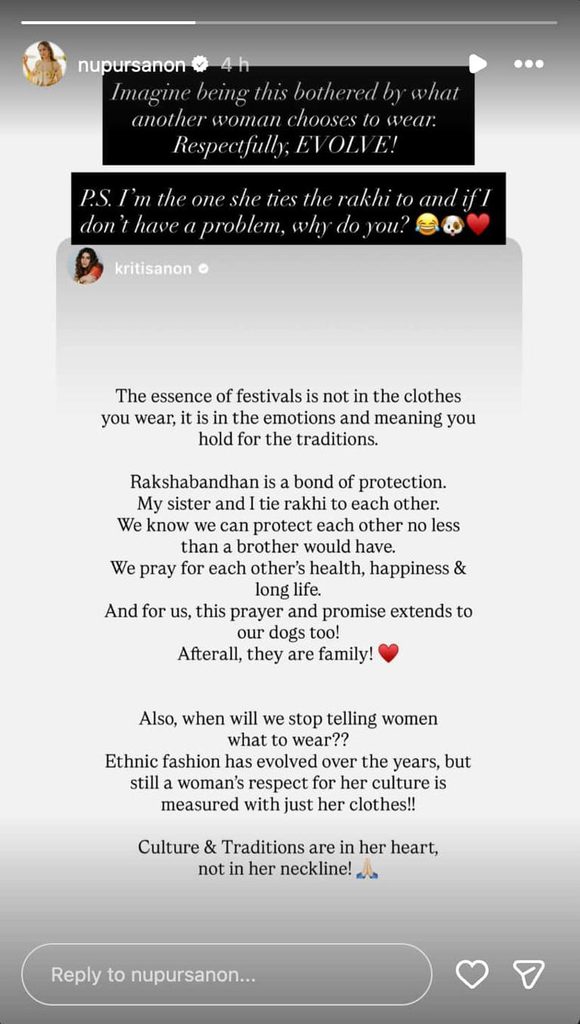
Nupur has now backed her sister, telling critics to “evolve” and pointing out that Kriti and Nupur themselves share a Raksha Bandhan tradition.
See more of our coverage in your search results.
Add Hunterfly on GoogleNupur Sanon Comes to Kriti’s Defence
Nupur responded to Kriti’s Instagram Story and directly addressed the criticism surrounding the advertisement.
Sharing her sister’s post, Nupur wrote:
“Imagine being this bothered by what another woman chooses to wear.”
She then added:
“Respectfully evolve.”
Nupur also highlighted the personal tradition she shares with Kriti, writing:
“P.S. I am the one she ties Rakhi to, and if I don’t have a problem, why do you?”
Her response was clearly aimed at those who had questioned Kriti’s clothing in the Raksha Bandhan campaign.
See more of our coverage in your search results.
Add Hunterfly on GoogleRather than debating the advertisement’s styling separately, Nupur focused on the broader issue of people judging women based on what they choose to wear.
What Did Kriti Sanon Say About the Controversy?
Kriti had already addressed the criticism before Nupur’s response.
In a statement shared on social media, the actress argued that the meaning of a festival should not be reduced to clothing.
See more of our coverage in your search results.
Add Hunterfly on Google“The essence of festivals is not in the clothes you wear, it is in the emotions and meaning you hold for the traditions,” Kriti wrote.
She described Raksha Bandhan as a bond of protection and explained that she and Nupur tie Rakhi to each other.
According to Kriti, the sisters believe they can protect one another in the same way that the traditional brother-sister relationship associated with Raksha Bandhan represents protection.
She also said that they pray for each other’s health, happiness and long life.
Kriti extended that sentiment to her dogs, whom she considers part of her family.
Kriti Questions Why Women Are Still Judged by Their Clothes
The actress then moved beyond the advertisement itself and raised a broader question about the way women are judged.
“Also, when will we stop telling women what to wear??” she wrote.
Kriti argued that ethnic fashion has changed considerably over the years, but women can still find their cultural values questioned based solely on their clothing.
“Culture & Traditions are in her heart, not in her neckline!” she added.
Her comments shifted the conversation from one advertisement to a wider debate about clothing, cultural identity and expectations placed on women.
For Kriti, the central point was that wearing a particular outfit should not determine whether a woman respects a festival or its traditions.
Why Did Kriti’s Raksha Bandhan Ad Face Backlash?
The controversy centred on a jewellery brand’s Raksha Bandhan campaign featuring Kriti.
The advertisement shows her celebrating Raksha Bandhan with her brother and tying a Rakhi to him. It also includes a moment in which she ties a Rakhi to her pet dog.
The styling, however, became the main talking point online.
Kriti wears a bralette-style blouse as part of her festive look, and some social media users questioned whether that outfit was appropriate for a Raksha Bandhan celebration involving her brother.
The criticism was not limited to ordinary social media users. Actress and politician Kangana Ranaut also commented on the campaign and criticised Kriti’s styling choice.
What Did Kangana Ranaut Say?
Kangana shared her reaction on Instagram Stories, questioning why a woman would choose what she described as a bikini or “undergarments” while tying a Rakhi to her brother when contemporary fashion offers many other options.
“It’s is a wonderful time to be a woman, our closets are full of variety of clothes,” Kangana wrote.
She continued by describing today’s woman as a “global woman” and listed different types of clothing, from cocktail dresses and lehenga cholis to jeans, saris, bikinis and salwar kameez.
She then questioned why Kriti would choose what she characterised as a bikini or undergarment-inspired look for the Raksha Bandhan advertisement.
Kangana also described the advertisement as “intentionally creepy”.
Her comments added another prominent voice to the criticism surrounding the campaign.
The Debate Is About More Than One Outfit
At the centre of the controversy is a familiar disagreement about the relationship between clothing and cultural traditions.
Critics of the advertisement have argued that the styling does not fit the traditional setting of Raksha Bandhan, particularly because the campaign depicts Kriti tying a Rakhi to her brother.
Kriti’s response takes the opposite position.
Her argument is that cultural respect cannot be determined by a neckline, silhouette or individual fashion choice. Instead, she places greater emphasis on the emotional meaning of the festival and the bond between family members.
Nupur’s response reinforces that position.
By pointing out that she is the person who receives Rakhi from Kriti, Nupur brought the debate back to the relationship at the heart of Raksha Bandhan.
Kriti and Nupur’s Rakhi Tradition
Kriti’s comments also highlighted that her relationship with Nupur does not necessarily follow the most traditional version of Raksha Bandhan.
The sisters tie Rakhi to each other and see the ritual as a mutual expression of protection and affection.
That detail is important to Kriti’s argument because she is not presenting the festival solely through the conventional brother-sister dynamic.
Instead, she views the underlying sentiment as something that can exist between family members more broadly.
Her mention of their dogs also underlines how she defines family and affection in her own way.
For Kriti, the emotional meaning attached to the ritual is more important than whether the participants fit a prescribed traditional template.

Nupur’s Response Adds a Personal Dimension
Nupur’s intervention gives the controversy a more personal dimension.
Rather than commenting as a celebrity observing the campaign from outside, she is directly involved in the Raksha Bandhan tradition Kriti described.
Her statement effectively asks critics to consider whether outsiders should be deciding how another family celebrates a festival.
Her “respectfully evolve” comment also reflects the broader argument made by Kriti: that social expectations surrounding women’s clothing may need to change as fashion and society evolve.
Social Media Debate Continues
The controversy has generated contrasting reactions online.
Some users have criticised the advertisement’s styling and questioned its suitability for a festival associated with family traditions.
Others have defended Kriti’s choice and agreed with her argument that clothing should not determine whether someone respects a cultural tradition.
The disagreement illustrates how celebrity advertising can quickly become part of a much larger cultural conversation.
What began as a jewellery campaign has now developed into a debate about fashion, Raksha Bandhan, family traditions and the expectations placed on women’s appearance.
What Happens Next?
For now, Kriti has made her position clear, while Nupur has publicly supported her.
Neither sister appears to be accepting the idea that a particular style of clothing should determine the sincerity of their Raksha Bandhan celebration.
The controversy also demonstrates how quickly a celebrity advertisement can generate discussion beyond the product being promoted.
Whether audiences agree with Kriti’s styling or not, her response has shifted the conversation towards a broader question: should a woman’s clothing be used as a measure of her relationship with culture and tradition?
Nupur’s answer appears to be clear.
If the sisters themselves are comfortable with how they celebrate Raksha Bandhan, she believes outsiders should reconsider why they are so concerned about it.