




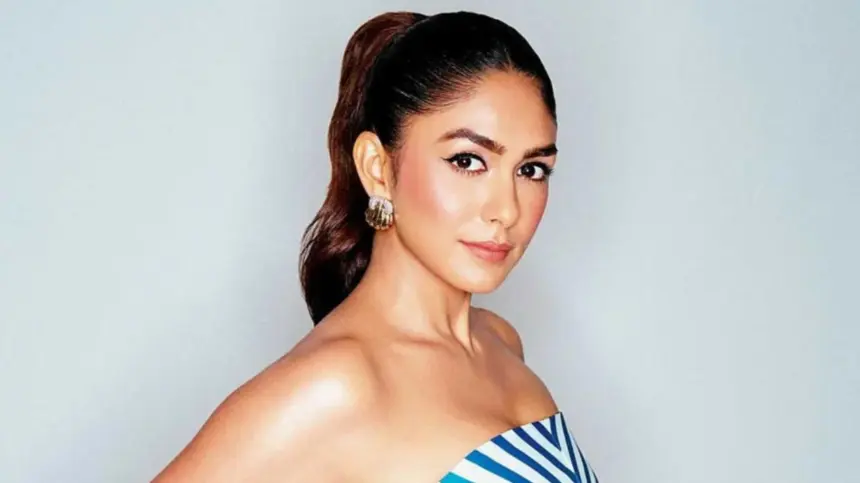
The actress reflects on overcoming self-criticism, appreciating different body types and discovering a broader understanding of beauty through her experiences and travels.
Actress Mrunal Thakur has opened up about her journey towards body confidence, sharing how her perspective on her appearance has changed over time.
Known for her performances in Hindi and Telugu cinema, the actress spoke about learning to appreciate her natural body shape after initially struggling with self-criticism.
In comments attributed to an interview with Filmfare, Mrunal discussed how she gradually stopped viewing her curves as something that needed correction.
Her reflections highlight a subject that extends beyond celebrity fashion: the pressure to fit into narrow beauty standards and the importance of developing a healthier relationship with one’s appearance.
Mrunal Thakur Says She Has Learnt to Love Her Curves
Mrunal reflected on a time when she frequently questioned aspects of her appearance.
Like many people who experience pressure surrounding their looks, she initially focused on perceived imperfections rather than appreciating her body as it was.
Over time, however, her outlook changed.
“I love my curves. Initially, I used to find faults with so many things about myself,” she told Filmfare, according to the supplied interview excerpt.
The actress went on to explain that she eventually recognised there was nothing inherently wrong with having a fuller figure.
Her comments present self-acceptance as something she developed gradually rather than a feeling that appeared overnight.
The distinction is important because body confidence is not always constant. People’s relationships with their appearance can change with experience, social expectations and personal circumstances.
For Mrunal, learning to appreciate her body appears to have involved questioning the standards against which she had previously judged herself.
How Travel Changed Mrunal Thakur’s Perspective on Beauty
Another significant part of Mrunal’s reflection concerned the role of travel in shaping her understanding of physical appearance.
According to the interview excerpt, meeting people from different ethnic and cultural backgrounds helped her appreciate the diversity of body types and skin colours.
Travelling can expose individuals to unfamiliar social environments and different attitudes towards fashion, appearance and personal expression.
Beauty ideals also differ across cultures and change over time.
What one society or community celebrates may not necessarily reflect the preferences or experiences of another.
For Mrunal, encountering people with different physical characteristics reportedly helped her develop a more inclusive understanding of beauty.
Her experience suggests that seeing a wider range of appearances can encourage people to question narrow assumptions about what is attractive or acceptable.
However, travel is not a requirement for developing body confidence. Similar perspectives can grow through diverse media representation, supportive relationships and everyday interactions.
Why Mrunal’s Comments Resonate Beyond Celebrity Fashion
Public figures often face intense attention surrounding their appearance.
From red-carpet events and promotional photographs to film roles and social media posts, actors are frequently evaluated not only for their professional work but also for how they look.
Conversations about weight, body shape, clothing and perceived beauty standards can become part of celebrity coverage.
That environment can reinforce unrealistic expectations, particularly when images are edited, carefully staged or presented without context.
Mrunal’s comments offer a different perspective by focusing on acceptance rather than transformation.
She is not describing her body as a problem that needed to be solved.
Instead, she is reflecting on a change in how she understands and values her appearance.
This distinction can be meaningful for readers who encounter constant messages about achieving an ideal figure.
Understanding Body Confidence and Self-Acceptance
Body confidence is often described as feeling comfortable with one’s physical appearance.
But self-acceptance does not necessarily mean feeling positive about every aspect of the body at every moment.
People may experience changes in confidence because of ageing, health, personal experiences or social pressures.
A more sustainable approach can involve recognising that physical appearance is only one part of personal identity.
Body neutrality offers another perspective.
Rather than requiring people to love how they look all the time, it encourages them to respect their bodies without constantly evaluating appearance.
Both approaches can be helpful, depending on individual preferences and experiences.
Mrunal’s reflections fit into a broader conversation about reducing unnecessary self-criticism and questioning restrictive beauty standards.
The Importance of Different Body Types in Entertainment
The entertainment industry has considerable influence over how beauty is represented.
Films, advertisements, fashion campaigns and celebrity imagery help shape the appearances that audiences regularly see.
When a narrow range of body types is repeatedly presented as desirable, people who do not resemble those images may experience unnecessary pressure.
Greater representation can help challenge that pattern.
Showing people with different body shapes, skin tones, ages and physical characteristics can contribute to a more realistic understanding of human diversity.
At the same time, meaningful representation involves more than visual appearance.
It also includes the kinds of roles, personalities and experiences that performers are allowed to portray.
For actresses such as Mrunal, discussing personal experiences with beauty expectations can add another dimension to conversations that often focus primarily on fashion and physical transformation.
How Social Media Can Influence Body Image
Social media plays an important role in contemporary discussions about appearance.
Platforms filled with fashion photographs, fitness content and celebrity imagery can provide inspiration.
However, they can also encourage constant comparison.
Lighting, camera angles, digital editing, styling and selective posting can make online images different from everyday reality.
People may compare themselves with carefully produced photographs without considering how those images were created.
That comparison can become particularly difficult when appearance is treated as a measure of personal success or worth.
Developing a more balanced relationship with social media may involve recognising edited imagery, following a wider range of creators and limiting content that consistently encourages negative self-comparison.
The goal is not to avoid fashion or beauty content altogether, but to approach it with a more realistic understanding of how images are presented.
What Readers Can Take Away From Mrunal’s Journey
Mrunal’s comments offer several ideas worth considering beyond the entertainment industry.
One is that personal perspectives can change.
A feature that once caused insecurity may eventually become something a person accepts without feeling a need to alter it.
Another is that exposure to different people and experiences can challenge assumptions about appearance.
Seeing greater diversity can make narrow standards feel less universal.
Her reflections also suggest that self-acceptance does not require approval from everyone else.
Personal comfort and confidence may develop independently of changing fashion trends or public expectations.
For readers, these ideas can encourage a less critical approach to appearance without creating pressure to feel confident all the time.
Mrunal Thakur’s Career Across Hindi and Telugu Cinema
Mrunal Thakur has built a career spanning television, Hindi cinema and Telugu films.
After gaining recognition through television, she moved into feature films and appeared in projects including Love Sonia, Super 30 and Toofaan.
Her performance in the Telugu romantic drama Sita Ramam introduced her to a wider audience across South Indian cinema.
She later appeared in Hi Nanna, continuing her work in emotionally driven stories.
Across these projects, Mrunal has taken on roles with different personalities, backgrounds and emotional journeys.
Her professional development provides useful context for her comments about personal growth.
As her career has evolved, her public image has also been shaped by fashion, interviews and appearances outside her films.
Yet the actress’s reflections on body confidence are best understood as her own personal experience rather than a statement about the requirements of her profession.
A Reminder That Beauty Does Not Have One Definition
Mrunal Thakur’s comments about embracing her curves highlight the importance of questioning restrictive beauty expectations.
Her reported journey from identifying perceived flaws to appreciating her natural appearance reflects a change in perspective rather than a physical transformation.
The actress also credits exposure to different cultures and people with helping her recognise the diversity of body shapes and skin colours.
Her experience does not offer a universal formula for confidence, but it reinforces a useful idea: there is no single body shape or appearance that everyone must aspire to achieve.
For those navigating their own relationship with body image, self-acceptance can involve reducing comparison, recognising personal worth beyond appearance and allowing confidence to develop gradually.
Mrunal’s message ultimately centres on a simple principle: people do not need to conform to one narrow standard of beauty to deserve respect or feel comfortable in their own bodies.
Have a story tip or feedback? Write to [email protected].