




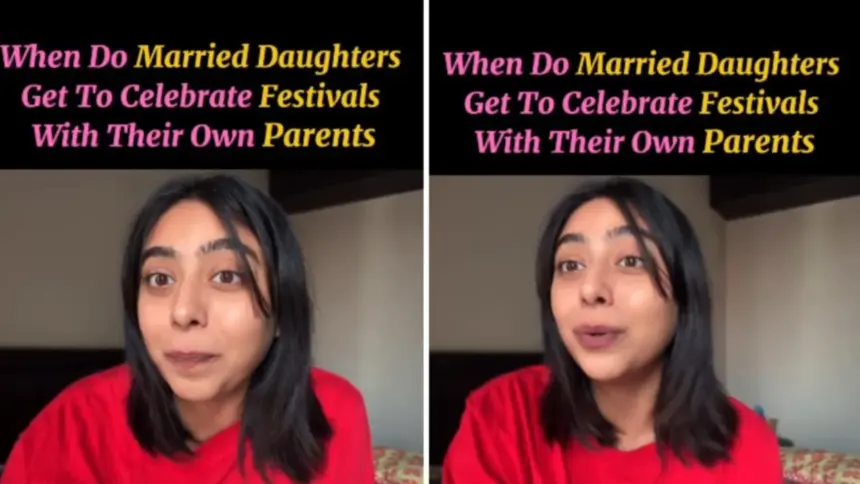
An Instagram video questioning why married daughters are often expected to celebrate major festivals with their in-laws has prompted a conversation about family responsibilities, marriage and equality. The woman asked what happens to parents who have only daughters after their children marry, drawing contrasting responses from women who shared their own experiences.
Married Daughters and Festival Traditions: Festivals such as Diwali, Holi and Navratri are closely associated with family gatherings, cherished traditions and the joy of spending time with loved ones. However, for some married women, deciding where to celebrate can become a complicated question.
An Instagram user has drawn attention to this issue by questioning why daughters are frequently expected to spend major festivals at their husband’s family home while married sons continue celebrating with their own parents.
Her questions focused particularly on families with only daughters.
What happens when all the daughters get married? Who celebrates with their parents? And should a woman’s marriage change her ability to participate in the family traditions she grew up with?
According to the supplied account, the video prompted responses from married women describing very different experiences.
While some said they freely celebrated with their parents, others expressed sadness about being unable to visit their childhood homes during important occasions.
Woman Questions Why Married Daughters Must Prioritise Their In-Laws
In the Instagram video, the woman questioned the expectations that can shape festival celebrations after marriage.
She asked:
“When do married daughters get to celebrate festivals with their own parents?”
Her concern was especially directed towards families where there are no sons.
She wondered whether parents with only daughters might be left celebrating important festivals without their children once those daughters marry.
The question highlighted a traditional expectation in some households that a married woman should primarily participate in festivals with her husband’s family.
While these arrangements differ across communities and individual families, the woman questioned why the decision is not always treated as a shared responsibility between spouses.
Her remarks also reflected an emotional concern: the possibility that parents may feel excluded from family celebrations simply because their children are daughters rather than sons.
‘What Happens to Parents Who Have Only Daughters?’
One of the most discussed parts of the video concerned parents who have no sons.
The woman asked whether such parents are expected to spend every Diwali, Holi and other important occasions alone after their daughters marry.
Her question challenged the assumption that sons should remain connected to their parents’ festive traditions while daughters should shift their celebrations to their marital homes.
For families with only daughters, this expectation can create a particular dilemma.
Parents may have spent years celebrating festivals with their children, only to find that those gatherings become less frequent after marriage.
However, whether parents actually experience this situation depends on family relationships, geographical distance, health, work commitments and the choices made by the people involved.
The woman’s post did not suggest that every family with daughters follows the same pattern.
Instead, it invited women to explain how such decisions are handled in their own homes.
Why Are Festival Expectations Different for Married Sons and Daughters?
The video also raised questions about the different expectations sometimes placed on married men and women.
The woman observed that a married man may continue celebrating Diwali, Holi or Navratri with his parents without facing the same questions about loyalty or adjustment.
Meanwhile, a woman who wishes to spend those occasions with her own family may feel pressure to justify her decision.
These expectations are connected to longstanding social traditions in which women commonly move into their husband’s household after marriage.
Such arrangements can influence where festivals are celebrated, who hosts family gatherings and which customs receive priority.
However, family structures have changed considerably over time.
Many couples live independently, work in different cities or maintain close relationships with both sets of parents.
For these families, festival arrangements may involve visiting both homes, alternating occasions or inviting relatives to celebrate together.
The central question raised by the video is whether those choices are made fairly.
Woman Says Both Partners Should Have an Equal Say
The Instagram user clarified that she was not suggesting married daughters should always prioritise their own parents.
Instead, she questioned why one family’s traditions might automatically receive preference.
Her argument focused on equal participation in decisions after marriage.
A couple may choose to celebrate Diwali with one family and Holi with the other.
They might also alternate years or invite both families to a shared gathering.
The arrangement itself is less important than whether both partners feel their relationships and responsibilities are respected.
Marriage creates a new family relationship, but it does not erase an individual’s existing emotional connection with their parents.
The woman’s message encouraged couples to discuss these expectations rather than accept them without question.
Married Women Share Positive Experiences With Supportive Families
The video received responses from women who said they continued celebrating festivals with their parents after marriage.
One commenter credited the support of her husband and in-laws.
“Yes I do.. i celebrate all my festival with my parents u just need supporting husband and in laws,” she wrote, according to the supplied comments.
Another woman, who described herself as an only child, said she made celebrating with her parents a priority.
“I’m an only child, and I celebrate every festival with my parents,” she commented.
These responses suggest that some women feel comfortable maintaining their childhood family traditions after marriage.
Support from a spouse and extended family may help make such arrangements easier.
However, each family’s situation is different, and no single arrangement will necessarily work for everyone.
Some Couples Find Ways to Celebrate With Both Families
Other commenters explained how they manage festive visits without requiring either partner to abandon their family traditions.
One woman described a flexible arrangement in which she spends time at her mother’s home and her husband joins her for part of the celebration.
She explained that both families matter.
Another commenter said festival arrangements should be decided between the two people in a marriage.
These responses introduced a practical perspective into the discussion.
Rather than treating the choice as a competition between parents and in-laws, couples can work towards arrangements that recognise the importance of both families.
Such choices may require advance planning, particularly when relatives live in different cities.
Travel expenses, work schedules and family responsibilities may also influence what is possible.
Nevertheless, the comments show that some couples have found ways to avoid placing all festive obligations on one side of the family.
‘My Parents Celebrate Every Festival Alone’: Women Share Emotional Experiences
Not every response described a positive experience.
Some women expressed sadness about being unable to spend major festivals with their parents after marriage.
One commenter said she and her two sisters were all married and that their parents now celebrated festivals without them.
“We are three sisters all married, now my parents are celebrating every festival alone,” she wrote, according to the supplied material.
She also described feeling incomplete during festive occasions because of the separation.
Another woman, who said she was one of two sisters, shared a similar experience.
She indicated that she had not had the opportunity to celebrate festivals with her parents after marriage.
These comments highlight why the Instagram user’s question resonated with some viewers.
Festivals often carry emotional significance because they are connected to childhood memories and family relationships.
For someone who wishes to return home but feels unable to do so, the occasion may bring sadness alongside celebration.
At the same time, these individual experiences should not be treated as evidence that all married daughters face the same restrictions.
Why the Discussion Matters for Parents With Only Daughters
The conversation has particular significance for parents whose children are all daughters.
Traditional expectations can sometimes imply that parents should rely on sons to maintain certain family rituals and celebrations.
The Instagram video questioned this assumption.
A daughter may continue to have a close relationship with her parents after marriage, regardless of whether she has brothers.
Likewise, parents’ emotional needs do not become less important because their children are women.
However, fairness does not necessarily require every married daughter to attend every festival at her parents’ home.
A more balanced approach recognises the importance of family relationships while accounting for personal circumstances.
For some households, celebrating together may involve travel.
For others, hosting parents or arranging visits around different festivals may be more practical.
The underlying principle is that family participation should not be determined solely by the gender of the children.
Can Couples Alternate Diwali, Holi and Other Festivals?
One possible approach for couples is to develop a flexible festival calendar.
For example, they may spend Diwali with one family and Holi with the other, then reverse the arrangement the following year.
Other couples may prefer celebrating major festivals at home and inviting both families.
Where distance or professional commitments make travel difficult, families may arrange smaller gatherings before or after the festival itself.
Video calls and other forms of communication can also help families remain connected when travelling is not possible.
However, these alternatives are not necessarily equivalent to being together in person, especially for parents and children who value shared rituals.
The most suitable arrangement will depend on the needs and preferences of everyone involved.
Importantly, such decisions work best when both partners can communicate openly without one person’s family consistently being treated as less important.
Marriage Should Not Mean Losing Childhood Family Traditions
The discussion also raises a larger question about identity after marriage.
Marriage may introduce new customs, relationships and responsibilities, but it does not automatically remove the significance of traditions followed during childhood.
For many people, festivals are closely connected to the homes where they grew up.
Specific foods, decorations, prayers, music and family routines may carry memories that remain meaningful throughout adulthood.
Allowing both partners to maintain those connections can strengthen family relationships.
It can also help children growing up in such households develop close bonds with both sides of their extended family.
While traditions vary widely across India, the desire to celebrate with loved ones is not restricted to sons or daughters.
Internet Reactions Show There Is No Single Experience
The supplied comments illustrate the range of experiences women may have after marriage.
Some described supportive husbands and in-laws who helped them maintain their family connections.
Others shared emotional accounts of parents celebrating without their married daughters.
Still others explained practical arrangements that allowed both families to participate.
These responses do not establish how common any one experience is.
They do, however, show why the original question has meaning for different households.
Rather than presenting one arrangement as universally correct, the discussion encourages consideration of fairness, emotional needs and individual choice.
A Simple Question That Challenges Festival Expectations
The Instagram user’s question goes beyond deciding where a couple should celebrate Diwali or Holi.
It asks whether marriage changes the way sons and daughters are expected to care for their parents and participate in family traditions.
The responses show that some women already have the freedom to make those choices, while others feel constrained by expectations.
The central issue is not whether married daughters should always celebrate with their parents or always celebrate with their in-laws.
It is whether both partners can make decisions that respect their relationships with their families.
For parents who have only daughters, that distinction can be especially meaningful.
Have a story tip or feedback? Write to [email protected].
© Hunterfly.in. Original editorial content.