





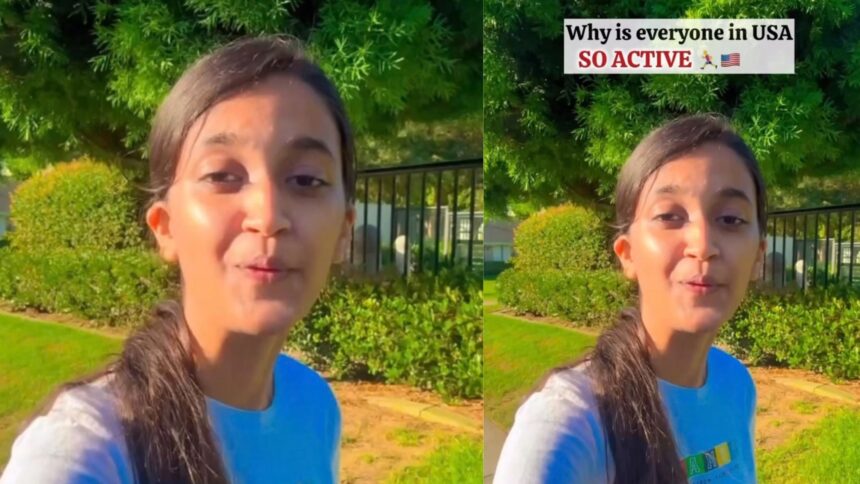
From running trails and hiking routes to public parks and outdoor recreation, the everyday environment in many parts of the US can make physical activity feel easier to incorporate into daily life. Indian CA and lifestyle creator Drishti Baldeva recently shared her perspective on why staying active can feel so common in America—and asked whether better infrastructure could encourage a similar culture in India.
If you spend time in some American cities and suburbs, it is common to see people running on dedicated trails, walking through neighbourhood parks, cycling, hiking on weekends or participating in recreational sports.
That observation recently became the subject of a social media post by CA Drishti Baldeva, who compared the active lifestyle she has noticed in the US with everyday life in India.
According to Drishti, access to clean parks, running trails and outdoor spaces can make exercise feel less like a separate activity and more like a natural part of the day.
See more of our coverage in your search results.
Add Hunterfly on GoogleWhy Does Fitness Feel So Visible in the US?
One factor Drishti highlighted is the availability of outdoor infrastructure.
In many American communities, residents have access to public parks, walking paths, running routes, recreational fields and hiking areas. Depending on the location, these spaces can be used for everything from a morning run to an evening walk or weekend outdoor activity.
That does not mean everyone in the US follows an active lifestyle. Fitness habits vary considerably by age, location, income, work schedule and access to recreational facilities.
However, when parks and trails are conveniently located and maintained, they can lower one practical barrier to exercise: finding a suitable place to be active.
For someone who enjoys walking, running or hiking, the environment itself can become part of the motivation.
See more of our coverage in your search results.
Add Hunterfly on GoogleRunning, Hiking and Outdoor Recreation
Drishti’s post points to a broader feature of American lifestyle culture: physical activity is not necessarily limited to gyms.
Running clubs, hiking groups, cycling routes, kayaking, recreational sports and outdoor fitness activities can all become social or leisure pursuits.
This can create a different relationship with exercise. Instead of viewing a workout solely as something that happens inside a gym, people can combine movement with recreation, travel or time outdoors.
See more of our coverage in your search results.
Add Hunterfly on GoogleThe distinction is particularly noticeable for people who enjoy activities such as hiking and trekking, where the destination and surroundings become part of the experience.
Could Better Infrastructure Make India More Active?
This is the central question raised by Drishti’s post.
India has no shortage of people interested in fitness. Gyms, yoga studios, running communities, sports clubs and wellness centres have expanded across major cities, while walking and running events have become increasingly visible.
But access to suitable public spaces can vary significantly between neighbourhoods.
For some people, the challenge is not a lack of interest in exercise but the practical environment around them. Busy roads, limited pedestrian infrastructure, traffic, weather conditions and a shortage of accessible recreational spaces can influence how easily outdoor exercise fits into a daily routine.
Better-maintained parks, safer walking and cycling routes and more accessible sports facilities could potentially make physical activity more convenient for more residents.
The impact, however, would depend on how such infrastructure is designed, maintained and used.
Drishti Baldeva Connects Fitness With Financial Thinking
As a chartered accountant, Drishti also presented another angle in her post.
She suggested that when healthcare costs are high, maintaining an active lifestyle can be viewed not only through the lens of health but also from a financial perspective.
Her argument is essentially that preventive health habits may have long-term value, particularly in a country where medical expenses can be substantial.
That should be understood as a personal perspective rather than a guarantee that exercising will prevent future healthcare costs. Medical expenses depend on numerous factors, including genetics, illness, accidents, insurance coverage and access to healthcare.
Still, the idea connects two increasingly popular conversations: health and personal finance.
Is Fitness Becoming a Lifestyle Rather Than a Routine?
The popularity of walking groups, running communities, hiking trips and recreational sports suggests that fitness can extend beyond traditional workouts.
For many people, an active lifestyle is built through small and repeatable choices—walking instead of driving for short distances, taking a trail on the weekend, joining a recreational sport or simply spending more time outdoors.
Infrastructure can support these choices, but individual habits, social communities and local culture also play important roles.
For India, the question may therefore be broader than whether people need more gyms. It could also involve asking whether cities provide enough safe, convenient and appealing opportunities for people to move throughout the day.
The Bigger India-US Lifestyle Conversation
Drishti’s observation ultimately raises an interesting comparison between everyday environments in the US and India.
The two countries have very different urban structures, climates, population densities and transportation patterns. A fitness culture that works in one environment cannot simply be copied into another.
But the underlying principle is easier to transfer: when physical activity is convenient, accessible and enjoyable, people may find it easier to make movement part of their routine.
From public parks and walking routes to community sports and recreational trails, infrastructure can influence how people experience an active lifestyle.
Whether India can create more of these opportunities—and how cities adapt them to local needs—could become an important part of the country’s broader conversation around fitness, public spaces and quality of life.
This article is based on observations shared by CA Drishti Baldeva on Instagram. Her comments about healthcare costs and fitness are presented as her perspective and should not be interpreted as individual medical or financial advice.