





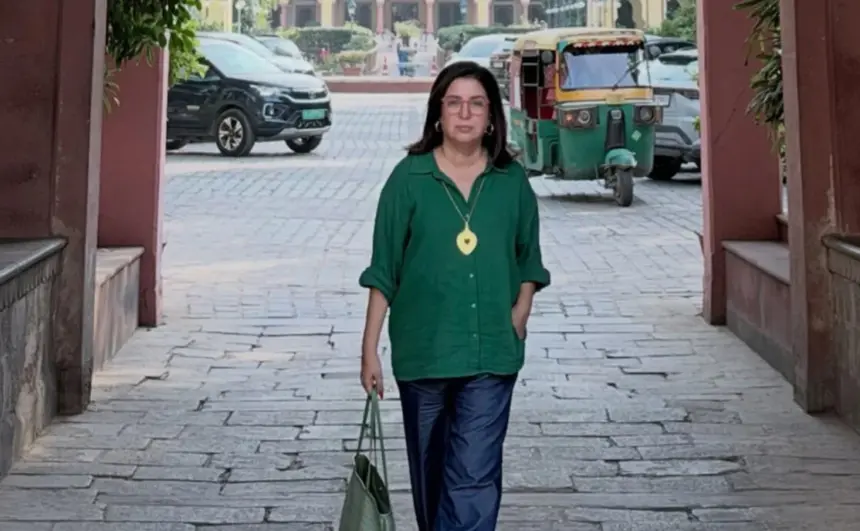
Farah Khan has revealed that her decision to work with a young Shreya Ghoshal on Main Hoon Na faced resistance from industry insiders. The filmmaker recalled how the singer’s talent eventually convinced the team to trust her with important songs in the 2004 film.
Bollywood filmmaker Farah Khan has revisited a memorable chapter from the making of her directorial debut, Main Hoon Na, revealing that her decision to work with playback singer Shreya Ghoshal was questioned by several people in the film industry.
During a conversation featured on Farah’s vlog, recorded at Shreya’s home, the filmmaker recalled how she and music composer Anu Malik supported the young singer despite concerns about her limited experience.
Shreya, who was still in her teenage years during the early stages of her film career, was considered a relatively new voice at the time.
Farah’s recollection offers a glimpse into the creative decisions behind the music of Main Hoon Na, the 2004 Shah Rukh Khan-starrer that marked her transition from choreography to film direction.
Farah Khan Reveals Why People Opposed Her Decision
According to Farah, several industry acquaintances questioned her decision to involve Shreya in the film’s soundtrack.
The filmmaker recalled receiving warnings about trusting a comparatively inexperienced singer with songs intended for a major Bollywood production.
At the time, established playback singers were already closely associated with leading actresses, making the selection of a newer voice a potentially significant creative decision.
However, Farah and composer Anu Malik reportedly believed that Shreya could bring a fresh vocal quality to the film.
Rather than selecting an artist solely on the basis of popularity or years of experience, the team was willing to consider the suitability of her voice for the compositions.
Looking back on the experience, Farah suggested that the concerns expressed by others did not change her confidence in the young singer.
The recollection highlights the uncertainty that can accompany creative decisions, particularly when a filmmaker chooses emerging talent for a high-profile project.
Shreya Ghoshal Was Still a Young Singer
Shreya’s journey in Hindi film music began with Sanjay Leela Bhansali’s Devdas, released in 2002.
Her playback performances in the film introduced audiences to a voice that would become widely recognized across Indian cinema.
During her conversation with Farah, Shreya reflected on how young she had been when she began receiving significant recording opportunities.
The account describes her as being around 18 during the early recording period associated with Main Hoon Na.
The conversation also referred to the period when her work on Devdas had not yet reached audiences.
The precise chronology of those recordings would need to be checked against the original conversation, given that Devdas was released in 2002 and Main Hoon Na arrived in cinemas in 2004.
What remains clear from the filmmakers’ recollections is that Shreya was at an early stage of her playback career when Farah and Anu Malik recognized her potential.
How Shreya Ghoshal Impressed the Main Hoon Na Team
One of the most interesting details from the conversation concerned Shreya’s initial recording assignment.
Farah reportedly recalled that the singer was first brought in for a relatively small musical portion associated with Amrita Rao’s character.
The team was impressed by her performance and subsequently felt confident about giving her more prominent singing responsibilities.
This included music associated with Sushmita Sen’s character in the film.
The decision represented an important moment for a singer who was still establishing herself in an industry filled with experienced playback performers.
It also demonstrated how a limited recording opportunity could develop into a more substantial collaboration when the creative team was satisfied with the result.
For Farah, the experience reinforced her original belief that the young singer’s voice could contribute meaningfully to the film.
Shreya Ghoshal Recalls Feeling Nervous About Sushmita Sen’s Screen Presence
Although Farah expressed confidence in her singing, Shreya admitted that she experienced some uncertainty while working on the film.
The singer recalled seeing footage featuring Sushmita Sen and wondering whether her recorded voice would adequately complement the actress’s appearance and screen presence.
The concern was understandable within the context of playback singing, where a vocalist performs a song that is subsequently presented through an actor’s on-screen performance.
A successful musical sequence depends on several elements working together, including the composition, vocal interpretation, choreography, cinematography and acting.
Shreya’s recollection suggests that she was aware of the responsibility involved in providing vocals for a major film actress.
Farah reportedly reassured her that the team was pleased with her work.
Their conversation revealed a contrast between the singer’s early uncertainty and the filmmaker’s confidence in her abilities.
The Songs That Made Their Collaboration Memorable
Main Hoon Na featured music composed by Anu Malik, with lyrics written by Javed Akhtar.
Shreya Ghoshal contributed to songs that became associated with the film’s romantic musical identity.
Among them were the title track, Main Hoon Na, and Tumhe Jo Maine Dekha.
The compositions formed part of a soundtrack that combined romantic melodies with the energetic presentation associated with Farah Khan’s filmmaking style.
Songs in Hindi cinema frequently serve purposes beyond providing musical entertainment.
They can develop relationships between characters, establish emotional tones and contribute to a film’s broader cultural identity.
In Main Hoon Na, the music played an important role in the romantic portions of the narrative, including sequences involving Shah Rukh Khan and Sushmita Sen.
The collaboration between Farah, Anu Malik and Shreya became part of a soundtrack that continues to be associated with the film.
Main Hoon Na Marked Farah Khan’s Directorial Debut
Released in 2004, Main Hoon Na was Farah Khan’s first feature film as a director.
The film featured an ensemble cast led by Shah Rukh Khan, alongside Sushmita Sen, Suniel Shetty, Amrita Rao and Zayed Khan.
The story followed Major Ram Prasad Sharma, an Army officer who enters a college as part of an undercover assignment while also dealing with personal and family relationships.
The film brought together action, comedy, romance, family drama and elaborate song sequences.
Its combination of genres reflected the mainstream Hindi cinema style of the period.
Farah, already known for her work as a choreographer, brought considerable experience in staging musical performances to the project.
The soundtrack and song picturizations became recognizable elements of the film’s identity.
Main Hoon Na also enjoyed commercial success, establishing Farah as a filmmaker capable of directing a major Bollywood production.
Shreya Ghoshal’s Journey From Devdas to Main Hoon Na
Shreya’s early playback career had already included an important milestone before Main Hoon Na reached audiences.
Her work on Devdas brought her widespread recognition, including a National Film Award for Best Female Playback Singer for Bairi Piya.
That achievement helped establish her credentials as an emerging artist in Hindi film music.
Her subsequent collaborations expanded her presence across film soundtracks and different musical styles.
Over the years, Shreya has recorded songs in numerous Indian languages, developing a career that extends well beyond Bollywood.
Her versatility, vocal control and ability to interpret different compositions have contributed to her long-standing popularity.
Looking back at her early work with Farah Khan provides an interesting perspective on a period when she was still adjusting to the expectations of major film productions.
Why Farah Khan and Anu Malik’s Decision Was Significant
The story shared during Farah’s vlog is not simply about a filmmaker choosing one singer over another.
It also illustrates the importance of creative judgment when evaluating emerging talent.
Experience can be valuable in film music, but selecting a playback singer also involves considering vocal tone, interpretation and compatibility with the composition.
A newer artist may offer qualities that a particular song requires, even without an extensive professional record.
According to Farah’s recollection, her decision was shaped by what she and Anu Malik heard in Shreya’s voice rather than by the concerns raised about her relative inexperience.
The eventual collaboration became part of an important early phase of Shreya’s career.
However, it would be inaccurate to describe Main Hoon Na as the film that launched her playback career, since she had already made her major Hindi film breakthrough with Devdas.
Instead, the 2004 production represented another significant collaboration during her rise in Bollywood music.
A Personal Reunion That Revisited Bollywood Music History
The conversation between Farah Khan and Shreya Ghoshal offered more than a conventional celebrity interview.
By revisiting their first professional collaboration, the two artists reflected on the uncertainty, trust and creative decisions involved in making film music.
Farah remembered the doubts expressed by others, while Shreya recalled her own nervousness about delivering the right performance.
Their contrasting memories reveal how the same recording experience can be viewed differently by a director and a singer.
For Farah, the episode was an example of supporting a promising voice.
For Shreya, it was part of the process of building confidence while working on prominent Bollywood productions.
Their conversation also offered longtime listeners an opportunity to revisit the music of Main Hoon Na from the perspective of the people involved in creating it.
Farah Khan’s Recollection Highlights the Value of Recognizing New Talent
More than two decades after Main Hoon Na was released, Farah Khan’s recollections provide insight into a decision that initially attracted skepticism.
The filmmaker’s willingness to work with a young singer and Shreya Ghoshal’s determination to meet the expectations of the production team became important elements of their early collaboration.
The story also serves as a reminder that established success is not always the only reliable indicator of creative potential.
For audiences familiar with the soundtrack, the conversation adds another dimension to songs associated with one of the recognizable Bollywood films of the early 2000s.
Have a story tip or feedback? Write to [email protected].
© Hunterfly.in. Original editorial content.