








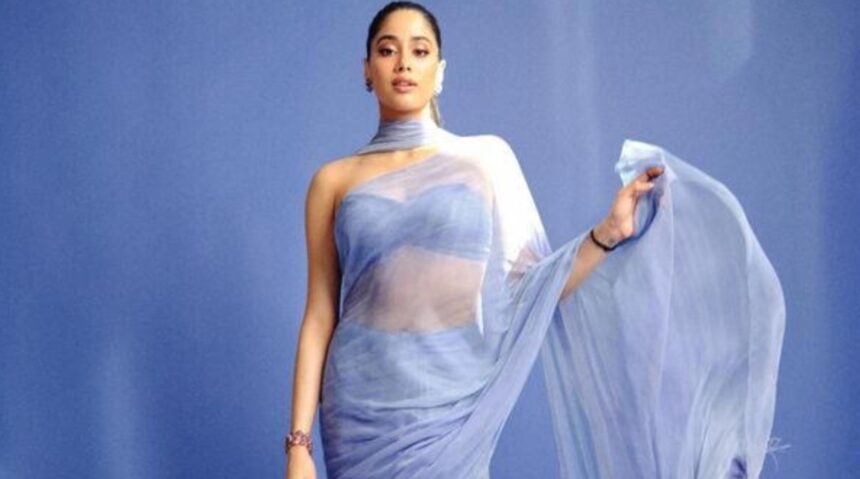
At a recent fashion pop-up in Bengaluru, women tried on sheer silk organza pieces and repeatedly offered the same response: “I love it, but I don’t know if I can wear it.”
That hesitation reveals something more complicated than a passing fashion trend.
Sheer clothing has become one of the defining visual languages of contemporary fashion. Designers across India and international luxury houses have experimented with transparency, layering and exposed silhouettes. Bollywood actors have worn sheer gowns and saris on red carpets, while social media has filled with conversations about body confidence and dressing without apology.
And yet, inside a fitting room, the relationship between women and transparency can become much more complicated.
See more of our coverage in your search results.
Add Hunterfly on GoogleThe question is not necessarily whether women like sheer clothing.
Often, they do.
The question is whether they feel permitted to wear it.
The contradiction behind body confidence
Fashion’s current conversation around body acceptance can sometimes feel contradictory.
On one side, women are encouraged to dress for themselves, embrace their bodies and stop treating conventional beauty standards as rules.
See more of our coverage in your search results.
Add Hunterfly on GoogleOn the other, social media continuously presents highly curated images of what an ideal body supposedly looks like.
The rise of weight-loss drugs such as Ozempic has added another layer to that conversation, with rapid or highly visible weight loss becoming part of contemporary celebrity and influencer culture.
The result is an uncomfortable paradox.
See more of our coverage in your search results.
Add Hunterfly on GoogleWomen are told to accept the body they have while simultaneously being shown the body they are expected to want.
Sheer clothing makes that contradiction particularly visible.
A pair of jeans can conceal the body.
A tailored jacket can reshape it.
A flowing dress can create distance between the garment and the person wearing it.
Transparency does something different.
It asks the wearer—and the viewer—to confront the body rather than hide it.
That can make an apparently simple fashion decision feel surprisingly personal.
What women said in the fitting room
At the Bengaluru pop-up, the concerns were remarkably specific.
One woman wondered whether the fabric would make her stomach look larger.
Another mentioned that she had worn sheer clothing when she was younger but had gradually stopped.
The conversations weren’t necessarily about disliking the garments.
They were about coverage, age, body shape and social comfort.
Those comments changed the nature of the design research behind the collection.
Questions that had seemed important during development—how transparent should the weave be, which weight of silk organza should be used, what colours would work best, whether detachable slips should be included—were suddenly joined by a different vocabulary.
Stomach.
Age.
Coverage.
Those words reveal how clothing operates beyond aesthetics.
A garment can be beautiful and still make someone feel exposed.
The complicated history of sheer clothing in India
To understand why transparency carries so much cultural baggage, it helps to look beyond contemporary fashion.
India has a long and complicated relationship with translucent fabrics.
Fine textiles have historically been prized for their lightness, softness and ability to move with the body.
But transparency has also repeatedly been associated with modesty, sexuality and social respectability.
Few images illustrate this contradiction more clearly than the wet sari in Indian cinema.
The cinematic device became one of Bollywood’s most recognizable ways of suggesting sensuality while technically maintaining clothing on the body.
The Bollywood wet-sari fantasy
In Raj Kapoor’s Satyam Shivam Sundaram (1978), Zeenat Aman appears in a translucent white sari during the film’s famous waterfall sequence.
A decade later, Sridevi’s rain-soaked chiffon sari in Mr. India (1987) became another defining example of the visual language.
Then came Madhuri Dixit in Dil To Pagal Hai (1997), where the sheer kurta-and-leggings combination became one of the memorable fashion images associated with 1990s Bollywood.
The formula was remarkably consistent.
The garment remained.
The body underneath became more visible.
In an industry where censorship and social conventions historically restricted explicit representations of nudity, transparency offered filmmakers a visual compromise.
The body could be suggested without being completely exposed.
That distinction made the sheer garment powerful.
It was not simply clothing.
It became a cinematic language.
The wet sari was never just about fashion
The history of the wet sari has attracted academic attention as well.
Scholar Rachel Dwyer, for example, has examined the erotic symbolism of the wet sari in Hindi cinema, considering how the trope functioned as a coded representation of sensuality.
That scholarship helps explain why the image remains culturally powerful.
For generations of Indian viewers, a transparent sari wasn’t necessarily a neutral garment.
It had already acquired meaning.
It could signify romance, desire, femininity or sexual availability depending on its context.
That history matters when we ask why a woman today might admire sheer clothing on a runway but hesitate to wear it herself.
The garment arrives with cultural associations that are older than the current fashion cycle.
Sheer clothing existed long before Bollywood
The story becomes even more interesting when we move outside cinema.
In Bengal, for example, fine fabrics were historically suited to the region’s hot and humid climate.
Lightweight and translucent textiles were not simply fashion statements.
They could also be practical responses to weather.
Yet transparency became a subject of social debate.
An 1868 issue of Bamabodhini Patrika, a Bengali women’s publication, carried an article titled Sūkṣmabastra, or Fine Cloth, which criticized very fine clothing and argued that it could make women appear insufficiently covered in public.
That historical episode reveals something important.
The debate around sheer clothing is not new.
Women have been negotiating the boundary between comfort, beauty, modesty and public respectability for well over a century.
Jnanadanandini Devi and the changing sari
The history of the Bengali sari also demonstrates that what is considered “proper” clothing is not fixed.
When Jnanadanandini Devi, the wife of Satyendranath Tagore, travelled to Bombay, she encountered Parsi women wearing saris with stitched blouses, petticoats and shoes.
She adapted elements of the style for Bengali women.
The resulting drape became associated with the Brahmika sari.
Jnanadanandini later promoted the style in Calcutta and reportedly used the same women’s publication that had criticized extremely fine fabrics to encourage women to adopt the new way of dressing.
The episode is revealing because it shows that clothing conventions change through social negotiation.
What one generation considers unconventional can become ordinary to the next.
The blouse itself, now so closely associated with the sari, was part of a broader evolution in how women dressed publicly.
Who gets to wear transparency?
This brings us back to the fitting room.
The question isn’t simply whether sheer clothing is fashionable.
It is also who feels entitled to participate in the trend.
When celebrities wear transparent gowns, the styling is controlled.
There may be strategically placed panels, nude-toned underlayers, body tape, tailored construction, professional lighting and an entire team working to create the final image.
A customer trying on a sheer organza blouse in a changing room doesn’t necessarily have any of those supports.
She has a mirror.
She has her own body.
And she has the imagined gaze of everyone she thinks might see her wearing it.
That is a very different experience.
Transparency can make age feel visible
Age emerged as another recurring concern.
This is particularly interesting because fashion often sells youth as a prerequisite for experimentation.
Women may become increasingly conscious of what they are “supposed” to wear as they get older.
A sheer garment can therefore trigger questions that have little to do with the garment itself:
Am I too old for this?
Will people think I’m trying too hard?
Will this look sophisticated or inappropriate?
Those questions are social rather than technical.
The fabric hasn’t changed.
The person wearing it hasn’t necessarily changed.
What has changed is the cultural permission she believes she has to be visible.
The difference between exposure and choice
There is an important distinction between being exposed and choosing to reveal.
Sheer clothing can make a person feel exposed when the transparency isn’t under their control.
But when the wearer chooses the level of visibility—through layering, colour, silhouette or styling—the same garment can become empowering.
That is why details such as detachable slips matter.
They provide agency.
A woman can decide how much transparency she wants.
She can wear the garment over a camisole, a tonal slip, a bralette or another layer.
She can change the styling depending on where she is going.
The garment becomes adaptable rather than prescriptive.
The fashion industry is learning this too
Contemporary designers have approached transparency in dramatically different ways.
Some use barely visible fabrics to create an almost weightless silhouette.
Others layer sheer materials over opaque garments.
Some expose sections of the body strategically.
Others use embroidery, appliqué, sequins or tailoring to interrupt the transparency.
The most interesting interpretations don’t necessarily ask women to reveal everything.
They play with what is visible and what remains concealed.
That tension is where much of the visual appeal comes from.
Sheer doesn’t have to mean naked
One misconception worth challenging is that wearing sheer clothing automatically means displaying the body.
It doesn’t.
Transparency can be controlled through styling.
A sheer organza shirt over a simple tank can create the effect without exposing the torso.
A transparent skirt over an opaque slip can introduce texture while maintaining coverage.
A sheer sari can be paired with a structured blouse.
A translucent jacket can be worn over a fitted dress.
The garment becomes a layer rather than a declaration.
That distinction may make sheer fashion feel more accessible to women who are interested in the trend but uncomfortable with extreme exposure.
Fashion has always negotiated the boundary
Perhaps the most revealing part of this story is that fashion has rarely been entirely about covering or revealing the body.
It has always negotiated the boundary between the two.
The sari can conceal the body while simultaneously outlining it.
The corset can cover the torso while emphasizing its shape.
The swimsuit can reveal more skin while remaining socially conventional.
The sheer garment simply makes that negotiation more obvious.
And because it does, it can expose cultural anxieties that other clothing allows us to ignore.
What the fitting-room hesitation really tells us
The women at the Bengaluru pop-up weren’t rejecting body positivity.
They were demonstrating its limitations.
Telling women to “love your body” is relatively simple.
Creating an environment in which women actually feel comfortable being seen in that body is much harder.
That requires changing more than advertising.
It requires changing the social meaning attached to bodies of different sizes, ages and shapes.
It also requires fashion itself to offer choices rather than a single definition of confidence.
A woman shouldn’t have to become thinner before she feels entitled to wear sheer fabric.
She shouldn’t have to be young.
She shouldn’t have to resemble a celebrity.
And she shouldn’t have to prove that she is confident enough.
She should simply be able to decide whether she likes the garment.
The future of sheer fashion may be about agency
Perhaps the next stage of the sheer-clothing conversation isn’t about making transparency more extreme.
It may be about making it more inclusive and adaptable.
Designers can offer different levels of transparency.
Retailers can show garments on different body types.
Styling can demonstrate multiple ways to layer the same piece.
And women can be shown that sheer clothing isn’t a test of body confidence.
It is simply another category of clothing.
That may sound like a small distinction.
It isn’t.
Because when a woman looks into a fitting-room mirror and thinks, I love it, the next thought shouldn’t have to be but can I wear it?
The more interesting question is:
How do I want to wear it?
And perhaps that is where fashion’s conversation about body confidence becomes real—not when women are persuaded to reveal more, but when they are given enough freedom to decide for themselves.