








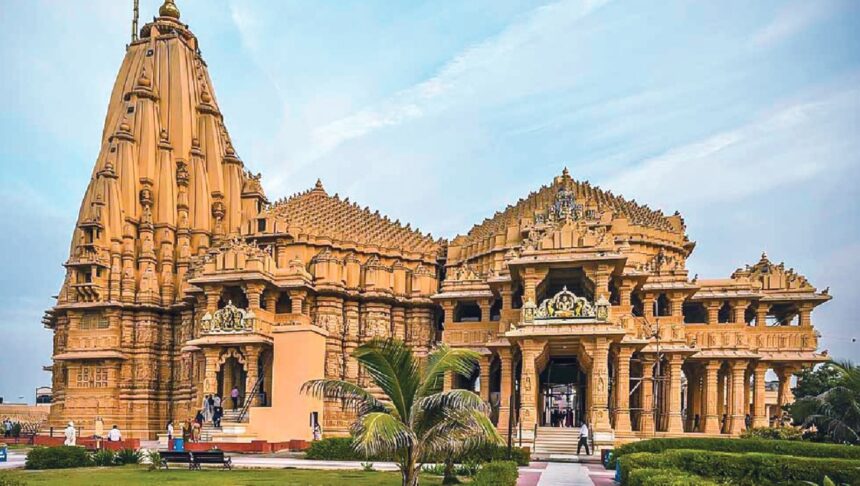
The word Somnath itself stirs something profound in the heart of Bharat. It is not merely a temple — it is the living proclamation of India’s soul.
Situated on the western coast of Gujarat at Prabhas Patan, Somnath occupies the foremost place among the twelve sacred Jyotirlingas of Lord Shiva. Ancient tradition begins the Dwadasha Jyotirlinga Stotram with the words:
“Saurashtre Somanatham Cha”
— declaring Somnath as the spiritual gateway of India’s civilisational consciousness.
A Thousand Years Since 1026
The year 2026 marks a solemn and historic milestone:
1,000 years since the first invasion of Somnath in 1026.
See more of our coverage in your search results.
Add Hunterfly on GoogleThat year, Mahmud of Ghazni launched a brutal assault on the shrine, driven not by conquest alone but by the desire to shatter a civilisation’s spiritual backbone. The devastation inflicted upon the town and the temple is recorded in painful detail in history — cruelty that still echoes through time.
Yet the story of Somnath is not a story of defeat.
It is the story of resurrection, resilience, and relentless faith.
Time and again, after repeated destruction, the people of Bharat rebuilt Somnath — stone by stone, generation by generation — refusing to let the light of their civilisation be extinguished.
The Eternal National Spirit
Swami Vivekananda captured this spirit after visiting Somnath in the 1890s. Speaking in Chennai in 1897, he observed:
“These temples bear the marks of a hundred attacks and a hundred regenerations… continually destroyed and continually springing up out of the ruins, rejuvenated and strong as ever. That is the national mind.”
Those words remain true today.
See more of our coverage in your search results.
Add Hunterfly on GoogleRebirth in Independent India
After independence, the responsibility of rebuilding Somnath fell upon Sardar Vallabhbhai Patel. Moved deeply during his 1947 visit, he resolved that the temple must rise again on its sacred ground.
On May 11, 1951, the restored Somnath Temple was consecrated in the presence of President Dr. Rajendra Prasad, fulfilling Sardar Patel’s vision. The unwavering support of K.M. Munshi ensured the revival of this civilisational beacon.
Why Somnath Matters Today
Somnath stands today not merely as architecture, but as proof of an idea expressed in the Gita:
See more of our coverage in your search results.
Add Hunterfly on Google“That which is eternal is indestructible.”
For a thousand years, invaders came and vanished into dust, while Somnath endured — rising again, stronger each time.
In 2026, as India strides forward toward a Viksit Bharat, Somnath reminds us that true strength flows from civilisational confidence, spiritual continuity, and unwavering belief in the power of renewal.
A Message for the Future
The waves of the Arabian Sea still crash against Somnath’s shores with the same force they did a millennium ago — telling a story of continuity, courage, and conviction.
Somnath teaches us that hatred may destroy for a moment,
but faith builds for eternity.
As India commemorates Somnath Swabhiman Parv (1026–2026), the temple stands as both memory and message:
If Somnath could rise again and again,
so too can Bharat rise — stronger, wiser, and more radiant than ever.
Jai Somnath.