






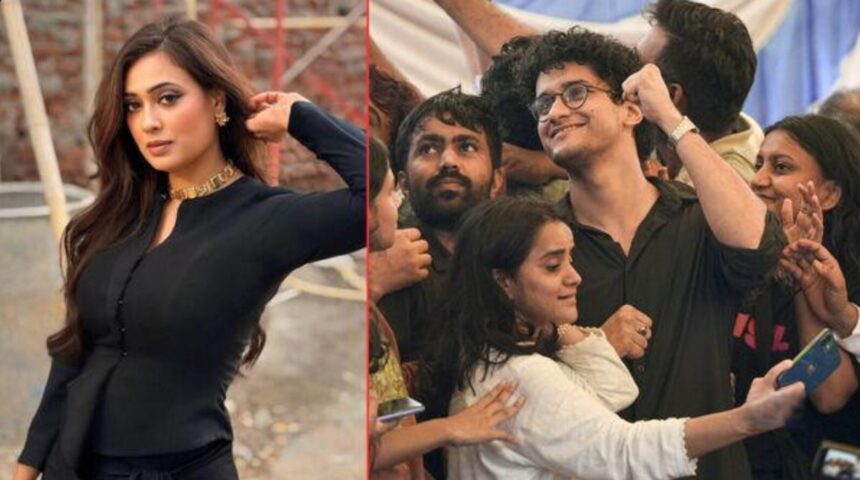
Actor Shweta Tiwari has found herself at the center of a heated online debate after questioning when the Cockroach Janta Party (CJP) would launch a protest in Punjab, days after the student-led movement celebrated the resignation of former Union Education Minister Dharmendra Pradhan.
Her comments, shared through Instagram Stories, quickly spread across social media platforms, triggering both criticism and political debate.
The discussion comes after weeks of nationwide demonstrations over the NEET-UG paper leak controversy, one of the biggest education-related issues in recent years.
Why Shweta Tiwari’s Comment Sparked Debate
Following Dharmendra Pradhan’s resignation on July 25, several Bollywood personalities publicly welcomed the government’s decision, describing it as a victory for students seeking accountability.
See more of our coverage in your search results.
Add Hunterfly on GoogleSharing a video of CJP founder Abhijeet Dipke, Tiwari wrote:
“Now, when is the Punjab Education Minister resigning? And when are you protesting there, Cockroach Janta Party?”
The statement immediately became a talking point online.
Some users interpreted her question as criticism of CJP’s alleged political proximity to the Aam Aadmi Party (AAP), which governs Punjab. Others argued she was unfairly expecting one student organization to lead protests across multiple states.
Social Media Responds
Within hours, hundreds of users reacted to Tiwari’s remarks.
Many questioned why she expected activists to organize every movement while not participating herself.
See more of our coverage in your search results.
Add Hunterfly on GoogleAmong the responses were comments encouraging the actor to lead a demonstration if she believed action was necessary.
Several users sarcastically suggested she begin a hunger strike herself, while others argued that students involved in the recent nationwide protests deserved time to recover after weeks of demonstrations.
Others pointed out that protests concerning examination issues and alleged irregularities had already been taking place in Punjab, saying local students were actively raising their concerns.
See more of our coverage in your search results.
Add Hunterfly on GoogleThe discussion continued throughout the day, with opinions sharply divided between those supporting her question and those criticizing its timing.
Background: The CJP-Led Student Movement
The controversy follows a major student movement demanding accountability after the NEET-UG paper leak.
The demonstrations called for action against those responsible for examination irregularities and greater protection for students affected by the controversy.
Following sustained protests, the government announced several decisions, including:
- Acceptance of key demands raised during the movement.
- The resignation of Union Education Minister Dharmendra Pradhan.
- Compensation for affected students.
- No criminal cases against students who participated in peaceful protests.
The developments were widely viewed as one of the most significant student-led campaigns in recent years.
Bollywood’s Reaction to the Resignation
The resignation prompted responses from numerous film personalities.
Several actors described the decision as an important moment for student activism and democratic participation.
Among those expressing support for the movement were:
- Alia Bhatt, who praised young people for raising their voices.
- Sonakshi Sinha, who applauded the determination shown by students.
- Shabana Azmi, who called the resignation only the beginning of broader reforms.
- Prakash Raj, who credited students and activist Sonam Wangchuk for sustaining public pressure.
- Bhumi Pednekar, who urged long-term reforms in the education system.
- Swara Bhasker, who described the outcome as a major victory for the movement.
- Pankaj Tripathi, who said the development reflected the strength of democratic participation.
Not every reaction was celebratory.
Actor Ranvir Shorey argued that the resignation should have happened much earlier and questioned whether governments respond only after prolonged street protests.
A Wider Conversation Beyond One Comment
Shweta Tiwari’s post has become part of a larger national conversation about student activism, political accountability, and the role public figures play in shaping public debate.
Supporters of her remarks argue that governments across states should face equal public scrutiny over education-related issues.
Critics, however, believe expecting one organization to lead every protest overlooks the role of regional student groups and local civil society organizations already working on similar concerns.
As discussions continue online, the incident highlights how celebrity statements can quickly become part of wider political conversations, especially during periods of heightened public attention surrounding education and governance.