




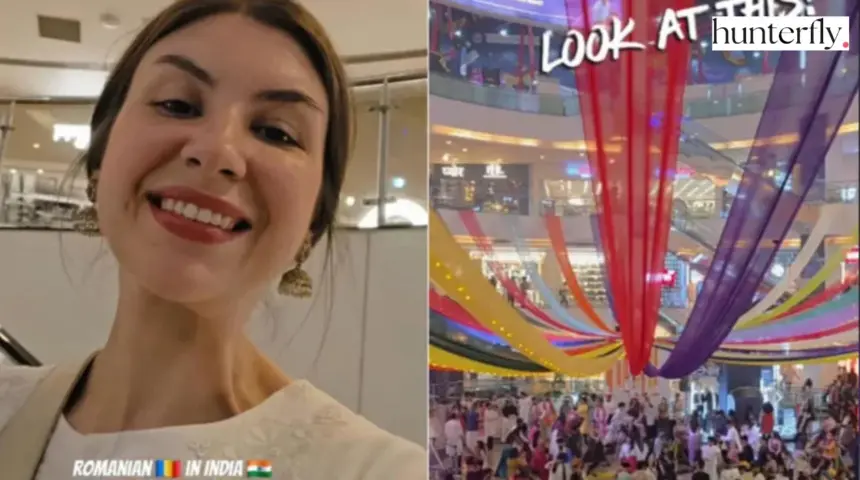
A Romanian woman living in India was moved to tears after witnessing people of different ages come together to perform Garba during Navratri. Content creator Maria Alexandra shared the experience in an Instagram video, expressing her admiration for the festival’s vibrant atmosphere and spiritual significance.
The video captured people dancing in traditional attire beneath festive decorations at a mall. For Alexandra, the gathering was more than a colourful celebration—it offered a glimpse into the connection between Indian cultural traditions, community and devotion.
She also reflected on how much she would miss India when she eventually leaves the country.
‘I’ve never seen anything like this in my life’
Dressed in a white kurta and jhumkas, Alexandra filmed the crowd as men, women and children participated in the traditional dance. The sight of people from different generations celebrating together left her visibly excited.
“I’ve never seen anything like this in my life,” she said in the video.
She went on to express her happiness at experiencing India during the festive season, pointing out the number of people participating in Garba and explaining that Navratri is dedicated to Goddess Durga.
Her reaction highlighted the scale and inclusiveness of the celebration, where participants gather to dance, celebrate and observe traditions during the nine-night festival.
Why the Garba celebration made her emotional
What particularly moved Alexandra was the religious significance she associated with the dance. She explained that Garba was not simply a form of entertainment but also an expression of devotion.
“What I found really moving is that the dancing itself is considered a form of worship, so every single person out there isn’t just celebrating; they’re honouring her through the dance itself. It’s not separate from the devotion; it is the devotion,” she said.
Garba is closely associated with Navratri celebrations, particularly in Gujarat, and is performed in honour of the divine feminine. The dance often takes place in circles, accompanied by rhythmic music and traditional songs.
Alexandra later admitted that she had spent a considerable amount of time watching the celebrations. The experience became unexpectedly emotional.
“I spent so much time just watching and enjoying their dancing and don’t judge me, but my eyes got really teary at one point,” she said.
She suggested that her reaction could have been connected to her appreciation of Indian culture, the thought of leaving India in the future or simply the happiness of seeing so many people celebrating together.
Internet appreciates her understanding of Indian culture
Alexandra’s video drew appreciative responses from viewers, according to the supplied account. Several commenters praised her for looking beyond the visual spectacle and recognising the cultural and spiritual meaning of the celebration.
One user wrote, “You’ve explained Indian culture really well, and I truly appreciate the time you spent in India and the effort you made to understand our culture. Thank you so much for sharing your experience!”
Another commenter said, “Glad to see that you are not only enjoying it but also feeling the real sense.”
A third user responded humorously, writing, “We can sleep without food for 2 days but not without music, without tea and without asking questions…. That’s india in brief.”
The comments reflected a mix of appreciation, cultural pride and humour. Alexandra’s reaction also prompted a broader reminder of how festivals can offer visitors a way to connect with local traditions and the communities that keep them alive.
For Alexandra, the Navratri gathering appears to have become a memorable part of her time in India. Her emotional response captured the joy of experiencing a celebration in which music, dance, community and faith come together.