



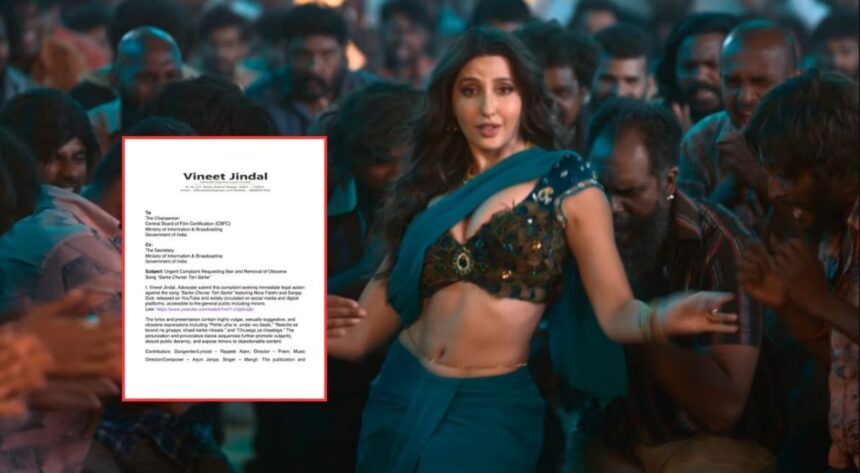
Nora Fatehi has addressed the controversy surrounding ‘Sarke Chunar Teri Sarke’, the song associated with the Kannada film KD: The Devil, after the track sparked criticism over its lyrics, visuals and the way Nora’s image was used in material circulating online.
In a recent appearance on the Dream with Dr Sheen podcast, Nora spoke at length about the backlash, the decision to issue a public clarification and why she believes her initial silence may have been misunderstood.
The actress maintained that she did not perform the Hindi version of the song and said she had not given permission for her image to be used in connection with it.
Nora also recalled that she had shot the original song several years ago in Kannada and explained that she only learned about some of the subsequent material when it was presented publicly.
See more of our coverage in your search results.
Add Hunterfly on GoogleNora Fatehi Says She Expected the Controversy
Speaking about the backlash on the podcast, Nora said she was not surprised that the controversy eventually became intense.
She explained that, after years of working in the entertainment industry, she has developed what she described as a “thick skin” when dealing with public criticism.
“I already know who hired you, when, and how much they paid you,” Nora said while discussing the reaction surrounding the controversy.
She suggested that the situation had been used by some people to generate attention and that the discussion around feminism contributed to the intensity of the reaction.
Nora said she was not panicking when the controversy began.
See more of our coverage in your search results.
Add Hunterfly on Google“I wasn’t panicking; I was not in fear,” she said, explaining that she had spent three days shooting the project without knowing how the material would later be presented.
According to Nora, she only became aware of the wider controversy after returning from the shoot.
‘Sometimes My Silence Could Be Misunderstood’
As online discussion grew, Nora decided to release a clarification video.
See more of our coverage in your search results.
Add Hunterfly on GoogleThe actress said she felt compelled to respond because several narratives about her involvement were circulating that she believed were inaccurate.
“Sometimes my silence could be misunderstood for something else,” Nora said.
She explained that she wanted to provide the details directly rather than allow speculation to continue unchecked.
“I explained myself. I told the truth,” she added.
Nora’s decision to speak publicly was therefore not simply a response to criticism of the song itself. Her main concern was clarifying the extent of her involvement and addressing claims that she had knowingly participated in the controversial Hindi version.
Nora Says She Did Not Shoot the Hindi Version
One of the central points in Nora’s explanation is that she did not shoot the Hindi version of Sarke Chunar Teri Sarke.
She said she had originally filmed the song approximately three years earlier in Kannada.
“I shot this song three years ago in Kannada,” Nora explained in an earlier video message.
According to the actress, she agreed to the original project because it was part of a major film and featured Sanjay Dutt.
She recalled that she understood the song to be connected to the Kannada version of the film and believed it was a remake of a song associated with Khal Nayak.
Her explanation was intended to distinguish the original filming from the Hindi-language material that later became the subject of controversy.
‘There Was No Permission Taken’
Nora was particularly clear about her position regarding the use of her image in connection with the Hindi version.
In a statement accompanying her earlier clarification video, she wrote:
“I would hate for anyone to think I endorse this.”
She continued:
“I do want to reiterate I had no idea about this Hindi song; I did not perform to it, and there was no permission taken to use it with my image.”
That distinction is central to Nora’s response.
While she acknowledges that she participated in the original Kannada song, she has denied being involved in the Hindi version in the manner suggested by some of the online discussion.
Nora Says She Had Already Raised Concerns
Nora also revealed that she had concerns when she attended an event connected to the song’s launch.
She said that she saw the Kannada version there and was unhappy with some of the visual material used in the lyrical video.
“When I attended the launch, I saw the Kannada version, and I had a major issue because they used unflattering photos in the lyrical video,” she said.
According to Nora, the material also included an AI-generated image involving her and Sanjay Dutt.
She recalled being irritated by what she saw at the event but said she chose to remain composed.
“I was very irritated at the event when I saw all that. However, I kept my calm,” she said.
Her comments suggest that her concerns about how the song and accompanying imagery were being presented existed before the later controversy surrounding the Hindi-language material.
Why Nora Released a Clarification
Nora’s public response came after snippets and promotional material connected to the song began circulating.
She said that the full song had not initially been released in the form people were discussing online.
According to her, only snippets, clips and AI-generated photographs had circulated at that stage.
Nora said she found it difficult to understand why some social media users continued to question her explanation after she had publicly described her involvement.
She recalled comments accusing her of lying and questioning how she could claim not to have known about a song that had not yet been released.
For Nora, the confusion came from people conflating the original Kannada shoot with the later Hindi version.
‘I Am the Most Articulate Person Out There’
While explaining why she chose to respond publicly, Nora emphasised that she had attempted to provide specific details rather than offer a vague denial.
“I gave all the details. I am the most articulate person out there,” she said.
Yet she said some users continued to reject her explanation.
The episode highlights one of the difficulties celebrities can face when responding to online controversies: even a detailed clarification does not necessarily end speculation.
Once a particular narrative gains momentum on social media, subsequent explanations can themselves become part of the debate.
Nora Says She Is Not Endorsing the Song
Nora also made an important distinction in her recent comments.
She said songs of this nature are produced regularly, but that does not mean she was endorsing the particular material at the centre of the controversy.
“Songs like these get produced every day. It is what it is. I am not saying that this is good,” she said.
The remark reflects her attempt to separate the reality of commercial film production from her own personal position on the content being discussed.
Her argument is not that the controversy should be ignored, but that her involvement should be represented accurately.
What Is ‘Sarke Chunar Teri Sarke’?
‘Sarke Chunar Teri Sarke’ is a song associated with KD: The Devil, a Kannada-language action crime film directed by Prem.
The track is sung by Mangli, with lyrics by Raqeeb Alam and music composed by Arjun Janya.
The film stars Dhruva Sarja, Sanjay Dutt, Shilpa Shetty and Reeshma Nanaiah.
Set in the 1970s, KD: The Devil follows a petty criminal named Kaali as he becomes involved in the underworld.
The film was released in theatres on April 30, 2026.
The controversy surrounding the song subsequently brought additional attention to Nora Fatehi’s earlier involvement with the Kannada version and the later use of material featuring her image.
Nora Fatehi’s Position in Simple Terms
Nora’s explanation can essentially be divided into three points.
First, she says she did shoot the original song in Kannada, but that filming happened around three years ago.
Second, she says she did not shoot or perform the Hindi version that became the subject of the recent controversy.
Third, she says permission was not taken to use her image with the Hindi song.
Her earlier clarification also indicates that she had concerns about the presentation of the Kannada version itself after seeing the lyrical video and certain images used to promote it.
These distinctions are important because the controversy has involved several different pieces of content that audiences may have interpreted as one production.
The Bigger Issue: How Viral Content Creates Confusion
The controversy also illustrates how quickly promotional material can become difficult to separate from the original creative work once it begins circulating across social media.
Short clips, edited images, AI-generated visuals and song snippets can reach audiences without the full context of how or when they were created.
For viewers, it can therefore appear that an actor directly participated in every piece of promotional content associated with a song.
Nora’s explanation challenges that assumption in this case.
She has said that her involvement was connected to an earlier Kannada shoot and that she did not participate in the Hindi version that subsequently generated controversy.
Nora Fatehi’s Latest Statement Adds Context
Nora’s appearance on the Dream with Dr Sheen podcast provides further context to the clarification she had already issued.
Rather than simply repeating her earlier denial, she explained how she experienced the controversy, why she initially remained calm and why she eventually decided to address the issue publicly.
Her comments also make clear that she believes silence can sometimes be interpreted incorrectly in the social-media environment.
For an actor whose image is frequently used in entertainment promotions, that distinction can be particularly important.
What Happens Next?
The controversy has already generated considerable discussion, but Nora’s latest comments make her position clear.
She has acknowledged her participation in the original Kannada shoot while distancing herself from the Hindi version of ‘Sarke Chunar Teri Sarke’.
She has also maintained that permission was not taken to use her image in connection with that version.
Whether further clarification comes from the makers or other parties involved remains to be seen.
For now, however, Nora is asking audiences to distinguish between the content she actually performed and material that she says was later associated with her image without her approval.