








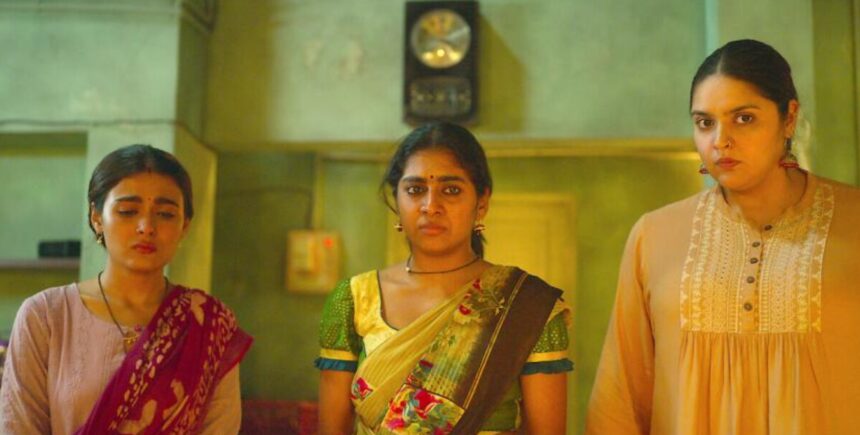
Nimisha Sajayan says she feels especially connected to characters who are raw, vulnerable and deeply human. In her latest Hindi release, Babita Singh Reporting, the acclaimed actor plays a suspended police officer whose journey becomes one of self-discovery and resistance.
Nimisha Sajayan has built a reputation for choosing characters who feel unmistakably human.
They are not always perfect. They may be wounded, conflicted, vulnerable or flawed. But that complexity is precisely what draws the actor towards them.
After earning widespread recognition for her acclaimed performance in the Malayalam film The Great Indian Kitchen, Nimisha has continued to explore characters that challenge conventional ideas of strength and heroism. Her latest role in the Hindi release Babita Singh Reporting takes that exploration in another direction.
See more of our coverage in your search results.
Add Hunterfly on GoogleIn the film, Nimisha plays Babita Singh, a suspended police officer from a small town who finds herself investigating the murder of a childhood friend.
But Babita’s struggle is not limited to solving a crime.
The character is also dealing with humiliation and prejudice in her personal and professional life. She is repeatedly body-shamed by people around her and faces exploitation and dismissive behaviour at work.
For Nimisha, however, Babita’s journey is not defined by weakness.
It is defined by the gradual discovery of her own voice.
See more of our coverage in your search results.
Add Hunterfly on Google‘I Wanted Her Emotions to Feel Real’
Nimisha says authenticity was at the centre of her approach to playing Babita.
The actor wanted the emotional journey of the character to feel believable rather than artificially dramatic. Her aim was to make Babita’s pain, confusion, fear and eventual transformation accessible to audiences.
That approach reflects a larger pattern in Nimisha’s acting choices.
See more of our coverage in your search results.
Add Hunterfly on GoogleRather than being drawn exclusively to glamorous or larger-than-life characters, she says she finds herself particularly interested in people who feel recognisable.
For her, flawed characters can often be the most compelling because human beings themselves are full of contradictions.
People can be strong and vulnerable at the same time. They can be insecure yet courageous. They can make mistakes and still possess beauty, sensitivity and resilience.
Nimisha believes this emotional complexity is what allows an actor to create a deeper connection with a character.
She is also open to exploring larger-than-life roles in the future. But she says there is something about raw, authentic and vulnerable characters that speaks to her more immediately.
Babita’s Heroism Is Not Loud
One of the most striking aspects of Babita’s character is that her idea of heroism is not built around conventional cinematic triumph.
She is not presented simply as an invincible police officer who dominates every room.
Instead, she is a woman struggling to reclaim her own sense of self.
According to Nimisha, Babita faces repeated body-shaming from her husband and relatives. She also experiences exploitation and professional pressure from her seniors.
On the surface, this could make Babita appear defeated.
But the character’s journey takes another direction.
At some point, she begins to recognise the patterns around her. She starts to understand how she has been treated and, more importantly, begins to find the courage to resist.
That recognition becomes the foundation of her transformation.
Nimisha’s interpretation of the role suggests that Babita’s strength is not about suddenly becoming fearless.
It is about choosing to stop accepting what has been imposed upon her.
Her heroism lies in finding her voice.
And that makes the character’s journey particularly relevant to contemporary storytelling about women.
A Story About Breaking Patterns
The emotional power of Babita’s story comes from the fact that the patterns she experiences are not necessarily unusual or unfamiliar.
Body-shaming, workplace exploitation and pressure within relationships can have a profound impact on a person’s confidence and sense of identity.
Babita’s story explores what happens when a person begins to recognise those patterns rather than simply living with them.
For Nimisha, this process of recognition is central to the character.
Babita does not become a hero because she suddenly acquires extraordinary powers. She becomes heroic because she begins standing up for herself.
It is a quieter form of courage.
And it is arguably more difficult to portray than a conventional image of cinematic heroism.
The transformation has to feel earned.
That is where Nimisha’s preference for emotional authenticity becomes important. Rather than treating Babita’s development as a sudden dramatic shift, the character’s evolution appears to emerge gradually from her experiences.
From Malayalam Cinema to Hindi Storytelling
Babita Singh Reporting also marks another important stage in Nimisha Sajayan’s expanding career.
The actor, whose work has been widely associated with Malayalam cinema and other South Indian projects, says the film is her second Hindi feature and one of her most rewarding experiences on a film set.
The experience also took her to a new setting.
The project gave Nimisha the opportunity to work in Madhya Pradesh, a place she was experiencing for the first time.
For an actor, location can become an important part of the process of understanding a character.
Nimisha’s journey through Madhya Pradesh was connected to Babita’s world, allowing her to experience the setting through the lens of the woman she was portraying.
She has also spoken positively about working with the film’s cast and crew, describing the experience as a significant one in her professional journey.
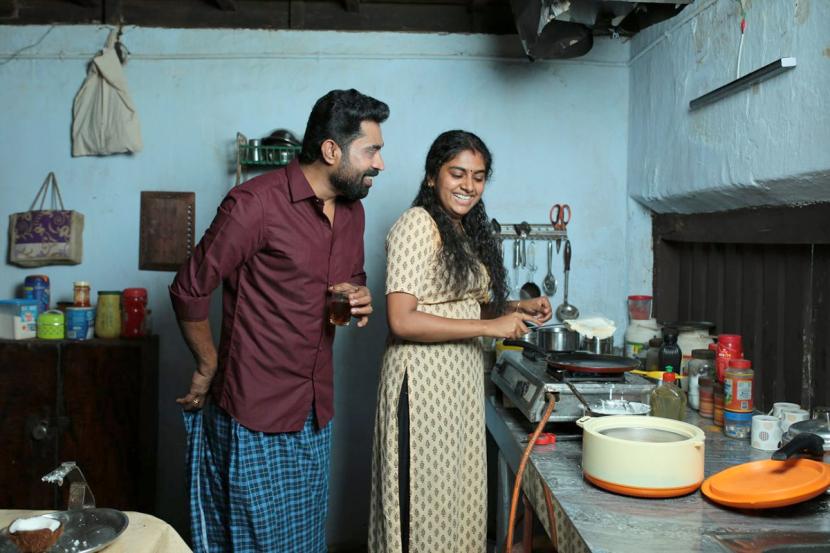
The Continuing Impact of The Great Indian Kitchen
For many audiences, The Great Indian Kitchen remains one of the defining films associated with Nimisha Sajayan.
The Malayalam drama earned widespread acclaim and brought its themes into conversations far beyond its original language and region.
Nimisha acknowledges that the film played an important role in helping her reach a much larger audience.
Yet she does not view it as something she must constantly compete against.
Every project, she says, exists on its own terms.
For an actor, repeatedly trying to recreate the impact of a previous success can become creatively limiting. Nimisha instead appears to approach each new character as a separate journey.
The Great Indian Kitchen remains an important chapter, but her focus is directed towards the stories she is currently working on and the characters she hopes to explore next.
That approach may explain the variety in her career choices.
Every Role Has Been Part of the Journey
Nimisha does not identify only one project as responsible for shaping her career.
Instead, she sees each film as part of her development as an actor.
Every set, every director, every co-star and every role has contributed something different to her professional experience.
Alongside The Great Indian Kitchen, she points to the audience response to projects such as Dabba Cartel, where she played the character Mala.
The reception to her work has helped reinforce a career built around characters rather than formulas.
This is significant at a time when actors are increasingly working across multiple industries, languages and platforms.
Nimisha’s filmography reflects that changing landscape.
A performer can now move between Malayalam cinema, Hindi films, Tamil projects and streaming platforms while reaching audiences far beyond traditional regional boundaries.
‘Dabba Cartel’ Offered a Different Kind of Experience
While Nimisha has often carried emotionally demanding narratives, Dabba Cartel gave her the opportunity to work within an ensemble.
She describes the experience as different from projects where the narrative rests more heavily on an individual character.
Being surrounded by talented performers created a different creative environment.
Nimisha has spoken particularly warmly about sharing the screen with accomplished actors such as Jyotika and Shabana Azmi.
For a performer, acting alongside experienced artists can itself become a form of education.
Sometimes the learning does not happen through direct instruction.
It happens through observation.
Watching another actor prepare, react, listen and build a character can reveal something new about the craft.
Nimisha says working alongside such performers was a valuable learning experience.
The Character Continues to Reveal Itself During Filming
Nimisha’s approach to acting does not appear to rely on one fixed formula.
When asked about what triggers an actor’s connection with a character, she explained that the process is different for every performer.
For her, there is no single moment when everything suddenly becomes clear.
Instead, the process continues throughout the shoot.
Every day on set can reveal something new about a character.
The longer an actor spends inhabiting a role, the more layers can emerge. A performance can therefore remain a process of discovery from the first day of filming to the last.
This approach helps explain why Nimisha is drawn to complex characters.
A layered character gives an actor something to keep exploring.
The goal is not simply to arrive on set with every answer already prepared.
It is also to remain open to discovery.
More Women’s Stories Still Need to Be Told
Nimisha also believes that there are still many stories about women waiting to be explored in Indian cinema.
While she sees encouraging progress in the growing acceptance of female-centred narratives, she believes there remains considerable room for new perspectives.
The increasing success of stories centred on women has demonstrated that audiences are willing to engage with complex female characters.
For decades, mainstream storytelling often placed women within narrow categories.
They could be romantic interests, mothers, victims or symbols of sacrifice.
Contemporary cinema and streaming have increasingly expanded those possibilities.
Women can now be detectives, criminals, leaders, survivors, antiheroes and deeply flawed protagonists.
They can be powerful without being perfect.
Characters like Babita contribute to that changing landscape.
Looking Ahead: Tamil Projects and a New Series
Nimisha Sajayan is currently working on Tamil projects and has also revealed that an upcoming series is preparing for release.
While her career continues to expand across languages and formats, her long-term ambition remains remarkably straightforward.
She wants to continue acting.
Looking five or 10 years into the future, Nimisha hopes she will still be part of good cinema and working on stories that genuinely excite her.
For her, success does not appear to be defined solely by the scale of a project or the visibility of a role.
The essential thing is the process of being part of stories she believes in.
That commitment to meaningful storytelling has become one of the most consistent elements of her career.
From The Great Indian Kitchen to Dabba Cartel and now Babita Singh Reporting, Nimisha Sajayan has repeatedly chosen characters who resist easy definitions.
They are vulnerable but not weak.
They are flawed but not without dignity.
And in the case of Babita Singh, the journey towards becoming a hero begins not with a dramatic act of victory, but with something far more personal.
The decision to finally listen to herself.
The decision to recognise what is wrong.
And the courage to find her own voice.