





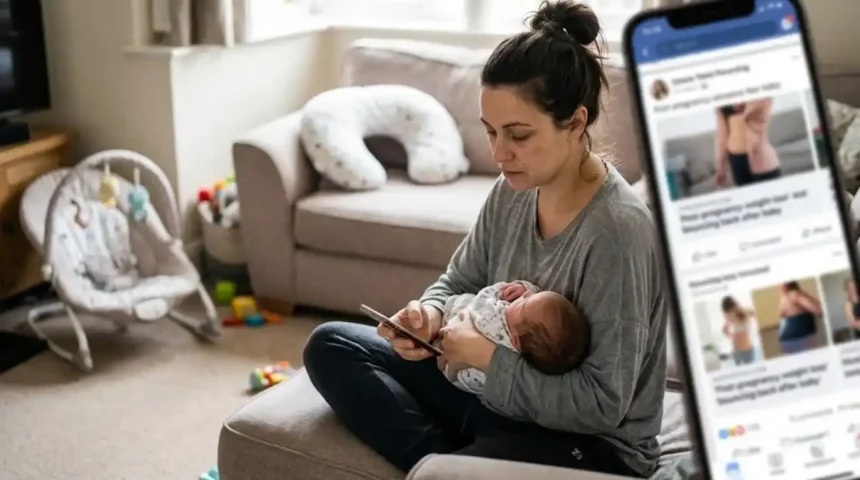
In a society deeply obsessed with appearances, motherhood has not escaped aesthetic scrutiny. Caught between the demand to remain thin and the idealisation of flawless bodies, many new mothers find themselves under intense and often silent pressure. A recent social-media discussion has once again brought this uncomfortable reality to the forefront, exposing how deeply ingrained and widespread these expectations have become.
When Image Erases Experience
Today, becoming a mother is no longer viewed solely as an act of life-giving—it is increasingly accompanied by an unspoken requirement to conform to near-unattainable beauty standards. Social media platforms are saturated with images of slim, smiling, perfectly groomed women holding their children, projecting an almost advertising-like version of motherhood.
This curated imagery leaves little room for the physical and emotional realities of the postpartum period.
The debate was recently reignited after an online user claimed to “trust” women only if they met certain physical standards, illustrating his point with images of slender, seemingly flawless mothers. A sharp response quickly went viral:
See more of our coverage in your search results.
Add Hunterfly on Google“Have you noticed that mothers are always thin? We expect women to have children, but we don’t want to see any trace of motherhood on their bodies.”
The remark struck a nerve, highlighting a stark contradiction—motherhood is celebrated, but its visible marks are often rejected.
Between Social Pressure and the Cult of Performance
Pregnancy undeniably transforms the body. It strengthens it, challenges it and enables it to accomplish extraordinary things. Yet, within the collective imagination, these changes are expected to disappear almost instantly.
Many women are pressured to return to their “pre-pregnancy body” as if nine months of physical transformation, emotional upheaval and childbirth could simply be erased. Some comments online go further, suggesting that women who don’t “get back in shape” risk judgment, rejection or even abandonment.
Supporters of these views often frame them as discipline or personal responsibility. But this narrative overlooks a crucial truth: the human body is not a machine, and postpartum recovery is neither linear nor uniform.
Mothers Are Speaking Up
In response, more women are breaking their silence. Many mothers are sharing their exhaustion, mental load and the realities of postpartum life—sleepless nights, hormonal shifts, breastfeeding challenges and the complete reorganisation of daily existence.
See more of our coverage in your search results.
Add Hunterfly on GoogleIn such circumstances, weight loss is often neither a priority nor a possibility. And increasingly, women are asking a fundamental question: why should it be?
Voices across platforms are reminding audiences that beauty cannot be reduced to a size or a number on a scale. A mother’s beauty lies in her resilience, patience and capacity to love. Her body tells a story—the story of a life carried, protected and brought into the world. These marks are not imperfections; they are proof.
Towards a Freer Idea of Motherhood
This debate underscores a persistent reality: women’s bodies remain under social surveillance, even during life’s most intimate transitions. Yet motherhood also offers a powerful opportunity—to challenge and redefine long-standing beauty norms.
See more of our coverage in your search results.
Add Hunterfly on GoogleWhat if, instead of demanding bodies that erase evidence of childbirth, society celebrated bodies that reflect lived experience? What if the standard itself were expanded?
The message growing louder is clear: no woman owes the world an explanation for her body. Motherhood does not mean disappearing behind an aesthetic ideal—it means occupying space fully and unapologetically.
Every mother’s body deserves respect, care and admiration—today, tomorrow and always.