




Madhuri Dixit’s recreation of the popular Jamal Kudu dance step from Animal has attracted attention online. Her effortless-looking glass-balancing move has drawn comparisons with Bobby Deol’s original performance, while some viewers have interpreted her rendition as a feminist take on the viral sequence.
Bollywood actress Madhuri Dixit has once again caught the attention of social media users, this time with her recreation of the widely recognised Jamal Kudu dance step from the 2023 film Animal.
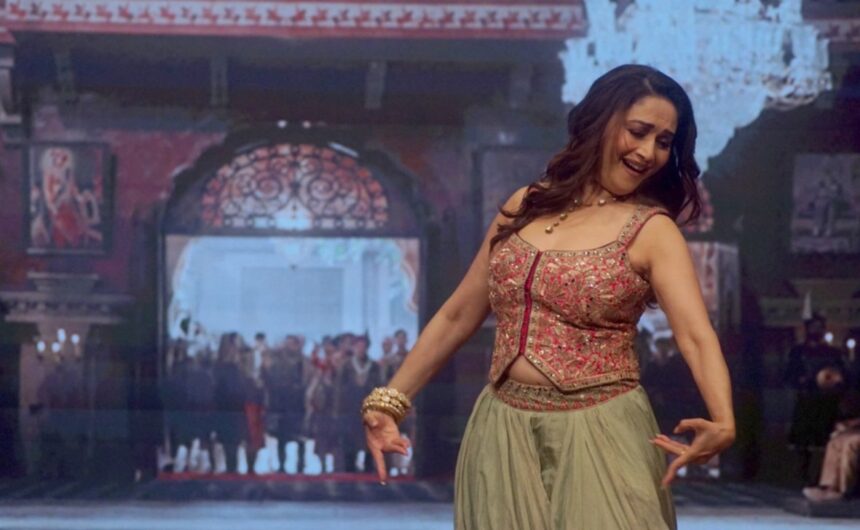
The performance, which features the actress balancing a glass on her head while dancing, has generated praise for its precision and composure. Viewers have particularly noticed how confidently she performs the familiar movement without disturbing the glass.
While Bobby Deol’s version became one of the film’s most memorable moments, Madhuri’s interpretation has introduced a different style to the same choreography, highlighting the lasting appeal of a step that continues to circulate on social media.
Madhuri Dixit’s Jamal Kudu dance grabs attention
The Jamal Kudu sequence became a popular part of Animal, with Bobby Deol’s entry and distinctive dance movement attracting considerable attention following the film’s release.
Madhuri’s recreation draws on the same recognisable visual element: a glass balanced on the head while the performer moves to the music.
In the circulating clip, the actress performs the step with carefully controlled movements, retaining the essence of the choreography while bringing her own style to the presentation.
The performance has reminded viewers why the sequence became a widely imitated dance trend.
Rather than relying on elaborate choreography, the signature movement creates its impact through rhythm, physical control and the challenge of maintaining balance.
Fans impressed by Madhuri Dixit’s glass-balancing skills
One of the most discussed elements of Madhuri’s performance is her ability to keep the glass steady throughout the dance.
Balancing an object while moving requires coordination and an awareness of posture, both of which are visible in the execution of the step.
The actress, widely admired for her dancing across decades of Hindi cinema, approaches the movement with the poise that audiences associate with her performances.
The steady glass becomes a focal point of the video, adding a playful challenge to the familiar routine.
It also creates an interesting contrast between the understated movement and the technical control needed to make it appear effortless.
For viewers familiar with the original sequence, the recreation offers an opportunity to appreciate how a simple dance step can acquire a different personality depending on the performer.
Social media calls Madhuri’s performance a ‘feminist version’ of Animal
The video has also prompted responses that go beyond admiration for Madhuri’s dancing.
According to the reactions described in the original report, some social media users referred to the performance as a “feminist version” of Animal.
Others praised her confidence, elegance and the ease with which she completed the glass-balancing movement.
One reaction described the actress with the words, “What a woman.”
The feminist interpretation appears to reflect how some viewers perceived the contrast between Madhuri’s presentation and the male-centred original scene.
However, it is important to distinguish those audience interpretations from the actress’s own intentions. The available account does not establish that Madhuri described her performance as a feminist statement.
The reactions instead demonstrate how audiences can attach new meanings to familiar film moments when they are performed by different artists.
How Madhuri Dixit’s version compares with Bobby Deol’s original
Bobby Deol’s Jamal Kudu dance gained attention partly because of its placement within Animal.
The sequence accompanies his character Abrar’s introduction and uses a distinctive combination of music, expression and physical movement.
The glass-balancing step became particularly memorable because it was easy for viewers to recognise and imitate.
Madhuri’s recreation retains that central feature but changes how the movement is perceived.
Where the original is closely associated with Deol’s screen character and the dramatic atmosphere of the film, her rendition is being appreciated for its controlled execution and graceful presentation.
Both versions demonstrate how the same choreographic idea can produce different impressions.
The comparisons also underline Madhuri’s enduring association with dance, an important part of her screen identity throughout her career.
What is the origin of the Jamal Kudu song from Animal?
The popularity of Jamal Kudu has also encouraged curiosity about the music behind the sequence.
The track used in Animal draws on Iranian musical influences and is associated with an older song commonly identified as Ey Siah-e Zangi.
Accounts of the song’s background have linked it to composer Ebrahim Shahdousti and musical traditions preceding its appearance in the Hindi film.
The Animal version was adapted for the film’s soundtrack, with Harshvardhan Rameshwar credited for the film’s music.
The song’s rhythmic arrangement and accompanying choreography helped the sequence reach audiences beyond those who had watched the film.
However, the precise history of the source composition, its authorship and its cultural context require careful verification against reliable music-history sources. Claims about its original meaning and specific historical narrative should not be treated as established without supporting evidence.
Why Bobby Deol’s Jamal Kudu dance became so popular
When Animal arrived in theatres in December 2023, its music and several individual scenes became widely discussed.
Bobby Deol’s dance was among the moments that travelled beyond the film itself.
The combination of a distinctive soundtrack, a recognisable movement and the visual challenge of balancing a glass made the routine suitable for short-form videos.
People could recreate the essential part of the sequence without reproducing the entire cinematic setting.
That flexibility helped the dance become a familiar reference across online entertainment content.
Madhuri’s rendition reflects the same quality. Even years after the film’s release, the choreography remains recognisable enough for a brief recreation to attract interest.
The continued attention also demonstrates how popular film choreography can develop a life of its own after a movie’s theatrical run.
Madhuri Dixit’s recreation brings a fresh perspective to the viral step
Madhuri Dixit’s performance has added another interpretation to a dance that audiences already associate strongly with Bobby Deol.
The actress’s balance, controlled movements and familiar elegance have become central to the online conversation, while some fans have used the video to express broader ideas about confidence and female representation.
Not every viewer may interpret the dance in the same way, but the reactions reveal how a recognisable cinematic moment can be reimagined.
For Madhuri, the performance is another reminder of the connection between her screen legacy and her ability to engage audiences through dance.
And for Jamal Kudu, it shows that a memorable piece of choreography can remain culturally relevant long after its original film release.
Have a story tip or feedback? Write to [email protected].
© Hunterfly.in. Original editorial content.