




Jewellery brand GIVA has withdrawn its Raksha Bandhan advertisement featuring Kriti Sanon after the campaign attracted criticism on social media.
The advertisement, created around the festival of Raksha Bandhan, featured Sanon in an ivory-toned ethnic outfit alongside a pet dog. While the campaign was intended to present a contemporary interpretation of family celebrations, some viewers objected to the actor’s styling and questioned the decision to include the dog in the festive concept.
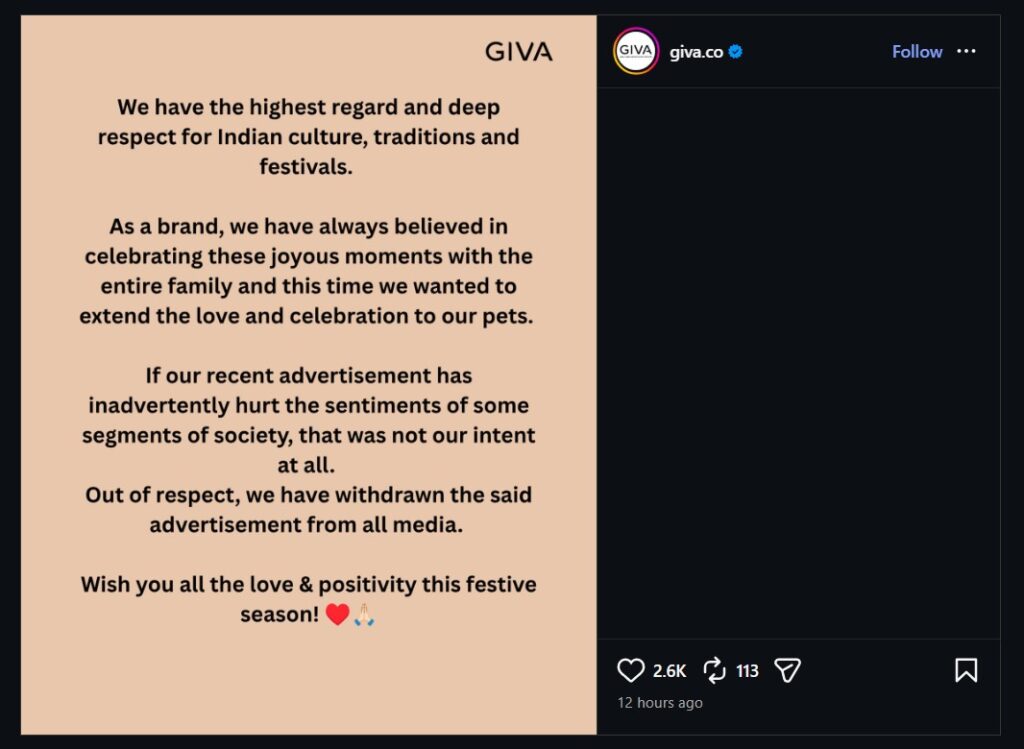
The controversy subsequently moved beyond social media commentary, with GIVA issuing a statement acknowledging the reactions and announcing that the advertisement would be removed from all media.
The development came shortly after Sanon herself responded to criticism and defended both her clothing choice and the broader idea behind the campaign.
See more of our coverage in your search results.
Add Hunterfly on GoogleGIVA Pulls Down Kriti Sanon’s Raksha Bandhan Advertisement
GIVA addressed the controversy in a statement explaining that the brand had intended to celebrate Raksha Bandhan as a family occasion and had sought to extend that sentiment to pets.
The brand said:
“We have the highest regard and deep respect for Indian culture, traditions and festivals.”
GIVA explained that its intention was to celebrate the festival with the entire family while also including pets in the celebration.
The brand added that if the advertisement had inadvertently hurt the sentiments of sections of society, that was not its intention.
It subsequently confirmed that the campaign had been withdrawn from all media.
See more of our coverage in your search results.
Add Hunterfly on GoogleThe statement ended with a message wishing people “love & positivity” during the festive season.
The decision effectively brought the campaign to an end after the advertisement became the centre of an online debate about cultural representation, fashion and advertising.
What Was Controversial About the Advertisement?
The campaign featured Sanon wearing an ivory ethnic ensemble comprising a draped skirt, cape and an off-white blouse styled in a bralette-inspired silhouette.
See more of our coverage in your search results.
Add Hunterfly on GoogleThe outfit itself became one of the primary points of discussion.
Some social media users argued that the styling was inappropriate for a Raksha Bandhan campaign, while others viewed the outfit as a contemporary interpretation of Indian festive fashion.
The debate consequently became less about the jewellery being advertised and more about whether modern fashion should be considered appropriate within advertisements built around traditional festivals.
The inclusion of a pet dog added another layer to the discussion.
In the campaign, the dog was incorporated into the family’s Raksha Bandhan celebration, reflecting the increasingly common idea of pets being treated as members of the household.
However, some viewers questioned whether including a pet in a traditional festival campaign was consistent with their understanding of Raksha Bandhan.
Kriti Sanon Defends Her Outfit
Before GIVA announced the withdrawal, Sanon addressed the criticism herself.
Taking to Instagram, the actor argued that the significance of a festival should not be determined solely by clothing.
She wrote:
“The essence of festivals is not in the clothes you wear, it is in the emotions and meaning you hold for the traditions.”
Sanon went on to explain her personal understanding of Raksha Bandhan.
According to her, the festival represents a bond of protection, and she noted that she and her sister tie rakhi to each other and share the same commitment to each other’s wellbeing.
She also defended the campaign’s inclusion of pets, saying that she and her family consider their dogs part of the family.
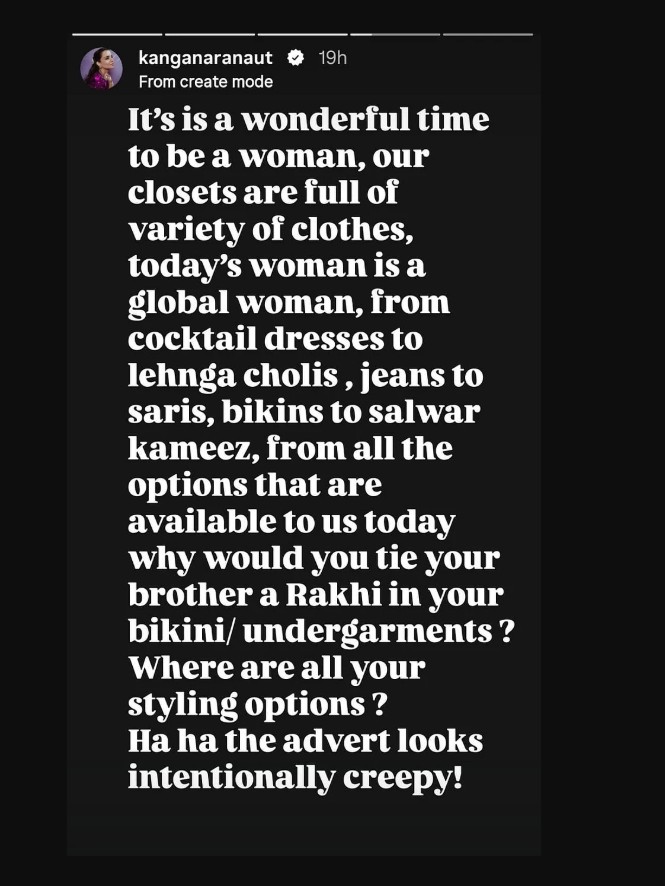
‘When Will We Stop Telling Women What to Wear?’
Sanon’s response then moved beyond the advertisement itself and addressed what she described as the wider tendency to judge women based on their clothing.
She questioned when society would stop telling women what they should wear.
The actor argued that ethnic fashion has evolved over time and that a woman’s connection to her culture should not be determined exclusively by the clothes she wears.
Her statement concluded with a pointed observation:
“Culture & Traditions are in her heart, not in her neckline!”
The comment quickly became another talking point in the discussion, with supporters praising Sanon for challenging the focus on her outfit.
At the same time, the brand’s decision to withdraw the campaign demonstrated how differently an advertisement can be interpreted once it reaches a broad public audience.
A Debate Over Tradition and Contemporary Fashion
The controversy has highlighted a recurring issue in Indian advertising: how brands should balance cultural traditions with contemporary aesthetics.
Festivals such as Raksha Bandhan, Diwali, Durga Puja and Onam carry strong cultural associations. Advertisers frequently use these occasions to create campaigns centred on family, relationships, clothing, jewellery and gifting.
At the same time, brands increasingly use modern styling, diverse family structures and unconventional visual concepts to appeal to younger audiences.
That combination can sometimes produce conflicting reactions.
A campaign intended to communicate inclusivity or modernity may be interpreted by another audience as moving too far away from traditional expectations.
The GIVA campaign illustrates how quickly that tension can emerge online.
Why the Pet Dog Became Part of the Conversation
Pets have increasingly become part of advertising narratives surrounding family life.
For many households, dogs and other companion animals are considered members of the family, and the campaign appears to have attempted to reflect that changing social reality.
Sanon explicitly supported this interpretation in her response, saying that the sentiment of protection and affection extended to their dogs as well.
However, Raksha Bandhan traditionally centres on the relationship between siblings, which led some viewers to question the campaign’s creative choice.
The disagreement therefore reflects two different interpretations of the festival: one rooted primarily in its conventional sibling relationship and another that places the celebration within a broader idea of family and companionship.
Social Media Amplified the Disagreement
The campaign’s controversy also demonstrates the speed at which advertising criticism can spread online.
An advertisement released as a festive campaign can quickly become detached from its original marketing context once users begin discussing specific elements of the content.
Screenshots, short clips and comments can circulate independently, allowing individual aspects of a campaign to become the focus of public debate.
In this case, the discussion centred on three interconnected issues: Sanon’s outfit, the representation of Raksha Bandhan and the inclusion of the pet.
The resulting conversation illustrates the challenge brands face when trying to create advertising that is both culturally recognisable and contemporary.
GIVA’s Response Was Different From Sanon’s
There is an important distinction between the responses of the actor and the brand.
Sanon’s response defended the creative idea and challenged criticism of her clothing.
GIVA, meanwhile, acknowledged that the advertisement had generated negative reactions and chose to withdraw it.
The jewellery company did not describe the campaign as intentionally disrespectful. Instead, it reiterated its respect for Indian culture, traditions and festivals and said that causing offence was not its intention.
The withdrawal therefore appears to have been presented as a response to audience sentiment rather than an admission that the campaign was deliberately designed to offend.
The Difference Between Criticism and Personal Attacks
The episode also raises questions about the way celebrities are discussed online.
Criticism of an advertising campaign is part of the normal public response to commercial content. Audiences can question an advertisement’s creative direction, cultural framing, styling or messaging.
However, conversations can become more personal when criticism shifts from the campaign to the individual appearing in it.
For brands and public figures, this distinction is increasingly important.
A campaign can be criticised without reducing the discussion to personal judgments about the actor involved.
In Sanon’s case, her response attempted to redirect the discussion from her neckline and clothing to the underlying message she believed the campaign was trying to convey.
Can Traditional Festivals Be Presented Through Modern Fashion?
The central question emerging from the controversy is not simply whether Sanon’s outfit was appropriate.
It is whether modern fashion and traditional festivals can coexist in mainstream advertising.
Indian festive fashion itself has changed significantly over the years.
Contemporary designers frequently combine traditional silhouettes, fabrics and techniques with modern cuts and styling. Celebrities routinely wear fusion clothing at weddings, festivals, premieres and public events.
Advertising often reflects these changes.
Yet the expectations surrounding a particular festival can vary significantly among audiences.
What one viewer considers a stylish contemporary interpretation may be viewed by another as inconsistent with the cultural character of the occasion.
There is no single response that will satisfy every audience.
What the Controversy Means for Brands
For advertisers, the episode offers a useful lesson about cultural marketing.
Festive advertising involves more than choosing a festival and placing products within a family setting. Every visual decision—from wardrobe and casting to dialogue, props and relationships—can influence how audiences interpret the campaign.
Brands therefore need to consider not only their intended message but also the range of interpretations that their creative choices may produce.
This does not necessarily mean avoiding contemporary ideas.
Instead, it underlines the importance of understanding the cultural context in which those ideas will be presented.
Why GIVA’s Withdrawal Matters
GIVA’s decision to remove the advertisement shows how brands can respond when a campaign generates significant public disagreement.
The company chose to prioritise its stated commitment to respecting cultural traditions and withdrew the campaign after acknowledging the concerns expressed by sections of the audience.
At the same time, Sanon’s defence demonstrates that the same campaign can be viewed differently by the people involved in creating or featuring in it.
For the actor, the central message was about emotional bonds, family and the freedom to interpret festive fashion in contemporary ways.
For critics, the visual presentation did not align with their expectations of a Raksha Bandhan advertisement.
Both reactions became part of the public conversation.
A Larger Conversation About Women’s Clothing
The controversy also feeds into a much broader discussion about how women’s clothing is scrutinised in public spaces.
Female actors frequently face commentary about what they wear, particularly when their appearance is connected to cultural or religious occasions.
Sanon’s response directly challenged that pattern.
Her argument was that a woman’s respect for cultural traditions should not be assessed simply by examining how much or how little clothing she is wearing.
That position has resonated with people who believe fashion should not be treated as a measure of cultural commitment.
Others, however, continue to argue that advertising campaigns built around specific festivals should reflect the traditional expectations associated with those occasions.
The Campaign’s Intended Message and Its Public Reception
The controversy ultimately demonstrates the difference between creative intention and audience interpretation.
GIVA said its intention was to celebrate Raksha Bandhan as a family occasion and extend that celebration to pets.
Sanon defended the same message and explained why she personally connected with it.
Yet sections of the audience interpreted the visual presentation differently.
This gap between intention and reception is one of the fundamental challenges of advertising.
A campaign can be created with a positive message and still provoke criticism if audiences perceive its execution differently from what the creators intended.
What Happens Next for Kriti Sanon?
The controversy is unlikely to define Sanon’s wider career.
The actor continues to work across Hindi cinema and has built a profile through films spanning comedy, drama, romance and other genres.
Her response to the GIVA controversy has nevertheless added another dimension to her public image, particularly because she chose to directly address criticism rather than remain silent.
For GIVA, the episode serves as a reminder of the sensitivity involved in festival-focused advertising.
For audiences, it has opened another discussion about whether cultural celebrations should follow conventional visual norms or whether brands and celebrities should have greater freedom to reinterpret them.
The Bigger Picture
The GIVA Raksha Bandhan controversy is ultimately about more than one advertisement.
It brings together several increasingly common themes in contemporary Indian culture: evolving fashion, changing ideas of family, the growing role of pets in households, celebrity influence, social media criticism and expectations surrounding traditional festivals.
Sanon has defended the idea that culture is rooted in emotion and values rather than clothing alone.
GIVA, meanwhile, has acknowledged the criticism and withdrawn the campaign while reiterating its respect for Indian traditions.
The advertisement may no longer be running, but the debate it generated raises a question that advertisers will continue to face: how far can a brand modernise a traditional festival before audiences feel that the original cultural context has been lost?
There is unlikely to be a universal answer.
What is clear is that festive advertising now operates under intense public scrutiny, where even a single styling choice or creative concept can become the centre of a much larger cultural conversation.