







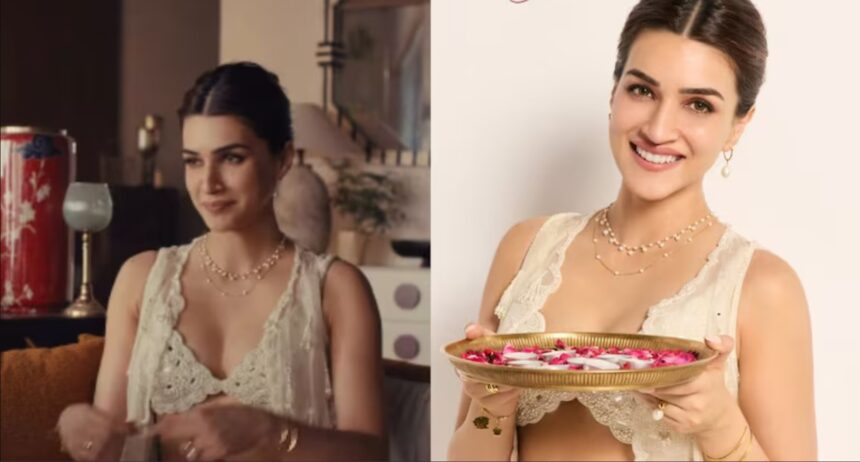
Kriti Sanon has become the subject of an online debate after her latest GIVA jewellery advertisement for Raksha Bandhan drew criticism from sections of social media.
The campaign, created around the sibling-focused festival, features Sanon in a contemporary Indo-western ensemble while celebrating Raksha Bandhan with her family. A pet dog also appears in the advertisement and is incorporated into the campaign’s festive concept.
While the advertisement appears designed to present a modern interpretation of a traditional celebration, some viewers objected to the styling and the way the festival was portrayed.
Several social media users criticised Sanon’s outfit, while others questioned the decision to include the dog in the Raksha Bandhan narrative. Some comments went further, accusing the campaign of disrespecting or making light of a festival that holds cultural and religious significance for many Indians.
See more of our coverage in your search results.
Add Hunterfly on GoogleNeither Kriti Sanon nor GIVA has publicly responded to the criticism cited in the social-media discussion.
What Is the Kriti Sanon GIVA Ad Controversy?
The controversy centres on GIVA’s latest Raksha Bandhan campaign featuring Kriti Sanon.
In the advertisement, the actor is dressed in an off-white bralette-style blouse, a cape and a draped skirt, giving the overall appearance a contemporary interpretation of festive Indian fashion.
The campaign also includes a dog as part of the family setting. The pet is shown interacting with Sanon during the Raksha Bandhan celebration, with the concept involving a rakhi for the dog.
For some viewers, the advertisement’s attempt to combine traditional festival imagery with contemporary fashion and pet culture was seen as an unconventional creative choice.
See more of our coverage in your search results.
Add Hunterfly on GoogleOthers felt the campaign crossed a line and did not adequately reflect the traditional sentiment associated with Raksha Bandhan.
Social Media Users Criticise Kriti Sanon’s Outfit
Much of the online criticism has focused specifically on Sanon’s clothing.
Some users described the outfit as inappropriate for a Raksha Bandhan campaign, particularly because of the blouse’s bralette-inspired design.
See more of our coverage in your search results.
Add Hunterfly on GoogleOne social media user called the appearance “extremely shameful.”
Another user wrote:
“Kriti Sanon wearing a bra while tying a rakhi to her brother in a new jewellery Ad. You won’t see them making fun of either Eid or Christmas.”
The comment reflects one interpretation of the advertisement, with the user arguing that the campaign treats a Hindu festival differently from other religious celebrations.
Another user wrote:
“In this ad, Kriti Sanon is tying rakhi in a bra kinda attire. Nudity was not this common before.”
These reactions are individual social-media opinions and do not establish a broader public consensus about the campaign.
Some Users Accuse the Advertisement of Disrespecting the Festival
The criticism extended beyond fashion.
Some users argued that the overall campaign did not adequately respect the cultural significance of Raksha Bandhan.
One comment read:
“Once again Hindu festivals are being demeaned. No woman dresses like this on Raksha Bandhan. Shame on you Kriti Sanon.”
The statement reflects a specific expectation that advertisements associated with traditional festivals should use conventional forms of dress and presentation.
However, festive clothing preferences differ considerably across families, regions and generations, and an advertisement’s styling does not necessarily represent how every person celebrates the occasion.
The debate therefore also highlights the challenge faced by brands attempting to give traditional festivals a contemporary visual identity.
Why Did the Dog in the Ad Become a Talking Point?
The presence of the dog became another significant element of the online discussion.
GIVA’s campaign appears to incorporate the pet into the family’s Raksha Bandhan celebration, presenting the animal as part of the household.
That reflects a growing trend in contemporary advertising in which pets are portrayed as family members rather than simply animals kept at home.
However, some social media users objected to the idea of including the dog in a Raksha Bandhan ritual.
One user commented:
“This is an ad from a jewellery brand featuring a Bollywood actress for Raksha Bandhan. In this ad, she is wearing a skimpy outfit while celebrating Raksha Bandhan. Not just that, she also got a Rakhi for her dog, giving the dog more importance than her brother. Spirit of Raksha Bandhan is being ruined and disrespected.”
The criticism shows how differently audiences can interpret the same creative concept.
For some viewers, including a pet is a modern representation of the idea of family. For others, Raksha Bandhan is specifically centred on the traditional sibling relationship and should remain focused on that bond.
Another User Questioned the Absence of Traditional Elements
Another social-media comment questioned the styling and presentation of the campaign, asking:
“Why are you wearing bra in front of your brother? Is this a Raksha Bandhan? Where is Tilak?”
The comment highlights the expectations some viewers bring to festive advertisements.
Traditional Raksha Bandhan celebrations can include rituals such as applying tilak, tying rakhi and exchanging sweets or gifts. Advertisers, however, frequently reinterpret such traditions to fit a particular campaign’s creative direction.
The GIVA advertisement appears to take a more contemporary approach, which may explain why it has generated contrasting reactions.
Social Media Has Turned the Ad Into a Larger Debate
The controversy illustrates how quickly celebrity advertising can move beyond its commercial purpose.
An advertisement may be created to promote a product, but when it features a major Bollywood actor and a culturally significant festival, audiences often analyse the campaign through a much wider lens.
Questions about clothing, cultural representation, family values and advertising choices can quickly dominate online discussions.
In Sanon’s case, the conversation has moved away from the jewellery being promoted and towards the campaign’s representation of Raksha Bandhan.
That shift is particularly common on social media, where individual reactions can quickly become part of a larger debate.
The Bigger Question: Can Festival Advertising Be Contemporary?
At the heart of the controversy is a broader question facing advertisers.
How should brands represent traditional festivals in contemporary India?
One approach is to rely heavily on familiar cultural imagery, including traditional clothing, rituals and family settings.
Another is to reinterpret festivals through modern fashion, urban lifestyles and changing ideas about family.
Both approaches can appeal to different sections of an audience.
GIVA’s campaign appears to lean towards the latter. It combines a traditional festival with contemporary fashion and a pet-focused jewellery concept.
For some viewers, that makes the campaign modern and relatable.
For others, it moves too far away from the traditional character of the festival.
Why Kriti Sanon’s Clothing Became the Main Focus
Celebrity fashion frequently attracts intense scrutiny, particularly when an actor is featured in a commercial connected to a cultural occasion.
Sanon is one of Bollywood’s prominent contemporary actors, and her fashion choices regularly receive attention online.
In this case, her outfit became particularly controversial because of the setting in which it was presented.
The same outfit might generate a different response in a fashion campaign, film promotion or red-carpet appearance. The association with Raksha Bandhan changed the context in which some viewers evaluated it.
This distinction is important because the debate is not simply about whether the outfit is fashionable. It is about whether viewers consider it appropriate for the cultural setting presented in the advertisement.
Critics and Supporters May See the Campaign Differently
The online reaction should also be viewed in context.
Not everyone who watches a contemporary festival advertisement will have the same expectations about clothing or rituals.
Some audiences may see Sanon’s look as a fashion-forward interpretation of festive dressing, while others may prefer a more traditional aesthetic.
Similarly, some families consider pets an integral part of their household and may find their inclusion in a family-oriented campaign natural.
Others may see the sibling relationship as the central element of Raksha Bandhan and prefer advertising that keeps the focus there.
These different perspectives explain why the same campaign can generate both engagement and criticism.
No Public Response From Kriti Sanon or GIVA So Far
At the time of publication, Kriti Sanon and GIVA had not publicly responded to the social-media criticism described above.
It is also important to distinguish between online comments and verified statements from the actor or brand.
Social media reactions can provide insight into how a section of an audience is responding, but they do not necessarily represent the views of the wider public.
Any future statement from Sanon or GIVA could provide additional context about the campaign’s creative intent.
Kriti Sanon’s Recent Work
The discussion around the GIVA advertisement comes as Sanon continues to remain active in the Hindi film industry.
The actress was recently seen in Cocktail 2, which co-stars Shahid Kapoor and Rashmika Mandanna.
Alongside her film career, Sanon has also continued to appear in commercial campaigns and fashion-related projects, making her a familiar presence beyond the cinema screen.
Her latest GIVA campaign is another example of the way Bollywood stars increasingly serve as the public faces of lifestyle and jewellery brands.
What This Controversy Says About Celebrity Advertising
The reaction to the GIVA campaign demonstrates the complicated relationship between celebrity advertising and cultural representation.
Brands want advertisements to feel fresh, visually distinctive and relevant to contemporary audiences. At the same time, campaigns built around festivals must navigate traditions that carry different meanings for different communities and families.
When a campaign takes an unconventional approach, discussion is almost inevitable.
The GIVA advertisement has become a case in point.
Its combination of Kriti Sanon, Raksha Bandhan, contemporary fashion and a pet jewellery concept has attracted attention far beyond the products being advertised.
Whether that attention ultimately benefits the campaign remains a matter for the brand and its audience, but there is little doubt that the advertisement has generated substantial online conversation.
The Debate Is Bigger Than One Advertisement
The criticism directed at Kriti Sanon’s GIVA campaign is ultimately part of a much larger discussion about how Indian culture is represented in modern advertising.
Traditional festivals continue to hold deep significance, while fashion and family lifestyles are changing rapidly.
Advertisers are therefore attempting to bring two worlds together: cultural tradition and contemporary consumer culture.
Sometimes that combination resonates immediately. At other times, it creates disagreement.
The GIVA Raksha Bandhan campaign has clearly fallen into the latter category for some social media users.
For others, the campaign may simply represent a modern family celebrating a traditional occasion in its own way.
Final Takeaway
The Kriti Sanon GIVA Raksha Bandhan advertisement has sparked an online debate over two central elements: the actor’s contemporary outfit and the campaign’s decision to include a dog in the festive celebration.
Some users have criticised the campaign as inappropriate or disrespectful to Raksha Bandhan, while others have defended the idea of allowing contemporary fashion and changing family dynamics to coexist with traditional festivals.
As of now, the controversy remains primarily a social-media debate, with no public response from Kriti Sanon or GIVA reported in the material available for this article.
The episode nevertheless raises a larger question for advertisers: when traditional festivals meet modern fashion, where should brands draw the line between creative interpretation and cultural expectations?