







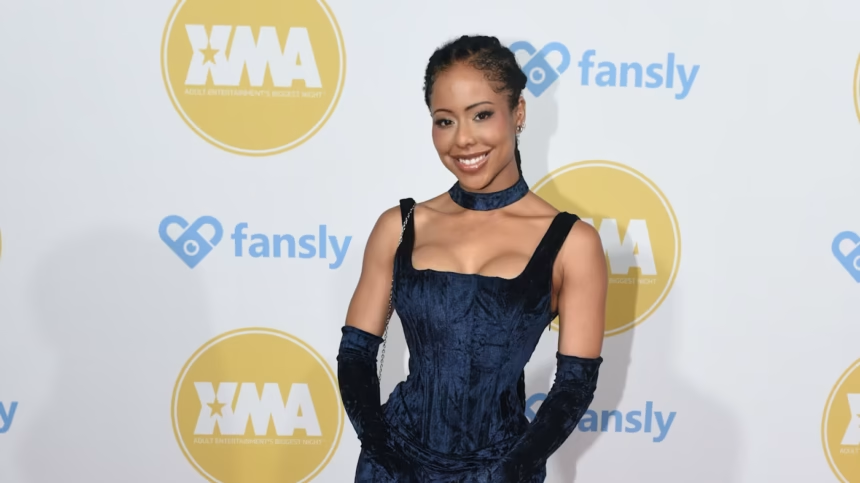
entertainer Kira Noir has recalled an unusual decision within the film industry surrounding the release of Marvel’s Black Panther, saying Black male performers once signed an open letter opposing the idea of making an parody of the superhero film.
Speaking on the 2 Goons podcast on August 13, Noir said the performers wanted to preserve the cultural importance of Black Panther rather than turn the film into a parody.
According to Noir, the group effectively ruled out their participation in such a project by signing an open letter.
Kira Noir Explains Why Performers Rejected the Idea
During the podcast conversation, Noir recalled that Black male performers were reluctant to participate in a Black Panther parody because they did not want to disrespect the franchise.
See more of our coverage in your search results.
Add Hunterfly on Google“They just didn’t want to disrespect it. They didn’t want to make fun of Black Panther by doing a parody,” Noir said.
She explained that the performers were attempting to “protect the sanctity” of the film, which had become an important cultural moment for Black audiences around the world.
Noir said she understood their reasoning, even though she personally would have welcomed the opportunity.
Noir Says the Decision Also Affected Her
While discussing the situation, Noir explained that finding suitable roles in parody productions had already been challenging for her because of her appearance and the types of characters typically represented in such projects.
She suggested that a Black Panther parody could have offered her an opportunity to play a role that was particularly well suited to her look.
See more of our coverage in your search results.
Add Hunterfly on GoogleAlthough she acknowledged why the male performers took their position, Noir admitted that she was disappointed by the decision.
Her comments offer a behind-the-scenes perspective on how performers viewed the cultural significance of Black Panther beyond its status as a major Hollywood release.
Why Black Panther Was Such a Cultural Milestone
Released in 2018 and directed by Ryan Coogler, Black Panther became one of the most successful superhero films of its era.
See more of our coverage in your search results.
Add Hunterfly on GoogleThe movie starred Chadwick Boseman as King T’Challa, alongside Michael B. Jordan, Lupita Nyong’o, Danai Gurira, Letitia Wright and Angela Bassett.
Set primarily in the fictional African nation of Wakanda, the film was celebrated for its predominantly Black cast, African-inspired world-building and themes surrounding identity, heritage and representation.
The movie went on to earn roughly $1.35 billion worldwide and received seven Academy Award nominations, winning three.
Black Panther’s Legacy Continued With Wakanda Forever
The franchise returned in 2022 with Black Panther: Wakanda Forever.
The sequel addressed the death of Chadwick Boseman, who died in August 2020 at the age of 43 after battling colon cancer.
Boseman’s passing profoundly affected the franchise, and Wakanda Forever incorporated T’Challa’s death into its story while introducing new developments within Wakanda.
The sequel also performed strongly at the global box office, earning approximately $859 million worldwide.
Black Panther 3 Is in Development
Marvel is continuing the franchise with a third Black Panther movie.
According to the information cited in the original report, David Jonsson has been cast as Prince T’Challa II, the son of King T’Challa. The project is expected to be directed by Ryan Coogler and is currently scheduled for release on December 15, 2028.
Marvel Studios president Kevin Feige has also discussed how Coogler came to view Jonsson as the right actor for the next chapter.
Feige recalled that Coogler met Jonsson while working on the 2025 film Sinners and subsequently told him that he believed Jonsson was the right person to carry the character forward.
A Different Kind of Black Panther Parody Story
Noir’s recollection adds an unusual footnote to the history of Black Panther.
While superhero properties routinely become the subject of parody and satire, Noir says some Black male performers deliberately chose not to participate in a parody of this particular franchise because they viewed it as culturally significant.
For Noir, however, the decision represented a missed professional opportunity. Her comments illustrate the different ways performers can view the relationship between parody, representation and a franchise that holds particular meaning for its audience.
The Bottom Line
Kira Noir says Black male film performers signed an open letter opposing participation in a Black Panther parody around the time the Marvel film was released.
According to Noir, the performers wanted to protect the film’s cultural significance and avoid making light of the franchise. While she said she understood their reasoning, she also acknowledged that she would have liked the opportunity to appear in such a project.