






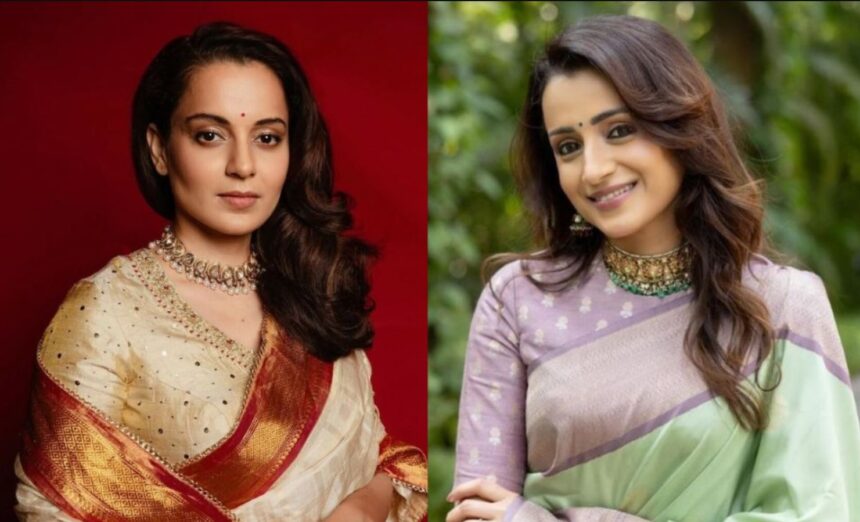
Kangana Ranaut has spoken out against the use of personal attacks and character assassination against women in public life, amid a controversy in Tamil Nadu involving actress Trisha and remarks allegedly directed at her. The actor-turned-politician described the issue as a broader problem affecting women across societies and said attacks on their character can be used as a way to undermine them.
Ranaut made the comments while speaking to reporters after a District Development Coordination and Monitoring Committee (DISHA) meeting in Kullu, Himachal Pradesh.
Her remarks came amid a political controversy in Tamil Nadu involving statements attributed by critics to senior political figures and references to the treatment of women in public life.
Kangana Ranaut Talks About Trisha Controversy
While discussing the issue with reporters, Kangana Ranaut referred to a recent controversy in Tamil Nadu involving a prominent actress.
See more of our coverage in your search results.
Add Hunterfly on GoogleWithout making the discussion solely about the individual personalities involved, Ranaut focused on what she described as a wider pattern in which women can become the targets of personal attacks when disputes involving powerful or prominent people enter the public sphere.
She argued that women can face disproportionate scrutiny and criticism, particularly when their personal lives become part of a political or public debate.
According to Ranaut, character assassination remains one of the methods through which women in positions of influence can be targeted.
‘Character Assassination’ of Women Is a Wider Issue
Ranaut said the problem should not be viewed exclusively through the lens of Indian politics or cinema.
She described attacks on women’s character as a phenomenon that exists globally and questioned why women continue to face such treatment when controversies involving them become public.
See more of our coverage in your search results.
Add Hunterfly on GoogleHer comments focused on the broader social attitude towards women rather than simply the latest dispute.
The actor-turned-politician also questioned when society would move away from judging women through their personal relationships or alleged private conduct.
What Is the Controversy Involving Trisha?
The remarks come against the backdrop of a political controversy in Tamil Nadu involving Trisha Krishnan.
See more of our coverage in your search results.
Add Hunterfly on GoogleAn alleged double-meaning comment attributed to Udhayanidhi Stalin at a Cauvery-related protest meeting in August drew attention online, with some observers interpreting the statement as an indirect reference to the actress.
However, Stalin has said that he did not mention Trisha by name.
That distinction is important when reporting on the controversy, as the alleged reference has been interpreted by others rather than established as a direct statement naming the actress.
The controversy subsequently led to wider discussion about the use of personal or suggestive references involving women in political discourse.
Kangana Also Referred to J Jayalalithaa
During her comments, Ranaut also referred to the treatment of former Tamil Nadu Chief Minister J Jayalalithaa and the abuse she faced during her political career.
Ranaut has a particular connection to Jayalalithaa’s story because she portrayed the late politician in the 2021 biographical drama ** Thalaivii **.
The film focused on Jayalalithaa’s journey from cinema to politics and her rise as one of Tamil Nadu’s most influential political figures.
By bringing up Jayalalithaa while discussing the treatment of women, Ranaut connected the current debate with a longer history of women in Indian public life facing intense personal scrutiny.
Why Kangana Ranaut’s Comments Are Significant
Ranaut’s intervention has attracted attention because she occupies both the entertainment and political spaces.
As an actor, she has frequently spoken about issues involving women and the film industry. As a political figure, her comments also come from someone who is involved in public life herself.
Her argument is that disagreements or political controversies should not become an excuse to attack a woman’s character.
The issue also raises a broader question about the boundary between political criticism and personal commentary.
Trisha Has Been at the Centre of the Discussion
Trisha, one of the prominent names in South Indian cinema, has remained at the centre of the controversy because of the interpretation surrounding the alleged remarks.
However, the actress’s name was reportedly not explicitly mentioned in the statement attributed to Stalin.
Therefore, the controversy continues to depend largely on how the remarks were interpreted by political observers and social-media users.
Any discussion of the matter should distinguish between what was actually said, what was alleged and how the statement was subsequently interpreted.
Debate Over Women and Public Discourse Continues
The controversy has once again brought questions about the way women are discussed in politics, entertainment and public life.
Ranaut’s comments shift the focus from the personalities involved to the larger issue of how personal attacks can affect women who occupy prominent positions.
Her central argument is that society needs to reconsider the tendency to judge women through personal allegations and character-based criticism.