





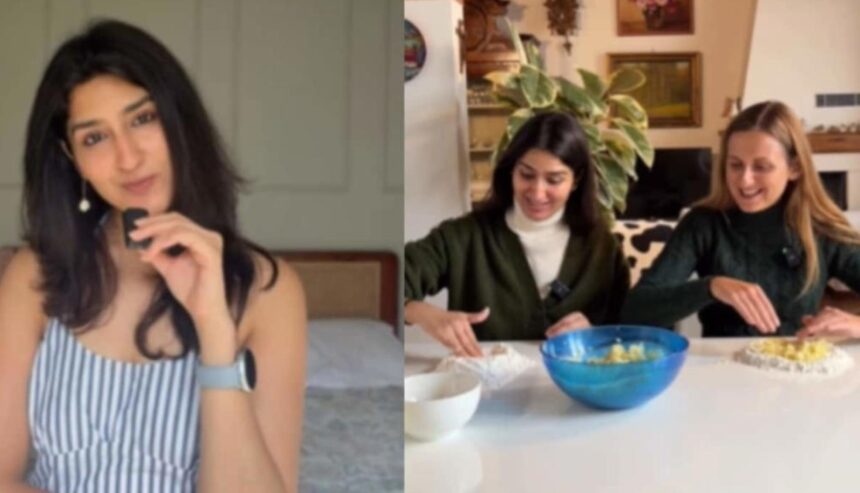
Indian traveller Visha Khandelwal has shared three lessons she picked up while spending time in Europe, from greeting strangers and arriving on time to making independent life decisions. Her observations have sparked a conversation on social media.
An Indian woman’s reflections on her travels across Europe have attracted attention on social media after she shared how seemingly ordinary habits changed the way she approaches everyday life.
Visha Khandelwal, who spent several months travelling and staying in European homes, recently posted an Instagram video discussing the cultural differences that stood out to her. Rather than focusing on tourist attractions or popular destinations, she highlighted the everyday interactions and attitudes she encountered.
From starting conversations with strangers to respecting other people’s time and making personal choices without worrying about outside opinions, Khandelwal said she had begun incorporating some of these lessons into her routine in India.
Her video, captioned “What I learnt from Europeans as an Indian travelling abroad”, prompted viewers to share similar experiences and discuss which habits they would like to adopt.
Indian Traveller Visha Khandelwal Shares What Europe Taught Her
Introducing her video, Khandelwal explained that her observations came from spending time inside European homes and interacting with people during her travels.
“As an Indian who spent the last few months inside European homes, here are the things I learned and how I’m applying them in my daily life. Let’s go,” she said.
Her reflections focused on three areas: everyday social interactions, punctuality and personal independence.
While the experiences were specific to the people and places she encountered, Khandelwal found them meaningful enough to influence her behaviour after returning to India.
Rather than suggesting that one culture is better than another, her observations offer an example of how travelling can encourage people to reconsider familiar routines.
Lesson 1: Small Greetings Can Lead to Meaningful Conversations
One of the first differences Khandelwal noticed was the habit of acknowledging people during ordinary daily interactions.
She recalled regularly greeting drivers, restaurant staff and even people she passed while walking.
“Two months in Europe, and I formed the habit of greeting everyone – cab drivers, waiters, even strangers passing by,” she said.
After returning to India, she realised that the same approach might not always fit every situation.
For instance, when booking an auto-rickshaw, practical details such as confirming the ride and sharing the required one-time password often take priority.
However, she found another way to apply the underlying lesson.
Instead of remaining silent throughout the journey, she began making an effort to speak with drivers once the ride was underway.
According to Khandelwal, these short conversations sometimes introduced her to experiences and perspectives she might otherwise never have encountered.
“Trust me, sometimes the perspective you can get even in those twenty minutes of an auto ride is mind-opening,” she said.
Her experience highlights how everyday encounters can create opportunities for conversation, provided both people are comfortable engaging.
Lesson 2: Punctuality Can Make Life Less Stressful
Another habit that impressed Khandelwal was punctuality.
She recalled travelling with another Indian woman and a Swiss man whose approach to meeting times stood out.
“If we wanted him to meet us at 8:30 in the morning, we would tell him 8:45, and he would still show up at 8:30,” she shared.
The incident became a memorable example of how seriously her travel companion treated agreed meeting times.
Over time, the experience encouraged Khandelwal to arrive earlier herself.
She said being punctual helped remove the stress associated with rushing, running late and having to apologise for keeping others waiting.
What surprised her most was how much more relaxed she felt when she did not have to worry about arriving after the agreed time.
She described that sense of freedom from stress and guilt as underrated.
Although punctuality varies among individuals in every country, her experience shows how adopting a small scheduling habit can improve everyday routines.
Arriving on time can also make shared plans easier to manage, particularly when travelling with others or coordinating professional commitments.
Lesson 3: Learning to Make Decisions Without Worrying About Others
Perhaps the most personal lesson Khandelwal discussed concerned independence and the ability to make life decisions without constantly seeking approval.
During her travels, she said she shared living spaces with women in their mid-30s and 40s who were pursuing their interests independently.
Some were travelling alone, while others were working on personal goals such as writing books or improving their fitness.
“I’ve shared co-living spaces with women aged 35 to 40 who were travelling alone, writing a book, focusing on their fitness, absolutely unbothered,” she said.
Khandelwal was particularly impressed by the confidence with which these women appeared to approach their choices.
She contrasted their experiences with the pressure some people in India feel to consider the opinions of extended family members before making important decisions.
“Log kya kahenge doesn’t even register as a thought,” she observed, referring to the familiar Hindi expression meaning “What will people say?”
She added that the women she met had developed independence through working, living away from home and learning from their own mistakes.
In a humorous comparison, Khandelwal described relatives as a “committee of stakeholders” who sometimes seem to have a vote in personal decisions.
The remark resonated with viewers who recognised the tension between individual aspirations and family expectations.
Her observation does not mean that everyone in Europe experiences complete independence or that all Indian families restrict personal choices. Instead, it reflects the differences she noticed in the lives of the people she met.
Two More Lessons: Saying No and Setting Personal Boundaries
Beyond the three main lessons featured in her video, Khandelwal also mentioned two additional habits that had influenced her thinking.
These involved becoming more comfortable saying no and establishing clearer personal boundaries.
Both ideas relate closely to her reflections on independence.
Being able to decline requests or commitments can help people manage their time and avoid agreeing to things they do not genuinely want to do.
Similarly, personal boundaries can make expectations clearer in friendships, family relationships and professional environments.
Although Khandelwal did not elaborate on these two lessons in the supplied video account, their inclusion suggests that her travels encouraged her to think more carefully about how she manages her time, relationships and choices.
Social Media Users React to Visha Khandelwal’s Observations
Khandelwal’s video sparked a discussion among viewers, many of whom shared their own experiences of interacting with strangers and observing different social habits.
One viewer wrote, “This is so relatable, especially the punctuality part.”
Another commented, “India needs this mindset shift slowly but surely.”
Some users were particularly interested in her observations about greeting strangers.
“Greeting strangers is such a simple thing, but it makes a huge difference,” one person wrote.
Another viewer shared an example of a memorable conversation during a ride booked through Rapido.
The user recalled spending around 20 minutes discussing artificial intelligence and changes in the job market with a rider.
The comment echoed Khandelwal’s point that unexpected conversations can provide insights beyond a person’s usual social circle.
Her humorous reference to relatives also attracted attention.
“Love it. How you described relatives as stakeholders – so well put,” a viewer commented.
Others were curious about the practical aspects of her travels, including how she arranged opportunities to stay with local people and experience different cultures.
Why Living With Locals Can Change the Travel Experience
Khandelwal’s observations also highlight a distinction between visiting a destination as a tourist and spending time in local residential settings.
Traditional sightseeing often focuses on landmarks, restaurants and well-known attractions.
Staying in shared accommodation or with local hosts may offer additional opportunities to observe everyday routines, social customs and personal habits.
These experiences can include how people organise their schedules, interact with service workers, maintain friendships and balance work with personal interests.
However, such experiences cannot represent the culture of an entire country or continent.
Europe includes many countries, languages and communities with different approaches to work, family, social interactions and individual freedom.
Khandelwal’s reflections are best understood as personal lessons drawn from her particular travel experiences rather than general rules about European society.
What Can Travellers Learn From Her Experience?
Khandelwal’s video presents three relatively simple ideas that do not require moving abroad to put into practice.
Being courteous during everyday interactions, making an effort to respect agreed meeting times and taking greater ownership of personal decisions can all be explored within familiar surroundings.
The examples also show that adopting a habit does not necessarily mean copying it exactly.
Khandelwal adapted the practice of greeting strangers to conversations with auto-rickshaw drivers in India, demonstrating how an idea learned elsewhere can be adjusted to fit a different environment.
Similarly, her reflections on punctuality and independence were less about following another culture’s rules and more about identifying behaviours that improved her own experience.
Travel, in this sense, can become an opportunity to reflect on everyday life rather than simply an escape from it.
For Khandelwal, the lasting value of her time in Europe appears to lie in the small changes she has begun making after returning home.
Have a story tip or feedback? Write to [email protected].
© Hunterfly.in. Original editorial content.