






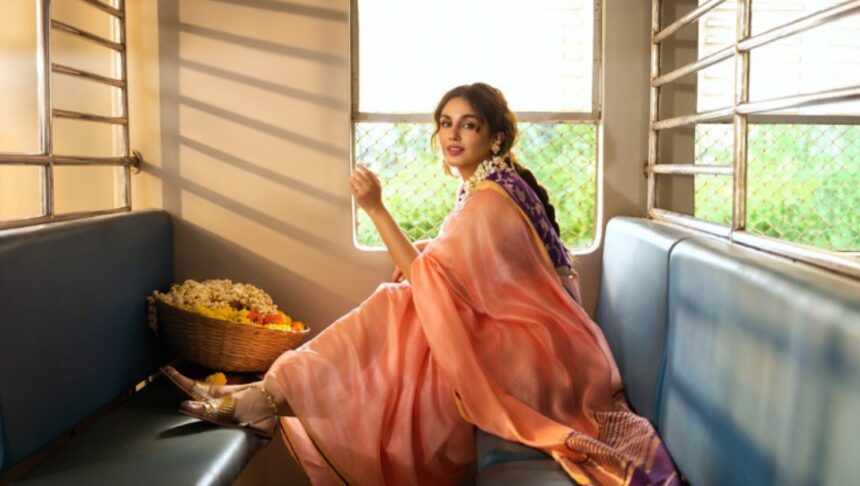
Huma Qureshi has joined hands with Indian handloom label Dressfolk to introduce Freefall, a new saree collection that places the woman wearing the garment at the heart of its design philosophy.
The collection brings together contemporary styling and traditional Indian weaving techniques, drawing from the textile traditions of Chanderi, Varanasi and Kutch. Each saree has been developed in collaboration with master artisans, with individual pieces taking more than 50 hours to create.
Freefall Brings Traditional Handloom Into a Contemporary Wardrobe
At the heart of Freefall is the idea that a saree does not have to be restricted to weddings, festivals or other formal occasions. Instead, the collection explores how India’s traditional six-yard drape can become a more personal and contemporary part of everyday dressing.
The collection reflects Huma’s own relationship with the saree and her belief that the garment can carry cultural history while still allowing the wearer to express her individuality.
See more of our coverage in your search results.
Add Hunterfly on Google“For me, the saree has always represented something much deeper than occasion or tradition. It carries history, craft and individuality, and yet it has the ability to feel completely personal,” Huma Qureshi said.
She added that Freefall was created to explore the meeting point between heritage and contemporary lifestyles.
“With Freefall, I wanted to explore that space where heritage meets the way we live today. The intention was to create sarees that feel effortless and contemporary while still retaining the soul of the craft behind them. Ultimately, it is about feeling like yourself in what you wear,” she said.
Sarees Crafted Across Chanderi, Varanasi and Kutch
The collection draws upon three distinct Indian textile traditions. Artisans from Chanderi, Varanasi and Kutch have contributed their expertise to the pieces, bringing regional weaving knowledge into a single contemporary collection.
According to Dressfolk, each saree takes over 50 hours to make, highlighting the time and craftsmanship involved in creating the handwoven pieces.
See more of our coverage in your search results.
Add Hunterfly on GoogleRather than separating traditional craft from modern design, Freefall attempts to place both within the same fashion vocabulary, allowing the techniques and expertise of master artisans to remain central to the finished garments.
Dressfolk’s Vision for Indian Handloom
For Nitin Mehrotra, Founder of Dressfolk, the collaboration reflects the label’s broader approach to the future of Indian handloom.
“Indian craft does not need to be preserved by keeping it untouched or confined to the past; it needs to thrive by finding a meaningful place in the present,” Mehrotra said.
See more of our coverage in your search results.
Add Hunterfly on GoogleHe explained that the collection aims to bring the skill and authenticity of India’s textile traditions to consumers through a design approach that feels relevant to contemporary wardrobes.
“Freefall is an expression of that belief, bringing together the authenticity and skill embedded in India’s textile traditions with a design sensibility that feels modern, considered and easy to engage with,” he added.
A Collaboration Focused on the Woman Wearing the Saree
The partnership between Huma Qureshi and Dressfolk combines the actor’s personal perspective on sarees with the label’s experience of working with India’s weaving communities.
The resulting collection is designed around the wearer rather than a particular occasion, while maintaining the traditional craftsmanship associated with the saree.
Mehrotra also emphasised that the intention was not to simplify or dilute India’s textile traditions, but to give them a contemporary context through which a wider audience can discover and appreciate them.
With Freefall, Huma Qureshi and Dressfolk bring together handloom heritage, artisan craftsmanship and contemporary design, presenting the saree as a garment that can be rooted in tradition while remaining deeply personal to the woman who wears it.