



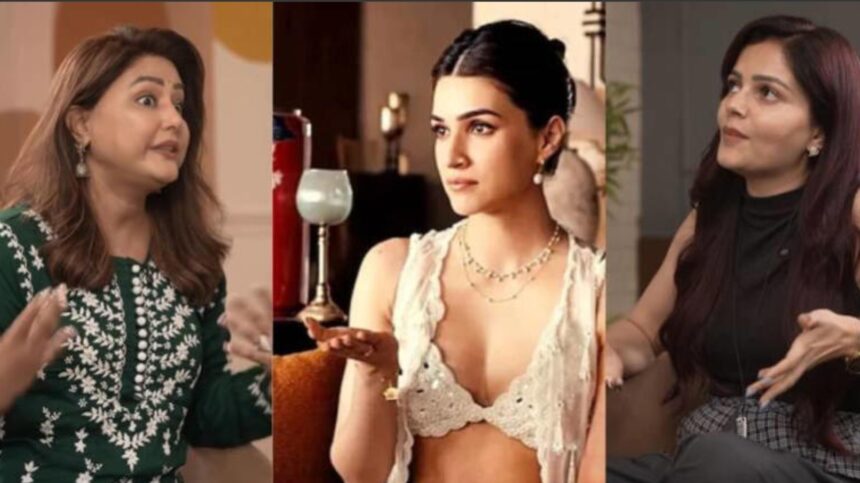
Hina Khan has shared her perspective on the controversy surrounding Kriti Sanon’s Raksha Bandhan advertisement, saying actors have the option to turn down projects when they are uncomfortable with the creative direction. Rubina Dilaik, however, disagreed with the suggestion that Kriti’s outfit was vulgar, while Hina maintained that the styling could have been more sensitive to the festival.
The debate surrounding Kriti Sanon’s recent Raksha Bandhan jewellery advertisement has now extended beyond social media, with television actors Hina Khan and Rubina Dilaik offering different perspectives on the controversy.
The advertisement, created for jewellery brand GIVA, attracted criticism over Kriti’s styling and was subsequently taken down. The campaign showed Sanon celebrating Raksha Bandhan in a contemporary outfit, including a bralette-style top, cape and flowing skirt.
Speaking about the controversy on the YouTube show The POV, Hina Khan said she believed the outfit was not appropriate for an advertisement centred around an Indian festival.
See more of our coverage in your search results.
Add Hunterfly on GoogleHina Khan says actors can choose to walk away
Hina’s argument focused less on blaming an actor and more on the choices available to performers when they are offered advertising campaigns.
“As an actor, you always have a choice,” Hina said.
She acknowledged that brands can sometimes have a strong creative vision and may be unwilling to change their approach. However, she argued that an actor can still decide whether to participate.
“Sometimes some brands are very adamant and they want to do it their way. But as an actor, you always have the option to opt out, considering it may backfire,” she added.
For Hina, the issue is particularly significant because celebrities become closely associated with advertisements once their faces appear in a campaign.
See more of our coverage in your search results.
Add Hunterfly on GoogleRubina Dilaik disagrees over the word ‘vulgar’
Rubina Dilaik offered a different perspective during the discussion.
While Hina described the styling as inappropriate for the occasion, Rubina disagreed with the characterisation of the outfit as vulgar.
Hina clarified her position, saying she did not necessarily consider the clothing vulgar but felt that the campaign could have been approached differently in view of the festival.
See more of our coverage in your search results.
Add Hunterfly on Google“No, it’s not vulgar. But there’s a saying, ‘jaisa desh, waisa bhesh’. I think, keeping the occasion and Indian tradition in mind, we could have made it more sensitive,” Hina said.
Her argument therefore centred on context rather than simply the amount of skin shown.
The actor suggested that the creative choices made for a campaign celebrating Raksha Bandhan should take the cultural significance of the occasion into consideration.
Hina says celebrity faces often bear the backlash
Hina also spoke about the relationship between celebrities and the brands they represent.
She pointed out that although an advertisement involves several parties—including the brand, production team and creative professionals—the public response often focuses overwhelmingly on the actor featured in the campaign.
“As public figures, we always make sure that whatever investments we are making in films, series or adverts, it’s our faces that become the first thing that will be attacked or praised. The brand, production, the creative team—everything takes a backseat,” she said.
That observation adds another dimension to the discussion.
An actor may be the most visible person in an advertisement, but the final creative decision is generally the result of collaboration between multiple stakeholders.
What happened with Kriti Sanon’s Rakhi advertisement?
The controversy began after the GIVA campaign featuring Kriti Sanon was circulated online.
The advertisement showed Sanon in a contemporary ensemble while celebrating Raksha Bandhan. Some social media users criticised the styling, arguing that the look did not fit the cultural context of the festival.
The criticism eventually led to the advertisement being removed.
Kangana Ranaut also commented on the controversy through an Instagram Story, questioning the decision to use a bikini or lingerie-inspired look in an advertisement associated with Raksha Bandhan.
She argued that women today have access to a wide range of clothing choices and questioned why such styling was necessary for the particular campaign.
Her comments added another prominent voice to the debate that had already been unfolding online.
GIVA responds to the backlash
GIVA subsequently addressed the controversy surrounding the campaign.
The jewellery brand initially announced that the advertisement was being withdrawn following the backlash. The company later issued another statement explaining its decision to take down the campaign and reiterating its position on the original message behind the advertisement.
According to the brand’s explanation, the decision was linked to concerns surrounding the situation that followed the campaign’s release, while GIVA maintained that it remained aligned with the idea of family inclusivity that informed the advertisement.
The controversy consequently became less about the jewellery itself and more about the intersection of fashion, advertising, cultural context and celebrity responsibility.
The larger question: where does creative freedom meet cultural context?
The disagreement between Hina Khan and Rubina Dilaik illustrates why advertising controversies involving celebrities rarely have a single straightforward answer.
One argument focuses on creative freedom and the changing way Indian festivals are represented in popular culture. Another stresses the importance of cultural context and the expectations audiences may have around traditional celebrations.
Hina’s comments also raise a practical question for celebrities: how much responsibility should an actor take for the creative decisions made by a brand?
While an actor’s face may become synonymous with an advertisement, the campaign is ultimately created by a wider team.
At the same time, public figures have a direct stake in how they are represented, making the decision to accept or decline a campaign an important professional consideration.
Hina Khan and Rubina Dilaik offer different takes
The exchange between the two television stars does not amount to a dispute between Hina and Rubina so much as a difference in how they interpret the advertisement.
Rubina objected to describing Kriti’s outfit as vulgar, while Hina emphasised that her criticism was about suitability for the occasion rather than judging the actor personally.
With GIVA having already addressed the backlash and the advertisement no longer being available in its original form, the discussion has now moved towards a broader question: should advertising around culturally significant festivals follow traditional visual expectations, or should brands be free to reinterpret them through contemporary fashion?
There may be no universal answer, but the Kriti Sanon campaign has certainly demonstrated how quickly a celebrity advertisement can become part of a much larger cultural conversation.