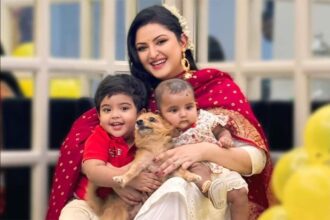






Harshita Gaur reflects on her journey from Mirzapur to Waiting Hai, working with Divyendu again, Ravi Kishan’s energy and Jitendra Kumar stepping into an established role.
Harshita Gaur has gone from being Dimpy Pandit in Mirzapur to playing Divyendu’s wife in the new web series Waiting Hai. While the two projects place her alongside the same actor in very different circumstances, Gaur says she approached the roles simply as an actor rather than allowing their previous on-screen equation to influence her performance.
Gaur played Dimpy, the sister of Ali Fazal’s Guddu Pandit and Vikrant Massey’s Bablu Pandit, in Mirzapur. Divyendu’s Munna Tripathi was closely connected to the violence that changed the Pandit family’s life.
In Waiting Hai, however, Gaur and Divyendu play a married couple, Princy and Sugam. In an interview with Hindustan Times, the actor discussed the contrast between the two projects, the understated strength of her new character and her return to the Mirzapur universe with Mirzapur The Movie.
Harshita Gaur says she did not think about Mirzapur while working with Divyendu
Gaur said she did not consciously approach Waiting Hai by thinking about her previous relationship with Divyendu’s character in Mirzapur.
For actors, she explained, the focus is on performing the characters in front of them, while audiences are capable of understanding the difference between fictional roles.
She said she was particularly pleased that viewers had connected with Princy and Sugam in Waiting Hai, just as audiences had previously embraced characters such as Munna and Dimpy.
Princy represents a different kind of female strength
One of the biggest changes for Gaur in Waiting Hai was playing Princy, a woman whose strength is expressed quietly rather than through confrontation.
Gaur praised Sunita Rajwar, who plays Princy’s mother-in-law, and said their scenes gave her an opportunity to explore a family dynamic she had not portrayed in the same way before.
She highlighted a moment in which Princy is repeatedly told that belongings can be taken away. Rather than arguing, the character simply picks up a suitcase and leaves.
For Gaur, the scene demonstrates Princy’s ability to stand her ground without raising her voice.
The actor also spoke about the wider importance of recognising women who serve as the emotional centre of their families. She pointed out that domestic responsibilities, maintaining relationships and supporting a household are forms of effort that can be overlooked because they do not always resemble conventional professional achievement.
For Gaur, Princy represents that quieter form of strength.
Harshita Gaur calls Divyendu an ideal co-star
Gaur had high praise for Divyendu, describing him as enjoyable to work with both on and off the set.
She said his acting allows co-stars to experiment without feeling overly conscious during a scene. According to Gaur, working with him is also a learning experience because he creates space for another performer to respond naturally.
She also highlighted the contrast between his Mirzapur persona, Munna, and his Waiting Hai character, Sugam.
Away from the camera, Gaur described Divyendu as witty and humorous, qualities that make long shoots more enjoyable.
Gurmmeet Singh keeps the Mirzapur set light
Despite the serious and often disturbing material in Mirzapur, Gaur said there is someone who consistently helps keep the atmosphere on set relaxed.
She credited director Gurmmeet Singh with maintaining that balance.
Because the cast frequently works on emotionally intense scenes, Gaur said having someone who can lighten the mood is particularly valuable.
Why Harshita Gaur thinks Mirzapur connected with audiences
Gaur believes Mirzapur stands apart from conventional crime dramas because its story is not built only around violence and crime.
She sees the series as a story about two young men who eventually become the very kind of people they once feared.
The actor also pointed to the show’s use of ordinary family dynamics within an extraordinary and violent setting. She recalled how the early episodes could initially make viewers expect a threatening situation before revealing a more recognisable family environment.
That contrast helped create a sense of familiarity, according to Gaur. Beneath the crime, violence and power struggles was a story involving families and relationships that audiences could recognise.
She believes that relatability helped viewers become invested before the larger world of Mirzapur gradually unfolded.
Harshita Gaur praises Ravi Kishan’s ‘child-like’ energy
Gaur also spoke about working around Ravi Kishan in Mirzapur The Movie.
Although she said they do not share many scenes and Kishan largely works with other members of the cast, the two spent considerable time together away from the camera.
Gaur praised his stories and his ability to retain a youthful enthusiasm despite a career spanning several decades.
She said there is a child-like quality in the way Kishan tells stories and approaches his work, along with an eagerness to keep experimenting.
For Gaur, that energy is something performers can learn from regardless of how long they have been in the industry.
Jitendra Kumar replacing Vikrant Massey in Mirzapur The Movie
The transition from Vikrant Massey to Jitendra Kumar is another major talking point surrounding Mirzapur The Movie.
Asked whether stepping into an established role could have been difficult for Kumar, Gaur said the actor himself would be the best person to answer that question.
She acknowledged that joining an established fictional universe can be challenging when audiences have already developed an association with another performer.
At the same time, Gaur said her experience on the set was remarkably smooth.
She explained that Kumar became part of the existing cast and world so naturally that the change did not feel noticeable to those working with him.
“He seamlessly became a part of this journey to the point where it felt like he was always there,” Gaur said.
Harshita Gaur calls the struggle between projects ‘non-selection’
Gaur also opened up about the uncertainty that comes with an acting career.
Instead of using the word “rejection,” she prefers to describe unsuccessful opportunities as “non-selection.” Her reasoning is that an actor may simply not be the right fit for a particular role rather than being personally rejected.
However, she acknowledged that long periods without work can affect confidence and motivation.
Her way of dealing with those periods is to keep reminding herself that the next opportunity could be only one job away.
Gaur said actors have to continue working on themselves even when they are between projects, while also paying attention to their mental health.
Why Harshita Gaur recommends having another source of income
The actor also discussed the financial instability that can accompany an acting career.
Because acting work is not always consistent, Gaur believes performers can benefit from having an additional source of income. Financial stability, she suggested, can make it easier for actors to continue developing themselves and wait for projects they genuinely want to pursue.
She also pointed to social media as a source of new earning opportunities for performers.
For Gaur, having financial flexibility can ultimately give actors greater freedom to make creative choices rather than accepting every opportunity simply because they need immediate work.