




Freida Pinto has welcomed the growing presence of complex female characters in Indian films and television, saying that women no longer need to be portrayed as flawless or strictly bound by traditional expectations. The actor believes imperfect, layered characters offer a more relatable view of human nature. She also called for a creative environment in India where young people can explore new ideas without their potential being restricted.
Indian cinema has long featured women in a wide range of roles, but conversations about how female characters are written have increasingly focused on individuality, moral complexity and personal agency. Freida Pinto believes the willingness to portray women with contradictions and imperfections marks a welcome development.
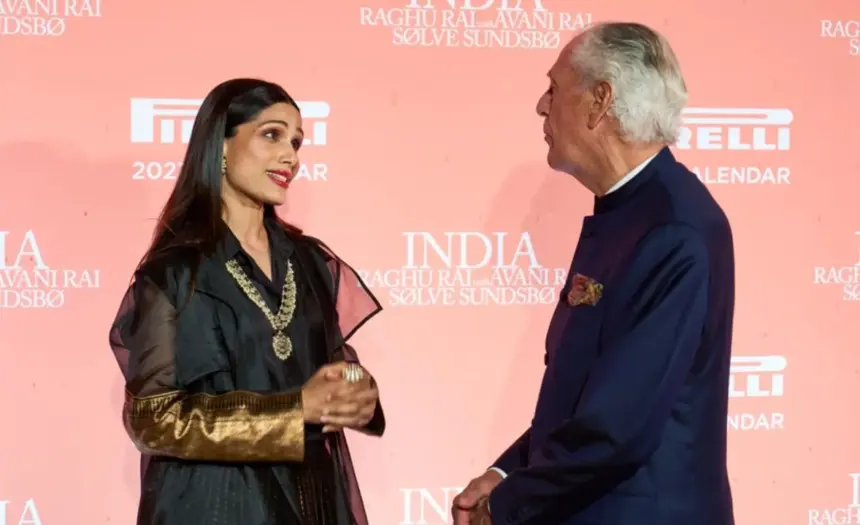
Speaking at the launch of the 2027 Pirelli Calendar, Pinto reflected on the changes she has observed in Indian film and television since her international breakthrough with Slumdog Millionaire in 2008. She expressed appreciation for stories that move beyond the familiar image of the endlessly dutiful or morally unquestionable woman.
For Pinto, characters become more compelling when their choices, flaws and conflicting emotions resemble those of real people.
Freida Pinto Says Imperfect Female Characters Feel More Real
Pinto highlighted the changing representation of women as one of the positive developments in Indian entertainment.
“It has changed in many beautiful ways and there are some changes that are very, very welcome, which is, as far as I’m concerned, is the representation of women in film and television,” she said.
She welcomed the opportunity to see women portrayed with different personalities and perspectives rather than being confined to traditional character types.
“Being able to see all kinds, not just the duty-bound or the puritanical women, but also the ones with their complexities and not perfect. I’m more interested in the things that are not perfect. The things that are perfect are boring and are not relatable,” Pinto added.
Her comments underline the value of characters who can make mistakes, struggle with difficult decisions and hold conflicting beliefs. Such portrayals allow writers to move beyond simple divisions between virtuous and flawed characters, creating stories with greater emotional depth.
Rather than suggesting that traditional female characters have no place in cinema, Pinto’s perspective highlights the importance of offering audiences a wider range of women and experiences.
The shift also creates opportunities for performers to explore characters whose motivations change throughout a story, making their journeys less predictable and more reflective of real life.
Freida Pinto Calls for a Creative Breakthrough in India
Beyond the representation of women, Pinto spoke about the importance of encouraging creative expression among India’s younger generations.
She expressed hope for an explosion of creativity in the country, pointing to the ideas, energy and enthusiasm of young people as an important source of artistic possibility.
Her message centred on giving emerging voices the freedom to experiment, develop original perspectives and challenge established storytelling conventions. She also expressed concern about the possibility of promising ideas being suppressed before they can reach their full potential.
The call is particularly relevant to an entertainment landscape that includes theatrical films, streaming series and independent productions. These formats can provide different opportunities for writers, directors and actors to explore stories that do not fit conventional commercial formulas.
Pinto’s own professional journey has taken her from international cinema to projects that explore a variety of human experiences. Through her production venture, Freebird Films, she has also pursued an interest in developing stories with distinctive perspectives.
Her comments reflect a broader argument for creative environments in which originality can flourish and young filmmakers can experiment without being discouraged from exploring unfamiliar themes.
Freida Pinto at the 2027 Pirelli Calendar Launch
Pinto’s comments came in connection with the 2027 Pirelli Calendar, for which she was among nine Indian women featured in the project, according to the supplied report.
The calendar’s creative approach was another subject of discussion. Pinto praised photographer Sølve Sundsbø for approaching the women without relying on preconceived ideas about what Indian women should look like or how they should present themselves.
The shoot was described as collaborative, with participants having room to express their personal preferences and feel comfortable with their chosen attire. This approach helped place the subjects’ individuality at the centre of the photographs rather than imposing a single visual identity on them.
The project was also described in the source material as the first edition of the calendar to place India at its centre. The calendar’s exact creative concept and production details should be confirmed against official announcements before publication.
For Pinto, the emphasis on individuality connects with her broader views on representation. Just as screen characters benefit from being portrayed with greater complexity, visual projects can become more meaningful when the people featured are treated as individuals rather than representatives of a predetermined stereotype.
Kriti Sanon Also Welcomes More Nuanced Female Roles
Freida Pinto is not the only actor to have spoken positively about the changing portrayal of women in Indian cinema.
Kriti Sanon has also discussed the limitations of being offered conventional “good girl” characters early in her career. She has expressed interest in roles that allow women to make mistakes, challenge expectations and display a wider range of emotions.
Such characters can be refreshing because they move away from the expectation that female protagonists must always behave impeccably or serve as moral examples for other characters.
When women are allowed to be ambitious, conflicted, vulnerable or occasionally wrong, their stories can become more unpredictable and emotionally engaging. Their identities no longer depend solely on how they relate to family, romance or society; their own motivations and decisions become central to the narrative.
The growing interest in these roles reflects an important creative opportunity for Indian filmmakers. Rather than relying on a single template for female characters, writers can develop personalities shaped by different backgrounds, ambitions, relationships and personal challenges.
Why Complex Women Matter in Storytelling
Characters with imperfections can make a story feel more authentic because real people rarely fit neatly into categories of good and bad. They can make admirable choices in one situation and poor decisions in another, often for reasons that become clearer as their experiences unfold.
For actors, such roles can provide more room to explore emotional transitions and conflicting motivations. For audiences, they can create opportunities to recognise aspects of their own lives in characters who are not presented as idealised figures.
Pinto’s remarks also point to the importance of creative freedom in deciding which stories reach the screen. Greater diversity in the people writing, directing and producing projects can help expand the experiences and perspectives represented in entertainment.
However, meaningful representation is about more than simply making female characters flawed. Their choices, development and relationships need to be written with depth, allowing them to exist as fully realised individuals rather than as stereotypes of a different kind.
Freida Pinto’s Perspective on the Future of Indian Entertainment
From her appreciation of complex female characters to her call for a freer creative environment, Pinto’s comments highlight two connected priorities: telling more nuanced stories and allowing fresh ideas to develop.
Her observations offer a reminder that representation is not just about the number of women appearing on screen. It also concerns the freedom those characters have to make decisions, experience contradictions and shape the stories in which they appear.
As Indian cinema and television continue to evolve, a wider variety of female characters can create more opportunities for distinctive performances and original storytelling. Pinto’s message is that imperfection need not be something a character must overcome to become worthy of an audience’s attention. Sometimes, it is precisely what makes the character believable.