





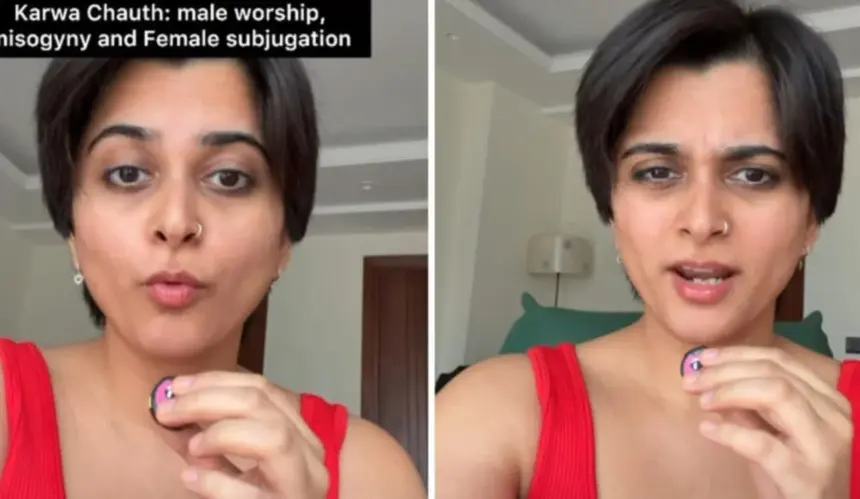
Counselling psychologist Divija Bhasin has sparked a discussion about gender equality in marriage after criticising the expectations traditionally placed on women during Karwa Chauth. Her remarks have prompted debate over fasting, expressions of love and whether religious and cultural practices should evolve with changing attitudes towards relationships.
Karwa Chauth is traditionally observed by many married Hindu women who fast from sunrise to moonrise, praying for their husbands’ health, well-being and long life. For some families, the festival is an important expression of devotion and marital commitment. For others, it has become an occasion to question the different expectations placed on husbands and wives.
This debate gained fresh attention after counselling psychologist Divija Bhasin shared a video criticising the gender imbalance she sees in the ritual. She questioned why women are expected to endure hunger and thirst for their husbands while men are not generally expected to undertake the same fast for their wives.
Her comments have reopened a broader conversation about the relationship between tradition, personal choice and equality within marriage.
Divija Bhasin Questions Why Wives Are Expected to Fast
In the Instagram video described in the report, Bhasin argued that husbands should reflect on what it means to accept a partner’s physical discomfort as proof of love.
She said, “You have to be some next level of shameless to watch your loving wife dehydrate and starve for you. It means that you either have no empathy for her or get a kick out of male worship.”
Bhasin also challenged what she considers the underlying message of Karwa Chauth: that women must demonstrate their devotion through sacrifice while comparable expectations are not placed on men.
“Karwa Chauth as a festival shows us how men view women in society. The underlying message is very clearly that women must prove their love for their husbands by suffering, and their husbands don’t have to do the same thing for them. The misogyny is obvious because why shouldn’t men also fast?” she said.
Her criticism centres on reciprocity in relationships. If fasting is understood as an expression of love and concern for a spouse, she questions why the practice is not equally expected of both partners.
The remarks have drawn attention because they challenge a familiar cultural practice through the lens of contemporary conversations about gender roles and emotional equality.
The Debate Over Rituals, Sacrifice and Marriage
Karwa Chauth has different meanings for different people. For many women, the festival is a cherished tradition associated with prayer, family gatherings, dressing up and spending time with loved ones. Some couples also treat the occasion as a shared celebration of their relationship.
At the same time, critics argue that a tradition can deserve scrutiny when participation becomes an obligation rather than a personal decision.
Bhasin also questioned customs associated with the conclusion of the fast, including practices in which wives offer prayers to their husbands or touch their feet in certain family or regional traditions.
“The funniest part is that the woman has to worship the man at the end and touch his feet. She’s literally starving for him. He should be worshiping the ground that she walks on. Honestly, shame on you for letting your wife suffer for you. You’re a loser,” she said.
Her language was deliberately confrontational, framing the practice as an example of unequal expectations within marriage.
However, Karwa Chauth customs are not identical across all communities or households. Some women observe the fast voluntarily as a meaningful expression of faith, while others may experience family or social pressure to participate.
Recognising these differences is important to understanding the debate. Criticism of gender inequality does not require assuming that every woman who observes the festival has the same motivations or experiences.
Social Media Users Express Different Opinions
Bhasin’s remarks prompted a range of responses from social media users, according to the supplied report. Some commenters supported her criticism, while others discussed their personal relationships with fasting and religious traditions.
One user questioned the practice, writing, “I don’t understand how women support this.”
Another shared a more personal perspective on fasting, saying, “I don’t even like normal vrat. I believe god likes me well fed and happy.”
Some commenters expressed a desire to move away from traditions they felt no longer reflected their values. One person wrote, “I will be the first one in my family to break this cycle.”
Others supported a more reciprocal interpretation of the festival. One comment stated, “Not oppression, but probably Men should be fasting too.”
Another user questioned whether the practice should continue in its current form, writing, “It’s high time we do away with all this! It’s crazy, it’s 2026!”
These reactions illustrate the range of opinions surrounding the festival, from those who question its gender expectations to those who favour changing the practice rather than abandoning it entirely.
The comments provided in the report should not be treated as a representative survey of public opinion. They offer a snapshot of an online discussion rather than evidence that society as a whole shares one particular view.
Can Karwa Chauth Become a More Equal Celebration?
The discussion raises a question that extends beyond one festival: how can couples preserve traditions that matter to them while ensuring that neither partner feels pressured into a particular expression of love?
For some couples, the answer may involve observing the festival together, with both partners fasting if they freely choose to do so. Others may decide to celebrate through prayer, shared meals, gifts or time spent together without fasting.
There is no single approach that fits every relationship. What matters is that decisions are made through mutual understanding rather than one-sided expectations.
Fasting is also not a risk-free activity for everyone. Going without food and water can lead to dehydration and other health concerns, particularly for people with certain medical conditions. Anyone considering a prolonged fast should take individual health needs into account and seek medical advice where appropriate.
The wider conversation is therefore about more than whether husbands should fast. It is also about consent, respect and the freedom to decide how religious or cultural traditions fit into a couple’s life.
Tradition and Changing Attitudes Towards Relationships
Karwa Chauth continues to hold cultural and personal significance for many families. At the same time, discussions about equality are encouraging people to examine how traditions are practised and whether their expectations are shared by both partners.
Bhasin’s comments have brought one particular question into focus: if a ritual represents love and concern for a spouse, should its responsibilities be limited to one person?
Supporters of her position may see mutual participation as a way to make the festival more equal. Others may prefer to retain the traditional form while emphasising that women should have the freedom to choose whether they observe it.
Ultimately, the conversation highlights the importance of distinguishing between a freely chosen act of devotion and a practice maintained through pressure or unequal expectations.
For couples navigating these questions, mutual respect may matter more than following a single prescribed version of the festival. Whether they observe Karwa Chauth traditionally, adapt its rituals or choose another way to celebrate their relationship, the decision should reflect their shared values rather than an assumption that one partner must make sacrifices for the other.