








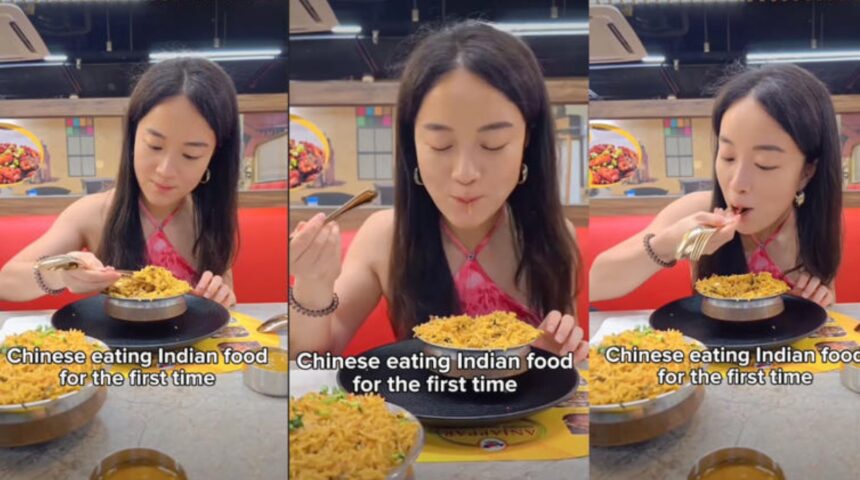
A Chinese woman’s first taste of biryani has become an amusing social-media talking point, but it was not just her reaction to the Indian dish that caught viewers’ attention.
In a video circulating online, the woman appears excited when a plate of biryani arrives and immediately begins trying the rice. However, instead of using the spoon in the conventional way, she holds it in a manner that resembles using chopsticks, attempting to pick up portions of rice with the utensil.
The unusual technique quickly became the funniest part of the clip, with viewers reacting to her enthusiasm and the way she adapted to an unfamiliar eating utensil.
Chinese Woman Tries Biryani for the First Time
The video captures what appears to be a light-hearted first experience with biryani.
See more of our coverage in your search results.
Add Hunterfly on GoogleAs soon as the dish is served, the woman begins tasting it with visible curiosity. Her attention is clearly focused on the food, but her unfamiliarity with the spoon creates an unexpected comic moment.
Rather than holding the utensil in the way many Indian diners might naturally use it, she grips it almost like chopsticks and attempts to scoop up the rice.
The simple moment quickly became the highlight for many viewers.
Her Spoon Technique Gets More Attention Than the Biryani
The appeal of the clip appears to come from the relatable experience of figuring out an unfamiliar food routine.
For someone more accustomed to chopsticks, handling a spoon in a new setting can take some adjustment. In the video, the woman appears to improvise her technique rather than letting that unfamiliarity stop her from enjoying the meal.
See more of our coverage in your search results.
Add Hunterfly on GoogleThat small detail turned an ordinary food tasting into a social-media moment that viewers found entertaining.
Viewers React to the Viral Food Video
The comments under the post included jokes, cultural observations and playful reactions.
One user referenced the long history of cultural exchange between India and China by jokingly asking whether “Chinese biryani” exists, given India’s own tradition of Indian-Chinese cuisine.
See more of our coverage in your search results.
Add Hunterfly on GoogleAnother commenter highlighted historical and cultural connections between the two countries, mentioning Buddhism, ancient trade and the Chinese community in Kolkata while also pointing to the presence of authentic Chinese food traditions in India.
A separate viewer simply wrote, “Obsessed with Chopsticks,” apparently referring to the woman’s unusual way of handling the spoon.
Some Comments Took a More Playful Turn
The viral nature of the video also brought more casual and humorous reactions.
One commenter joked about marrying a Chinese woman, while another left a stereotypical remark involving intelligence and Chinese people.
Such comments represent individual reactions to the clip and should not be interpreted as reflecting the views of all viewers or either culture.
Why Food Videos Often Go Viral
Food-related videos can travel quickly on social media because they combine several naturally engaging elements: unfamiliar dishes, cultural differences, genuine reactions and moments of humour.
In this case, the biryani itself was only part of the story. The woman’s attempt to use the spoon in a chopstick-like manner gave viewers an immediately recognisable visual gag.
The moment also highlights how people adapt when they encounter food traditions or dining habits that differ from what they are accustomed to.
Another Chinese Food-Reaction Story Involved Indian Cuisine
The latest viral clip also recalls another food-related interaction involving a Chinese woman and Indian cuisine.
According to the supplied report, YouTuber Passenger Paramvir previously encountered a Chinese woman who was hesitant to eat Indian food because she had seen online videos depicting unhygienic food preparation in some places in India.
She reportedly showed Paramvir videos of food being prepared in conditions she considered concerning, leading her to believe that Indian food could be unsafe.
Paramvir Explained That Viral Clips Do Not Represent Every Restaurant
Paramvir reportedly responded by pointing out that examples of poor food hygiene can be found in different countries and that isolated videos should not automatically be used to judge an entire country’s food industry.
He then attempted to give her a different experience of Indian cuisine.
To do so, he took her to an Indian restaurant in China, where they ordered dishes including dal makhani, shahi paneer and naan.
She was initially hesitant, but her reaction changed after tasting the meal.
From Hesitation to ‘Yummy’
According to the supplied account, the woman eventually enjoyed the food and described it as “yummy.”
The interaction became an example of how direct experiences can differ from impressions formed through a handful of viral videos.
While the two incidents are separate, both revolve around the same theme: people encountering another culture’s food for the first time and adjusting their expectations through personal experience.
Biryani Becomes the Star of Another Cross-Cultural Moment
The latest biryani video is less about a debate over food hygiene and more about the humour of navigating an unfamiliar eating style.
The woman’s apparent enjoyment of the dish remains central to the clip, while her spoon technique adds the unexpected element that viewers have latched onto.
It is a small moment, but one that illustrates why simple food experiences can become highly shareable online.
A Light-Hearted Food Moment Goes Viral
A Chinese woman’s first experience with biryani has attracted attention online after her unconventional spoon technique became the unexpected star of the video.
While viewers reacted with jokes and cultural observations, the underlying moment is simple: someone trying a new dish and figuring out how to eat it in her own way.
The earlier story involving Passenger Paramvir similarly showed how trying Indian food firsthand could challenge assumptions formed from social-media content.