





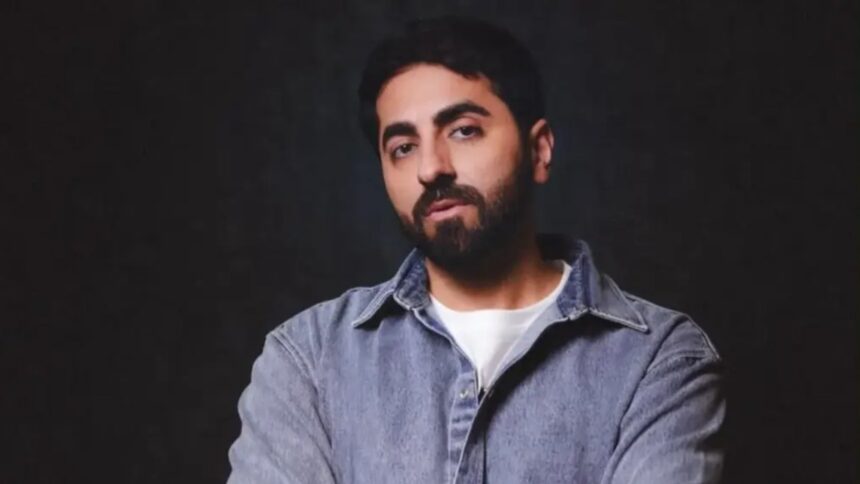
Ayushmann Khurrana was reportedly the first choice for the central role in Hichki before producer Aditya Chopra suggested reworking the story around a female protagonist. The change brought Rani Mukerji into the 2018 drama, which went on to become a notable success for Yash Raj Films.
Casting decisions can change the direction of a film long before it reaches the big screen. That was the case with Hichki, the 2018 Hindi drama starring Rani Mukerji. The project reportedly began with Ayushmann Khurrana being approached for the lead role, but a creative suggestion from Yash Raj Films head Aditya Chopra ultimately changed the story’s direction.
The revelation came from Ayushmann himself during an appearance on Neha Dhupia’s chat show in 2018. His account offered a glimpse into how a change in the central character transformed the project into a female-led film about a teacher determined to prove herself despite a neurological condition.
How Ayushmann Khurrana Was Connected to Hichki
Director Siddharth P. Malhotra initially brought the script of Hichki to Ayushmann Khurrana, according to the actor’s account on Neha Dhupia’s show.
Ayushmann subsequently took the project to Aditya Chopra, who was associated with the film through Yash Raj Films. Chopra reportedly felt that the central character would work better as a woman, prompting the story to be reworked around a female protagonist.
Rather than proceeding with the original male-led version, the filmmakers developed the story in a new direction. Rani Mukerji eventually took on the lead role, giving the film a different perspective and making the teacher’s personal and professional struggles the heart of the narrative.
The change was significant because it affected more than the casting. It shaped the film’s central character, emotional perspective and the way its themes were presented to audiences.
Why Rani Mukerji’s Character Became Central to Hichki
In Hichki, Rani Mukerji plays Naina Mathur, an aspiring teacher who has Tourette syndrome. The condition can cause involuntary movements and vocalisations, which become an important part of how other characters initially perceive her.
Naina’s professional journey is complicated by prejudice and doubts about her ability to manage a classroom. When she is assigned a group of 17 students from a disadvantaged background, she faces another challenge: earning the trust of children who have little reason to believe that the education system is on their side.
Instead of allowing these obstacles to define her, Naina develops her own approach to teaching. Her determination to connect with her students gradually becomes the driving force of the story.
The film explores several themes, including discrimination, inclusive education, self-confidence and the importance of looking beyond a person’s visible differences. Its central conflict is not simply about a teacher managing a medical condition; it is about her effort to be recognised for her abilities rather than judged by her symptoms.
That focus gave Rani’s character a clear emotional journey. Her performance also helped bring a relatively unfamiliar subject to a mainstream Hindi-film audience.
Hichki’s Box Office Performance and Commercial Success
Released in 2018, Hichki attracted attention for its subject and Rani Mukerji’s return to a leading role. The film was produced by Maneesh Sharma and directed by Siddharth P. Malhotra under the Yash Raj Films banner.
According to figures cited by Sacnilk, the film was made on a reported budget of approximately ₹20 crore and earned around ₹236.48 crore worldwide.
These figures indicate a substantial commercial performance relative to the reported production budget. However, worldwide gross collections and production budgets are different measures, and the gross figure should not be treated as the filmmakers’ net profit. Distribution expenses, marketing costs, revenue-sharing arrangements and other factors also affect a film’s final financial outcome.
The film’s performance nevertheless illustrates how a character-driven drama can reach a broad audience when its central theme connects with viewers.
What Ayushmann Khurrana’s Hichki Story Reveals About Casting
The story behind Hichki highlights how casting and screenplay development can influence one another. A project may begin with a particular actor in mind, but a producer or director can identify a different approach that better serves the story.
In this case, the reported decision to shift the protagonist’s gender led to a substantial reworking of the screenplay. Rani Mukerji’s eventual casting also brought a different perspective to the story of an educator confronting prejudice in her professional life.
It would be speculative to say that the film could not have succeeded with Ayushmann in the original version. What can be established from the reported account is that the creative direction changed before production, and the released film was built around Rani’s portrayal of Naina Mathur.
That distinction matters: the story is not simply about an actor losing a role. It is about a screenplay evolving into a different film.
What Is Ayushmann Khurrana’s Latest Film, Udta Teer, About?
Ayushmann Khurrana’s more recent film, Udta Teer, is described in the supplied reporting as a spy comedy involving mistaken identity, amnesia and a cross-border operation.
The story follows an Indian agent who loses his memory after an explosion in Pakistan and comes to believe that he is an officer with India’s Counter-Terrorism Squad. The misunderstanding leads to a series of espionage-related complications, mixing action with comedy.
The reported cast includes Sara Ali Khan, Rahul Bose, Ram Kapoor, Gulshan Grover, Mukul Dev, Suhail Nayyar, Brijendra Kala, Supriya Pilgaonkar and Raghubir Yadav.
The supplied box-office report lists the film’s opening-day domestic net collection at ₹4.10 crore, followed by ₹7.25 crore on Saturday and ₹8.10 crore on Sunday. It also cites an estimated domestic gross of ₹23.08 crore and an India net total of ₹19.45 crore.
These figures should be attributed to the relevant trade-tracking source and checked against its latest update before publication, as box-office estimates can change. The film’s release date, cast credits and current collection totals should likewise be confirmed against reliable, up-to-date sources.
For readers interested in Ayushmann’s career, the contrast between the two projects is noteworthy. Hichki represents a role he was reportedly considered for before the screenplay changed direction, while Udta Teer is presented as a spy-comedy vehicle built around his own screen persona.
The Final Word
The story of Hichki is a reminder that a film’s eventual identity can differ considerably from its earliest version. Ayushmann Khurrana’s account of the project’s development points to a creative decision that led the makers to reshape the screenplay around a female teacher.
Rani Mukerji ultimately brought Naina Mathur to the screen, anchoring a story about ambition, discrimination and the value of inclusive education. The film’s reported worldwide box-office performance added a commercial dimension to its reception.
For moviegoers, the most interesting part of this casting story is not who missed out on a role, but how a change in perspective helped determine the film audiences eventually saw.