




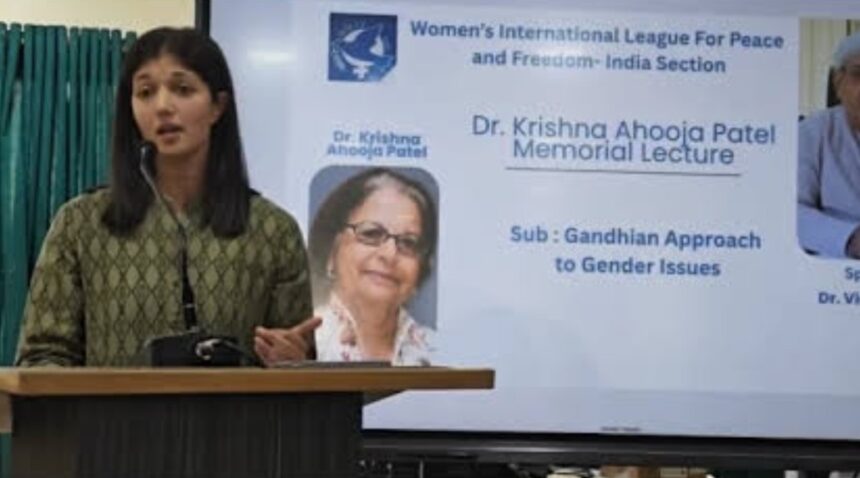
Nia Patel has questioned how institutions practise gender equality after saying she was interrupted while speaking at a memorial lecture for her grandmother, women’s rights advocate and peace activist Krishna Ahooja-Patel.
According to an October 30 report by The Times of India, Nia shared an Instagram video describing the incident in Ahmedabad. She said a male attendee asked her to conclude while she was discussing women’s experiences in India and environmental concerns.
Nia connects the interruption with gender justice
Nia described the experience as “silencing a woman in real time.” Her criticism concerned the contrast between honouring a campaigner for equality and how a woman speaking at that event was treated.
In her account, the speech connected her grandmother’s work with contemporary questions about justice and development. She interpreted the interruption as inconsistent with the values the memorial was intended to recognise.
The available report does not establish the allotted speaking time, the full exchange or an explanation from the organisers. It therefore supports reporting Nia’s account and criticism, rather than independently determining why she was interrupted.
Who was Krishna Ahooja-Patel?
Krishna Ahooja-Patel was a lawyer and peace activist whose career included approximately 25 years of work within the United Nations system.
The Women’s International League for Peace and Freedom, or WILPF, records that she served as its president from 2001 to 2004. Her international work included roles associated with the International Labour Organization and the UN International Research and Training Institute for the Advancement of Women.
A biographical record held by Saint Mary’s University documents her studies in political science and international relations, alongside legal training at London’s Inner Temple. Her professional interests included employment, migration, labour law and development.
A career focused on women’s participation
WILPF’s remembrance describes Ahooja-Patel as a persistent advocate for peace, social justice and women’s empowerment.
Among her priorities was making UN Security Council Resolution 1325 available in more languages. The resolution addresses women’s participation in conflict prevention, conflict resolution and peacebuilding—issues closely connected to her wider advocacy. She died on December 27, 2018.
Ahooja-Patel was also included in the 1000 Women for the 2005 Nobel Peace Prize initiative. This was a collective nomination campaign; she was not a Nobel Peace Prize laureate.
What remains unconfirmed about the memorial
Nia’s post raises a question about whether commemorative events make room for discussion of the concerns their subjects championed.
However, the material reviewed does not provide a complete event recording or an organiser’s response. Those details would help readers assess the circumstances without assuming the interruption’s motive.
For now, the distinction is important: Nia has publicly described an experience she found silencing, while the wider context of the exchange remains incomplete.