


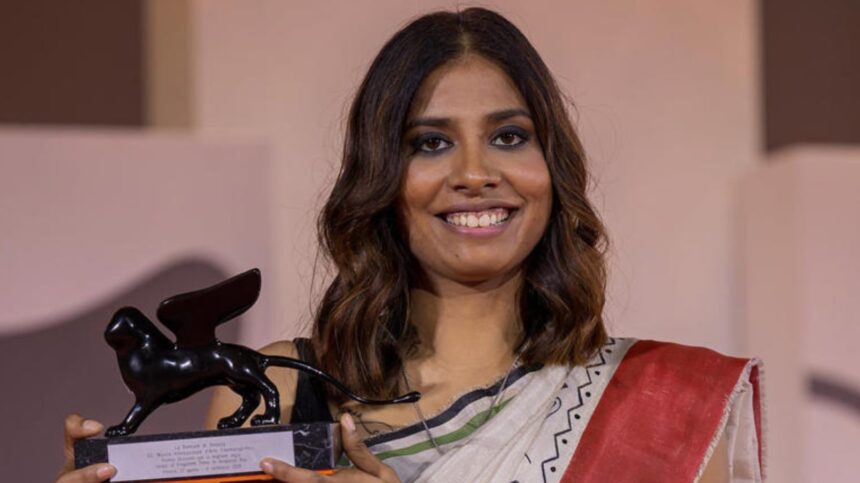
Filmmaker Anuparna Roy is returning to the Venice International Film Festival with her second feature, Lovers in the Blue Night, just a year after winning the Best Director award in the Orizzonti section for Songs of Forgotten Trees. Her latest film has been selected for the Orizzonti Competition at the 83rd Venice International Film Festival.
Roy’s return marks another significant chapter in a rapidly developing filmmaking career. Her new feature moves beyond the intimate scale of her debut and explores several interconnected lives against the nocturnal landscape of Mumbai.
Anuparna Roy Returns to the Orizzonti Competition
Roy first drew major international attention at Venice with Songs of Forgotten Trees.
The film earned her the Best Director award in the Orizzonti section in 2025, making her the first Indian filmmaker to receive that particular honour, according to reports surrounding the festival.
See more of our coverage in your search results.
Add Hunterfly on GoogleA year later, Roy is back in the same competitive section with Lovers in the Blue Night.
The consecutive Venice selections give the filmmaker an unusual opportunity to present two feature films at one of the world’s major international film festivals in successive years.
The new film will compete in the Orizzonti Competition, a section traditionally focused on films representing emerging cinematic voices and contemporary approaches to filmmaking.
What Is Lovers in the Blue Night About?
Unlike the two-character focus of Songs of Forgotten Trees, Roy’s new film follows an ensemble of characters whose lives intersect during the night in Mumbai.
The story revolves around four people living very different lives.
See more of our coverage in your search results.
Add Hunterfly on GoogleAt the centre is a husband who conceals his sexuality from his family. His wife works nights at a bar and yearns for genuine recognition and connection.
The narrative also follows a small-time thief and a man involved in sex work.
Their individual stories eventually overlap, creating a portrait of people navigating loneliness, desire and survival in one of India’s most restless cities.
See more of our coverage in your search results.
Add Hunterfly on GoogleThe film is primarily in Hindi, while also incorporating Sylheti Bengali and Marathi.
A Story About Longing, Migration and Identity
At its core, Lovers in the Blue Night explores questions surrounding identity, migration, desire and belonging.
Roy has connected the film’s ideas to her own experience as a migrant and to her observations of working-class communities living within the pressures of an expanding city.
Mumbai becomes more than a backdrop in the film. Its streets, nightlife and transient communities form an important part of the story.
The characters exist in spaces where people can be surrounded by others while remaining deeply isolated.
That tension between proximity and loneliness appears to be one of the central ideas running through the film.
A Childhood Memory Helped Shape the Film
Roy has previously spoken about a personal memory that influenced the origins of the project.
She has recalled Ameena, a bonded labourer who lived within her household when Roy was growing up.
That memory became one of the seeds from which the film developed.
The connection helps explain Roy’s interest in stories that bring together personal experience and broader social questions.
Rather than treating political and social themes as separate from intimate human stories, the filmmaker has described an approach in which the two intersect.
How the New Film Differs From Her Debut
The production of Lovers in the Blue Night also represented a change for Roy behind the camera.
Her debut feature, Songs of Forgotten Trees, was made under considerably tighter financial conditions and relied on an intimate production approach.
The new film required a larger cast and a more structured production environment.
Roy has described the experience as considerably more professional, involving firmer deadlines and production constraints.
That shift has presented a different set of challenges for the filmmaker, who has had to adapt to the demands of a larger production while retaining the filmmaking sensibility established in her debut.
The Team Behind Lovers in the Blue Night
The film brings back several collaborators from Songs of Forgotten Trees.
Vikas Kumar of Khan & Kumar Media, known for projects including Aarya and Kaala Paani, and Sharib Khan are among the producers.
Returning collaborators Bibhanshu Rai and Romil Modi are also associated with the project.
The production has additionally expanded internationally, with Rhet Topham joining as a US-based producer and Beesham Sreecharan serving as an executive producer.
London-based Amar Singh is the associate producer, while Neeraj Churi is also an executive producer.
Cast and Technical Crew
The ensemble cast features:
- Neelima Sharma
- Pritam Pilania
- Bhushan Shimpi
- Jatin Sarin
- Kajal Keshav
- Vinod Suryavanshi
Behind the camera, Debjit Samanta serves as cinematographer, while Ketul Thakkar is the editor.
The film’s music is composed by Nishant Ramtake.
The combination of an ensemble cast and multiple languages reflects the film’s focus on different communities and perspectives within Mumbai.
Parallax Boards International Sales
International sales for Lovers in the Blue Night have been acquired by Parallax ahead of its world premiere in Venice’s Orizzonti Competition.
The company has highlighted the film’s restrained approach, pointing to its emphasis on quiet and subtle moments rather than overt dramatic gestures.
Parallax’s Liuying Cao has also expressed confidence in Roy’s filmmaking and indicated an interest in continuing the relationship on her future projects.
The international sales deal gives the film an additional pathway to audiences beyond its festival premiere.
From Songs of Forgotten Trees to Venice Again
Roy’s return to Venice is particularly notable because Songs of Forgotten Trees established her as a filmmaker to watch on the international festival circuit.
The debut’s intimate storytelling and eventual Orizzonti recognition provided a strong foundation for her next feature.
With Lovers in the Blue Night, Roy is now taking on a broader ensemble narrative while continuing to explore characters who exist on the margins of conventional social structures.
The new film’s Venice selection gives audiences and international distributors their first major opportunity to see how her filmmaking has evolved since her award-winning debut.
Why Anuparna Roy’s Venice Return Matters
For Indian independent cinema, Roy’s consecutive appearances in the Orizzonti competition represent a notable achievement.
Her journey also highlights the growing international attention being given to filmmakers working outside conventional commercial filmmaking structures.
After the recognition received by Songs of Forgotten Trees, expectations around her second feature are naturally higher.
Yet Lovers in the Blue Night appears to be pursuing a different scale and narrative structure rather than simply repeating the formula of her debut.
Its Mumbai setting, ensemble cast and exploration of identity and vulnerability give the film its own distinct identity.
What Comes Next for Lovers in the Blue Night?
The film’s Venice premiere will be an important next step for Roy and her collaborators.
Its selection in the Orizzonti Competition puts the project before an international festival audience and industry professionals, while Parallax’s involvement gives it an established international sales presence.
Further details about the film’s wider release plans are expected to emerge following its festival premiere.
For Anuparna Roy, however, the Venice return is already another major milestone.