






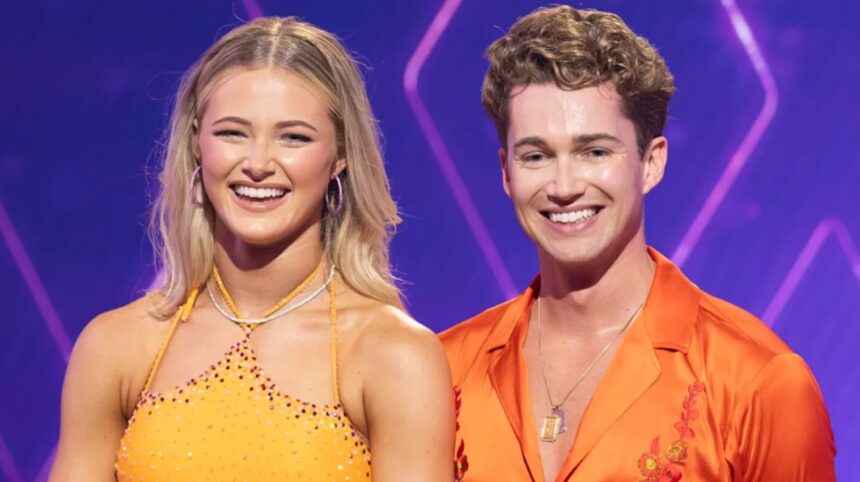
AJ Pritchard’s fiancée, Zara Zoffany, has sparked a social-media debate after responding to comments made by Dancing With the Stars professional Rylee Arnold about Pritchard’s teaching style on Dancing With the Stars: The Next Pro.
The exchange began after the August 24 episode of Dancing With the Stars: The Next Pro, when the competition’s final four contestants were paired with established Dancing With the Stars professionals for a special challenge.
AJ Pritchard was partnered with Rylee Arnold, but their rehearsal experience later became a talking point. Arnold said she found Pritchard’s approach more intense than she initially expected, describing a rehearsal dynamic that involved frequent critiques and limited affirmation.
Zoffany subsequently pushed back on Arnold’s comments in a TikTok response, defending her fiancé and questioning the broader interpretation of his coaching approach. Her remarks triggered a wave of reactions from fans, while Dancing With the Stars pro Ezra Sosa and fellow The Next Pro contestant Selena Hamilton publicly weighed in.
See more of our coverage in your search results.
Add Hunterfly on GoogleRylee Arnold says AJ Pritchard was ‘kind of intense’
During the episode, the Dancing With the Stars professionals reportedly discussed their experiences rehearsing with the Next Pro contestants with judges Shirley Ballas, Mark Ballas and Kym Johnson.
Arnold, who was paired with Pritchard for the challenge, acknowledged that she initially experienced a lighthearted atmosphere. However, she also said that his teaching style felt particularly intense to her.
“At the beginning, I felt that lightheartedness, but I will say, he’s kind of intense,” Arnold said, according to the comments cited from the episode.
She added that she was unsure whether Pritchard would consistently offer the kind of encouragement and affirmation that some dance partners might need, saying that she experienced frequent critiques during their rehearsals.
Her comments reflected her own account of the partnership and the rehearsal dynamic shown around the challenge.
See more of our coverage in your search results.
Add Hunterfly on GoogleIn professional dance, however, teaching styles can vary significantly. Some instructors rely heavily on direct technical correction, while others combine corrections with more frequent verbal encouragement. The balance between the two approaches can also change depending on whether a dancer is working with a beginner, an experienced amateur or another trained professional.
That distinction became central to Zoffany’s response.
Zara Zoffany defends AJ Pritchard in TikTok comment
Pritchard’s fiancée, Zara Zoffany, responded to Arnold’s criticism in a TikTok comment, arguing that Pritchard’s feedback should be understood within the context of the challenge.
See more of our coverage in your search results.
Add Hunterfly on GoogleZoffany wrote that Pritchard would not have needed to offer so many corrections if everything in the rehearsal had been going correctly. She also pointed to another partnership from the competition as an example of how his approach could differ depending on the experience level and circumstances of his dance partner.
According to the reported social-media exchange, Zoffany argued that working with an amateur contestant and rehearsing with an established professional presented two very different dynamics.
She also made a claim about an alleged rehearsal incident in which Arnold reportedly hit Pritchard in the head. Zoffany said this allegedly left him with a “slight concussion” and required him to see a physiotherapist.
The reported injury claim should be treated as an allegation made by Zoffany unless independently confirmed by Pritchard, Arnold, the programme or another reliable source.
Zoffany further compared the situation with another incident reportedly shown during the programme involving professional dancer Steph Sosa and contestant Natalie Jolley.
After her TikTok response drew attention, Zoffany shared a screenshot of the comment on her Instagram Story and wrote that she was “just speaking facts,” according to the social-media posts referenced in the reports.
AJ Pritchard also reportedly liked Zoffany’s TikTok comment, adding another layer to the online conversation.
Fans criticise Zara Zoffany’s response
The response quickly became a subject of debate among Dancing With the Stars fans.
While some social-media users defended Zoffany for standing up for her fiancé, others criticised the way Arnold’s professional qualifications and rehearsal experience were discussed.
The disagreement raised a broader question about professional criticism in dance: can one person offer feedback while another honestly describe how that feedback felt?
That was the position later emphasised by Ezra Sosa, a fellow Dancing With the Stars professional and a close friend of Arnold.
Ezra Sosa defends Rylee Arnold
Ezra Sosa responded publicly to the controversy, strongly defending Arnold’s qualifications and right to describe her own experience.
“Rylee is more than qualified to be a pro, and one dance with a completely different partnership does not erase the years of training, talent, and work that earned her that title,” Sosa wrote.
He stressed that dancers can experience the same rehearsal environment differently and that personal perspectives should not automatically be treated as attacks on another performer.
“Everyone’s perspective and experience in this dance world will be different,” he continued. “AJ is allowed to give feedback, and Rylee is allowed to be honest about how that feedback felt to her. Both can exist.”
Sosa’s response became one of the most widely discussed reactions to the dispute.
He also defended Arnold’s character and professional abilities, arguing that supporting Pritchard did not require publicly questioning Arnold’s qualifications.
Sosa wrote that Arnold is an accomplished professional and dancer and said he found it disappointing to see another woman’s professional standing questioned publicly.
His comments shifted the discussion away from the original rehearsal critique and toward the larger issue of how public disagreement plays out between people connected to a high-profile television competition.
Selena Hamilton also reacts to the controversy
Dancing With the Stars: The Next Pro contestant Selena Hamilton also addressed the discussion on social media.
Hamilton referred to the physical risks that can come with dance work and said that accidents during rehearsals or performances should not automatically become justification for treating someone as less qualified or deserving of respect.
“I’ve been hit, dropped, and more on a job,” Hamilton wrote in a reported Instagram Story. “Never has that been an excuse for me to treat someone like they are less than me or not qualified to be a part of the project.”
She added that accidents can happen in dance and encouraged people to show more grace.
Hamilton’s response reflected a perspective shared by many professional dancers: physically demanding rehearsals involve close contact, lifts, fast movements and complicated choreography, meaning accidental collisions can occur even among experienced performers.
Her statement did not address every aspect of the dispute but appeared to push back against using an alleged accident as part of a broader argument about professional qualifications.
Why the debate over AJ Pritchard and Rylee Arnold matters
The disagreement may have started with a relatively ordinary discussion about coaching styles, but it developed into a wider conversation about feedback, professional standards and public criticism.
Dance partnerships are particularly complex because they combine technical instruction with physical coordination and creative collaboration.
A professional dancer may be expected to correct timing, technique, posture, musicality and performance quality within a short rehearsal period. Direct criticism can be an essential part of improving a routine.
At the same time, the person receiving that feedback may experience the teaching style differently.
That appears to be at the centre of the dispute involving Pritchard and Arnold.
Arnold described how Pritchard’s critiques made her feel during their rehearsal experience. Zoffany, meanwhile, argued that his feedback was constructive and contextually appropriate.
Neither perspective necessarily cancels out the other.
As Sosa pointed out in his response, a person can be entitled to give feedback while the person receiving it can also be honest about how that feedback was experienced.
The social-media reaction continues
The online reaction has highlighted how quickly a television segment can extend into a broader social-media controversy.
What began as comments about a rehearsal partnership soon involved family members and partners, fellow professional dancers, contestants and viewers.
The situation has also placed renewed attention on the contestants competing in Dancing With the Stars: The Next Pro as the competition approaches its conclusion.
AJ Pritchard remains one of the programme’s most closely watched contestants, while Rylee Arnold continues to be a prominent figure within the wider Dancing With the Stars franchise.
For now, the disagreement appears to remain centred on public social-media reactions rather than a formal dispute between the dancers themselves.
A debate about perspective, not just performance
The controversy surrounding AJ Pritchard, Zara Zoffany and Rylee Arnold ultimately demonstrates how differently people can interpret the same professional environment.
Arnold shared her perspective on what it felt like to rehearse with Pritchard. Zoffany publicly defended Pritchard’s methods and offered her own explanation of the situation.
Ezra Sosa then argued that both experiences could coexist, while Selena Hamilton added her own perspective on accidents and professional respect in the dance industry.
As Dancing With the Stars: The Next Pro continues toward its finale, the discussion has become another reminder that the drama surrounding a competition can extend well beyond the routines seen on screen.
The contestants may be competing for a major professional opportunity, but their personalities, partnerships and rehearsal dynamics are also becoming part of the conversation among viewers.