




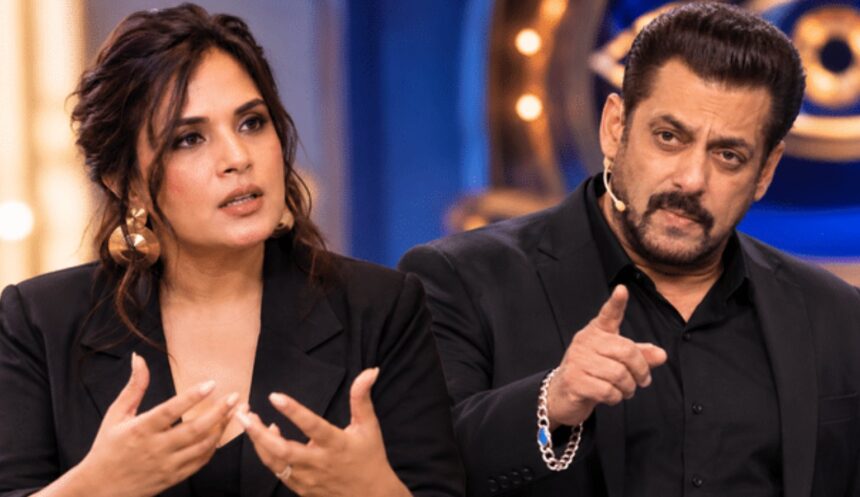
Richa Chadha has praised Salman Khan for speaking out against online trolling and body-shaming during Bigg Boss 20. The actor said criticism targeting women over their weight, appearance or bodies after childbirth should not be normalised, while also opening up about her own experiences with body-shaming and her postpartum journey.
Actor Richa Chadha has spoken in support of Salman Khan after the Bollywood star addressed online trolling during a recent Bigg Boss 20 Weekend Ka Vaar promo.
Salman spoke broadly about the different reasons people use to target others online, including weight, appearance, family background, ageing, professional failures and motherhood. His comments came amid discussions around the way actresses and women in the public eye are scrutinised for changes in their appearance.
Richa welcomed his decision to address the issue and connected it to the wider conversation around body-shaming, particularly criticism directed at women after pregnancy and childbirth.
See more of our coverage in your search results.
Add Hunterfly on GoogleWhat Did Salman Khan Say About Online Trolling?
In the Bigg Boss 20 promo, Salman spoke about the tendency to attack people online over personal characteristics and circumstances.
Without naming a particular person, he said:
“Why do you want to troll? Uske wazan par, uske looks par, uske khaandaan par, kisi ke smile par, kisi ke flop par, kisi ke maa banne par, aap apni upbringing dikha rahe ho.”
His comments covered several forms of online criticism, including remarks about someone’s weight, looks, family, smile, professional setbacks and becoming a mother.
The remarks have since been discussed in the context of online trolling faced by celebrities.
Richa Chadha Calls Salman’s Stand ‘Magnanimous’
Reacting to Salman’s comments, Richa said she appreciated the actor addressing the subject.
See more of our coverage in your search results.
Add Hunterfly on Google“I didn’t know he spoke about it but it’s great! It’s a magnanimous thing to do. One shouldn’t pay heed.”
Richa also spoke about the gender dynamics she sees behind online trolling. She argued that women should not allow anonymous comments about their appearance to determine how they view themselves.
She further pointed to the physical experience of pregnancy and childbirth, saying men cannot personally experience giving birth.
Her comments were particularly focused on the tendency to mock mothers for changes in their bodies.
See more of our coverage in your search results.
Add Hunterfly on GoogleRicha Chadha on Why Body-Shaming Mothers Is Harmful
Richa strongly criticised people who make disparaging comments about women after they become mothers.
“They cannot exist without us. All of them came from a womb. In the natural order of things, if you start to make fun of mothers, it backfires very badly.”
She also connected body-shaming with dissatisfaction about one’s own appearance, arguing that people who ridicule others may themselves have insecurities about their bodies.
The remarks reflect a broader discussion around the unrealistic expectations often placed on actresses and public figures to quickly return to a particular physical appearance after pregnancy.
Richa Has Spoken About Her Own Body-Shaming Experience
Richa’s comments also draw from experiences she has discussed publicly in the past.
The actor has spoken about facing body-shaming during her career and the pressure to conform to conventional expectations surrounding the appearance of a Bollywood heroine. She has also discussed her experience with an eating disorder.
Richa has previously criticised the scrutiny faced by other actresses, including comments about Aishwarya Rai Bachchan’s appearance and postpartum weight.
For Richa, the issue extends beyond celebrity gossip. She has argued that women should not be expected to hide natural changes in their bodies simply to satisfy public expectations.
Her Postpartum Journey Became the Focus of Musafiri
Richa is also exploring these themes through her non-fiction YouTube series ** Musafiri **.
The project has been described as an extension of her postpartum journey, with Richa taking on several roles behind the scenes. She has created, written, produced and hosted the series.
Instead of presenting a heavily stylised version of herself, she has chosen to appear without placing conventional glamour or physical appearance at the centre of the show.
Speaking about the project, Richa said:
“I can’t bother about vanity here. I can’t think that I’m overweight from the last time people saw me… I’m making a show about my postpartum journey. So, my body is as is, my hair is as is and my skin has acne. That’s just how it is.”
The approach allows the series to document her life without presenting postpartum recovery through an artificially polished lens.
Richa on Filming in Dharavi Without Focusing on Glamour
Richa also discussed filming an episode in the lanes of Dharavi, explaining that she wanted to blend into the surroundings rather than appear conspicuously styled for the camera.
“In an episode, you’ll see me roaming around the bylanes of Dharavi. I didn’t want to look like an out-of-place foreigner.”
She said only a small number of people recognised her while the team was filming.
Richa added:
“I’ve to blend in and do my work. Very few people recognised us and came to talk to us while we were filming. It’s a great quality to blend in.”
Her comments highlight the contrast between her work in mainstream cinema and the more observational, everyday format she is pursuing through Musafiri.
The Bigger Conversation Around Celebrity Body-Shaming
Salman’s remarks and Richa’s response have brought renewed attention to the way public figures are discussed online.
Weight, ageing, pregnancy, postpartum recovery and physical appearance remain frequent subjects of social-media commentary, particularly when the person involved is a female actor.
At the same time, criticism and speculation about a celebrity’s appearance can quickly become amplified when social-media users interpret general remarks as being directed at a particular individual.
In this case, some fans have linked Salman’s comments to recent online criticism faced by Katrina Kaif, but neither Salman’s quoted remarks nor the supplied material establishes that he was specifically referring to her.
Richa’s response, meanwhile, focuses on the larger issue: the expectation that women should meet particular appearance standards even while navigating pregnancy, motherhood and the natural changes that accompany them.