








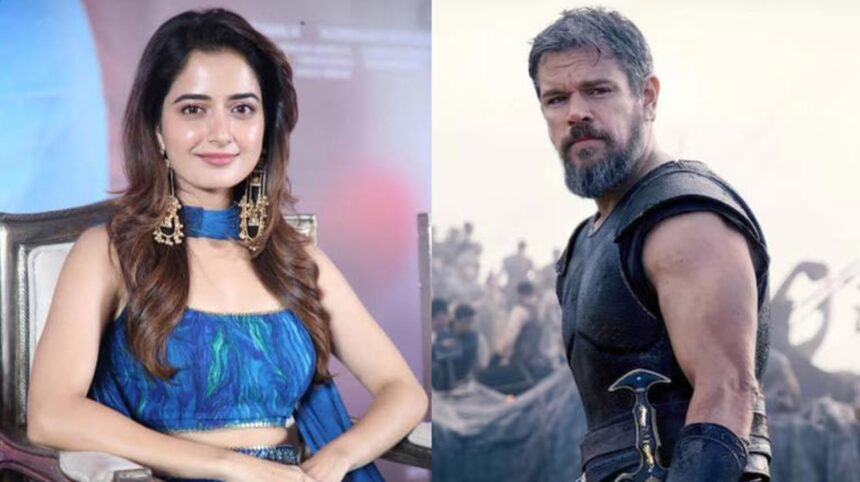
Mumbai: Actor Ashika Ranganath has sparked an interesting cultural conversation after sharing her reflections on Christopher Nolan’s The Odyssey, drawing thematic parallels between the celebrated Greek epic and elements of the Indian epic Mahabharata.
The actor took to social media to explain why Nolan’s adaptation continued to occupy her thoughts long after she watched the film. While she found herself immersed in its storytelling and world-building, she said there was something unexpectedly familiar about the narrative that she could not immediately identify.
That realization, she explained, came only after she encountered discussions comparing aspects of Greek mythology with themes found in ancient Indian texts.
A Reflection That Resonated
Sharing her thoughts with followers, Ashika explained that her familiarity with writings about the Mahabharata, particularly those exploring the final days of Lord Krishna and the beginning of Kali Yuga, led her to view The Odyssey through a different lens.
See more of our coverage in your search results.
Add Hunterfly on GoogleAccording to the actor, she was fascinated by an interpretation suggesting that both narratives explore periods of profound societal transformation.
Rather than focusing on a single dramatic event, she noted that these stories examine gradual changes in human behavior, morality, and the values that once held communities together.
The observation quickly attracted attention among fans of mythology and cinema, many of whom engaged in discussions about the enduring relevance of ancient narratives.
Clarifying Her Position
Ashika was careful to clarify that she was not suggesting any direct connection between the two stories.
She emphasized that her comments were not intended to imply that one narrative inspired or copied the other.
See more of our coverage in your search results.
Add Hunterfly on GoogleInstead, she expressed admiration for how entirely different mythological traditions can independently explore similar philosophical questions and human experiences.
Her remarks reflected a broader appreciation for the way myths from different civilizations often address universal themes such as duty, morality, leadership, loss, and societal change.
Understanding the Parallel
Scholars and mythology enthusiasts have long observed that ancient epics from different cultures frequently contain comparable themes despite emerging from distinct historical and geographical contexts.
See more of our coverage in your search results.
Add Hunterfly on GoogleIn Greek mythology, the conclusion of Odysseus’ journey is often viewed as symbolic of the transition from the Age of Heroes to the Age of Iron—a period associated with increased conflict, moral decline, and reduced divine intervention in human affairs.
Similarly, in Hindu tradition, the events following the Kurukshetra War are understood as marking the end of the Dwapara Yuga and the beginning of Kali Yuga, an era characterized by the gradual decline of righteousness, truth, and virtue.
While the stories differ significantly in their characters, settings, and theological foundations, both narratives explore societies entering periods of uncertainty and transformation.
Why Ancient Stories Still Matter
The conversation initiated by Ashika highlights why mythology continues to resonate with modern audiences.
Epic narratives often serve as reflections of human nature, examining how individuals and societies respond to periods of change, conflict, and moral challenge.
Experts in comparative mythology note that recurring themes across cultures demonstrate how civilizations separated by vast distances frequently grappled with similar questions about justice, leadership, destiny, and human responsibility.
This universality is one reason why works such as the Mahabharata, The Odyssey, the Iliad, and other ancient epics continue to inspire filmmakers, writers, scholars, and audiences around the world.
Christopher Nolan’s Epic Continues to Generate Discussion
Since its release, The Odyssey has become one of the most talked-about films of the year, generating discussions not only about its cinematic achievements but also about the philosophical and cultural themes embedded within its narrative.
Nolan’s adaptation has drawn praise for its visual scale, storytelling ambition, and exploration of timeless human questions.
The film’s impact has extended beyond traditional movie discussions, encouraging audiences to revisit ancient texts and compare mythological traditions from different parts of the world.
Ashika’s comments have added another dimension to that conversation, highlighting how audiences often connect global stories with cultural narratives that are familiar to them.
A Meeting of Mythologies
What makes Ashika’s observation noteworthy is not the suggestion of a direct link between Greek and Indian mythology, but the recognition that great stories often arrive at similar insights about humanity.
Whether through the journey of Odysseus or the transition into Kali Yuga described in the Mahabharata, both traditions explore moments when societies confront uncertainty, shifting values, and the consequences of human choices.
For many readers and viewers, these parallels serve as a reminder that while cultures may tell different stories, the questions they seek to answer are often remarkably similar.
Reporting and Analysis by The Headline Guardian.