







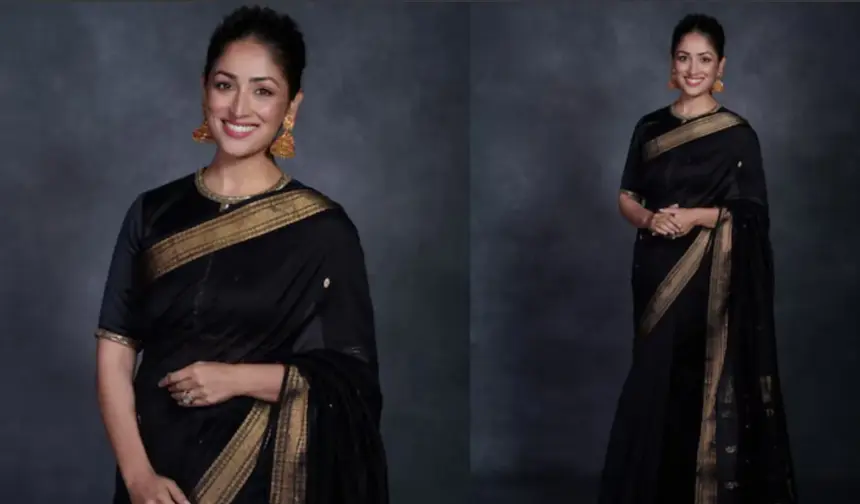
Yami Gautam used the National Film Awards as an opportunity to celebrate not only Indian cinema but also the country’s rich handloom heritage. After receiving the Best Actress award for Article 370, the actress attended the ceremony in an elegant black Maheshwari saree, drawing attention to the generations of craftsmanship behind the textile.
The saree, according to Yami, was woven by a seventh-generation Salvi family weaver from Maheshwar, connecting her red-carpet appearance with a centuries-old textile tradition from Madhya Pradesh.
Yami Gautam Highlights the Weaver Behind Her Maheshwari Saree
Rather than treating the saree simply as a fashion choice, Yami highlighted the artisan and family tradition responsible for creating it.
Sharing details of the ensemble, she wrote on Instagram:
See more of our coverage in your search results.
Add Hunterfly on Google“The black Maheshwari saree is woven by a seventh-generation Salvi family weaver from Maheshwar, carrying forward a family legacy of handloom craftsmanship. Woven in silk, cotton and zari.”
The saree featured a deep black base complemented by a traditional gold border. Yami kept the rest of her styling relatively understated, allowing the weave, texture and border to remain the focal point of her National Film Awards appearance.
Her choice also brought attention to the continuing relevance of India’s regional handloom traditions on major public occasions.
Yami Gautam Credits Ahilyabai Holkar’s Role in Maheshwari Weaving
Yami also acknowledged Maharani Ahilyabai Holkar, whose patronage played an important role in developing Maheshwar as a prominent weaving centre.
“The beauty is in the hands that have kept this craft alive for generations,” Yami wrote, while noting that Maheshwari weaving was nurtured under Ahilyabai Holkar, who brought skilled weavers to Maheshwar.
Ahilyabai, the celebrated 18th-century ruler of the Malwa region, made Maheshwar her capital and encouraged artisans and skilled weavers to settle there. Her support helped establish the town as an important centre for textile production.
See more of our coverage in your search results.
Add Hunterfly on GoogleHowever, the history of weaving in Maheshwar predates her reign.
Maheshwar’s Weaving Tradition Is Older Than Ahilyabai Holkar
Maheshwari weaving is sometimes closely associated with Ahilyabai Holkar because of her influential patronage, but she was not the literal originator of weaving in the region.
According to handloom information from the Ministry of Textiles, Maheshwar had a history of handloom weaving going back centuries, with references placing the tradition as far back as around the fifth century.
See more of our coverage in your search results.
Add Hunterfly on GoogleAhilyabai’s contribution came much later, during the 18th century. As ruler, she encouraged the growth of weaving and invited skilled artisans from places including Hyderabad and Mandav to settle in Maheshwar.
Government handloom accounts also preserve the tradition that she commissioned distinctive sarees from local weavers for royal use and gifting.
Her patronage therefore became an important turning point in the development and recognition of the Maheshwari saree as a distinctive textile tradition.
The Maheshwari Saree Draws Inspiration From Maheshwar’s Architecture
The textile’s identity is closely connected with the city in which it developed.
One of the most recognisable features of a Maheshwari saree is its geometric border, with traditional motifs associated with the architectural surroundings of Maheshwar.
Design influences are linked to elements found around Maheshwar Fort, temples and the ghats along the Narmada River. Traditional patterns include geometric forms associated with bricks and mats, alongside floral motifs such as jasmine.
These details give the saree a visual language that connects the textile directly to the cultural landscape of Maheshwar.
Silk, Cotton and Zari Give Maheshwari Sarees Their Distinctive Character
Historically, Maheshwari sarees were predominantly associated with cotton weaving. Over time, weavers developed combinations incorporating silk and zari, giving the textile its characteristic balance of lightness, sheen and structure.
Yami’s National Film Awards saree similarly combined silk, cotton and zari, according to her description.
The result is a textile that can appear elegant without being excessively heavy, making Maheshwari sarees suitable for both traditional occasions and contemporary styling.
Why Handloom Craftsmanship Still Matters
Yami’s choice also highlights a broader issue within Indian fashion: the importance of preserving traditional weaving knowledge.
A handloom saree is the product of specialised skills that are often passed through families over multiple generations. In the case of Yami’s saree, the seventh-generation Salvi lineage she highlighted represents precisely this continuity.
The value of such textiles therefore extends beyond their appearance. They carry regional techniques, artisan knowledge and cultural histories that can otherwise become difficult to sustain when traditional crafts lose demand.
Handloom production can also provide employment within weaving communities and generally involves lower energy consumption than highly mechanised textile manufacturing.
Yami Gautam Turns a National Awards Look Into a Celebration of Indian Craft
Yami Gautam’s black Maheshwari saree ultimately became more than a formal National Film Awards ensemble. By identifying the seventh-generation weaver behind the textile and discussing Maheshwar’s history, she shifted attention towards the craftsmanship that made the garment possible.
At an event celebrating Indian cinema, the actress also showcased another part of India’s cultural legacy: the artisans, techniques and regional traditions preserved through handloom weaving.
Her choice demonstrates how traditional textiles can remain relevant in contemporary fashion while continuing to carry stories that stretch back generations.