





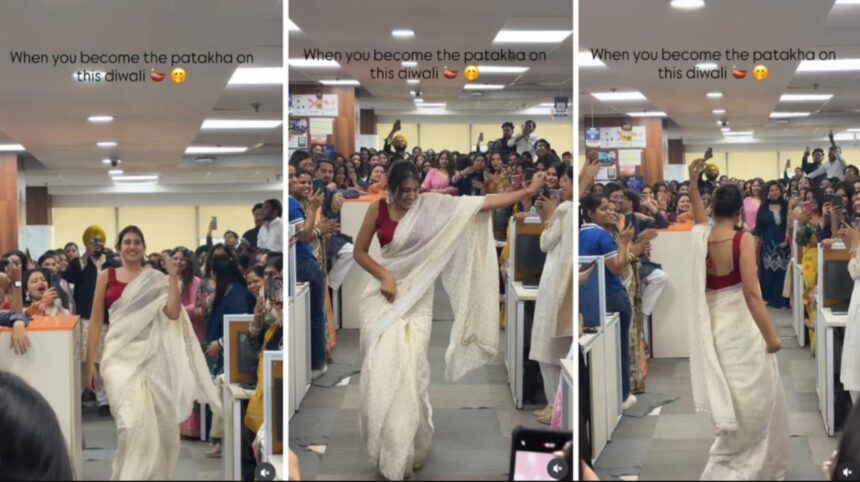
A woman’s energetic dance to the popular Haryanvi track Teri Aakhya Ka Yo Kajal during an office Diwali celebration has sparked contrasting reactions on social media, with some praising her confidence and others questioning workplace entertainment boundaries.
A festive dance performance at an office Diwali party has become the subject of an online discussion after a video shared by Instagram user Anshii Malik attracted both appreciation and criticism. The clip shows Malik dancing to Teri Aakhya Ka Yo Kajal, a popular Haryanvi song closely associated with dancer Sapna Choudhary.
Dressed in a red-and-white saree, Malik performs in front of her colleagues as the workplace celebration continues around her. Several people can be seen filming the performance on their mobile phones, while others respond with cheers and encouragement.
Although the performance appeared to entertain those present, its circulation on social media prompted a wider discussion about personal expression, festive celebrations and expectations of professional conduct.
Woman’s Office Diwali Dance Video Goes Viral
The video was shared by Anshii Malik on Instagram with a playful caption that referenced the festive season.
“When you become the pataka on this Diwali,” she wrote.
In the clip, Malik can be seen performing dance moves to the familiar beats of Teri Aakhya Ka Yo Kajal while colleagues watch.
Her red-and-white saree adds to the festive setting, and the reactions of people around her suggest that the dance was part of the office’s Diwali celebrations.
Workplace events often provide employees with opportunities to participate in activities outside their daily professional responsibilities. Dance performances, music and informal gatherings are common features of such celebrations.
However, once Malik’s performance reached a wider online audience, viewers expressed sharply different opinions about whether the dance was appropriate for a professional environment.
Why Sapna Choudhary’s Teri Aakhya Ka Yo Kajal Remains Popular
The song featured in the video, Teri Aakhya Ka Yo Kajal, has long been associated with Haryanvi dancer and performer Sapna Choudhary.
Known for its energetic rhythm and recognisable dance steps, the track became popular through stage performances and celebrations.
The song is sung by D.C. Madana, with lyrics credited to Veer Dhaiya, and was released as part of the album Suit Tera Patla Vol 2.
Its popularity has extended beyond traditional Haryanvi music audiences, making it a familiar choice at weddings, parties and other social gatherings.
The song has also attracted attention internationally. In an earlier viral instance, people in Amsterdam were seen dancing to the track during King’s Day celebrations.
Its continued presence at public and private events reflects how regional Indian music can reach audiences far beyond its original cultural setting.
Social Media Users Criticise the Workplace Performance
Despite the cheerful atmosphere shown in the office video, some social media users expressed discomfort with the performance.
One commenter described the dance as “atrocious” and questioned whether it represented an appropriate way to celebrate Diwali in a workplace.
Another critic referred to what they called “those cheap Bollywood dances”, arguing that such performances were unsuitable for professional gatherings.
A separate viewer raised concerns about the potential consequences for female employees, suggesting that performances of this kind could become subjects of unwanted gossip or inappropriate comments.
These responses reflected differing expectations about how employees should behave during office-sponsored celebrations.
However, the critical remarks represent opinions expressed by individual social media users, not evidence that Malik violated any workplace policy or acted inappropriately.
Other Viewers Defend Anshii Malik’s Dance
Not everyone agreed with the criticism.
Several social media users defended Malik’s performance, questioning why a dance at a festive office gathering had attracted such negative attention.
Supportive viewers argued that there was nothing inherently offensive about participating in a celebratory dance and saw no reason for the performance to generate controversy.
From this perspective, the video showed an employee enjoying a cultural occasion alongside colleagues who appeared engaged and supportive.
The contrasting responses demonstrated how differently people can interpret the same public-facing moment, especially when a workplace activity is viewed outside its original context.
Office Celebrations and Professional Boundaries Become Part of the Debate
The discussion surrounding Malik’s video raises a broader question about the expectations placed on employees during workplace celebrations.
An office party is different from an ordinary workday. Such events are often designed to encourage participation, strengthen team relationships and allow employees to interact in a more relaxed environment.
At the same time, workplaces have different cultures, policies and expectations regarding entertainment and personal conduct.
What is considered acceptable at one organisation’s celebration may not necessarily reflect the practices of another.
In Malik’s case, the available video description shows a performance accompanied by cheering and colleagues filming. It does not establish whether the organisers had specific guidelines for performances or whether any formal complaint was made.
The online debate therefore centres largely on viewers’ personal opinions rather than a documented workplace dispute.
Viral Diwali Dance Highlights Different Attitudes Towards Self-Expression
As videos of celebrations increasingly circulate beyond their original audiences, moments intended for friends or colleagues can become subjects of public scrutiny.
Malik’s dance illustrates that shift. What began as part of a festive office gathering became a discussion about confidence, entertainment and professional expectations.
Some viewers interpreted her performance as harmless enjoyment, while others considered it unsuitable for a corporate setting.
The disagreement also highlights how women can face public commentary about their appearance and behaviour when personal moments are shared online.
Ultimately, the clip shows how a single festive performance can produce contrasting reactions once it reaches audiences with different social and cultural expectations.
Whether viewed as an expression of festive enthusiasm or a subject for workplace etiquette discussions, the incident has drawn attention to the changing relationship between office celebrations and social media visibility.
Have a story tip or feedback? Write to [email protected].
© Hunterfly.in. Original editorial content.