








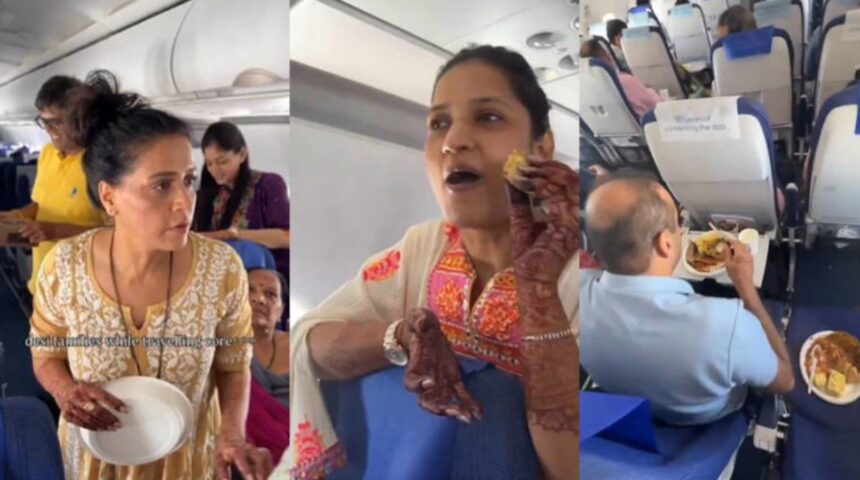
A viral video showing a large group of passengers sharing homemade food and moving through an aircraft cabin with plates has triggered a wider online debate about public etiquette, personal freedom and behaviour in shared spaces.
A short video circulating on social media has drawn widespread attention after appearing to show several passengers eating and distributing homemade food during a flight. The clip, which has reportedly received millions of views, shows members of a group moving through the aircraft aisle while carrying plates.
According to posts accompanying the video, the passengers had brought homemade dhokla and thepla for the journey. The footage has since generated sharply divided reactions online, with some viewers criticising the group’s behaviour as disruptive in a confined shared space, while others questioned whether the backlash had gone too far.
The discussion has extended beyond the food itself and raised a broader question: Where should passengers draw the line between personal comfort and consideration for fellow travellers?
See more of our coverage in your search results.
Add Hunterfly on GoogleViral Video Triggers Debate Online
The approximately 25-second clip shows a group of passengers apparently sharing food inside the aircraft cabin. The video was circulated alongside criticism of what one social-media user described as a lack of public etiquette.
Posts sharing the footage claimed that the group consisted of around 15 family members and that they had brought their own food for the journey.
However, the viral video’s context, including the flight, date and circumstances surrounding the incident, should be independently verified before all claims accompanying the footage are treated as confirmed.
The food visible or reportedly discussed in connection with the clip includes dhokla and thepla, two popular dishes commonly associated with Gujarati cuisine and frequently carried by travellers as convenient homemade snacks.
While bringing food onto many flights is not necessarily prohibited, depending on the airline and route, critics of the video argued that the issue was the way the food appeared to be consumed and distributed in a shared and restricted environment.
See more of our coverage in your search results.
Add Hunterfly on GoogleIs Bringing Homemade Food on a Flight Actually Against the Rules?
One important distinction in the debate is the difference between carrying food on board and behaving in a way that disrupts other passengers or flight operations.
Airline policies can vary depending on the carrier, route and destination. Certain countries also impose restrictions on bringing particular food items across borders for customs or agricultural reasons.
In general, passengers should always check the specific airline’s policy before travelling.
See more of our coverage in your search results.
Add Hunterfly on GoogleBut even when carrying homemade food is permitted, questions of etiquette may still arise.
Aircraft cabins are highly confined spaces shared by dozens or, in some cases, hundreds of passengers. Limited personal space, narrow aisles and restrictions on movement mean that individual behaviour can have a greater impact on others than it might in a larger public setting.
A passenger eating food at their seat may not attract attention. But repeatedly walking through the cabin with plates, gathering in the aisle or blocking the movement of crew and other passengers can create a different situation.
The key issue, therefore, is not necessarily whether passengers choose to eat homemade food, but whether their actions interfere with others or affect the safe and orderly operation of the flight.
Why Food Smells Can Become a Point of Contention
One of the most common arguments raised by critics of the viral video concerned food odours.
Airline cabins are enclosed environments, and passengers have limited ability to move away from strong smells that may cause discomfort to others.
This does not mean that one particular cuisine or type of food is inherently inappropriate for travel. Food preferences are personal and culturally diverse, and criticism based solely on the identity or background of passengers can easily cross into stereotyping.
The more relevant issue is the impact of any strongly scented food in a confined shared environment.
The same principle can apply to perfume, loud music, alcohol consumption, phone conversations and other behaviours that may be acceptable in one setting but become intrusive when people cannot easily leave the space.
A viral reaction to the video summed up the broader argument by saying that the debate should not be reduced to regional identity.
The user argued that the real issue was public-space etiquette, noting that an aircraft is a shared environment where individual freedom must be balanced with consideration for fellow passengers.
Online Reactions Are Divided
The viral clip generated strong reactions across social media.
Some users criticised what they believed was a disregard for the comfort of other passengers, particularly because the footage appeared to show people moving around the cabin with food and plates.
Others took issue with attempts to turn the incident into a broader criticism of people from a particular region of India.
Several social-media users argued that the incident, if accurately represented in the viral clip, should be discussed as a matter of behaviour rather than regional or cultural identity.
That distinction is important.
A single video involving a group of travellers cannot reasonably be used to make conclusions about an entire nationality, state, region or community.
Public etiquette problems can occur anywhere and can involve people from any background.
Shared Spaces Require Shared Consideration
The viral debate highlights a basic principle of public behaviour: just because an action is permitted does not automatically mean it is considerate in every situation.
A person may be allowed to bring food onto a flight. Another passenger may be entitled to move through the cabin when permitted by the crew. Families may want to sit together and share food while travelling.
At the same time, an aircraft is not a private dining area.
Passengers share limited space, and cabin crew need to keep aisles clear for safety and service.
The challenge is to balance personal preferences with the comfort and safety of everyone else on board.
This principle is not unique to air travel.
It applies to trains, buses, airports, cinemas, waiting rooms and other public places where people with different habits and expectations occupy the same space.
What Does Good Etiquette on a Flight Look Like?
While every airline has its own rules, some general principles can help passengers travel more comfortably alongside others.
Keep Aisles Clear
Aircraft aisles are used by passengers and cabin crew. Unnecessary gatherings or prolonged activity in the aisle can obstruct movement and potentially create safety concerns.
Follow Cabin Crew Instructions
Cabin crew members are responsible for safety and service. Passengers should follow instructions regarding seating, movement and the use of the cabin space.
Be Mindful of Strong-Smelling Food
Passengers who bring their own meals may want to consider how strongly scented food could affect people sitting nearby.
Keep Food Consumption Organised
Eating at one’s assigned seat, where appropriate, is generally less disruptive than turning shared sections of the cabin into an informal gathering space.
Respect Fellow Passengers
People on a flight may be sleeping, working, travelling with children or experiencing anxiety. Small acts of consideration can make the journey more comfortable for everyone.
Avoid Blocking Shared Areas
Aisles, exits and crew workspaces should remain accessible, particularly during boarding, meal service and other busy periods.
The Danger of Turning a Viral Video Into a Cultural Debate
Social-media discussions often move quickly from a specific incident to sweeping conclusions about entire groups of people.
That happened in some of the reactions to the viral flight video, where criticism of the behaviour seen in the footage expanded into broad claims about Indians, regional communities and travellers in general.
Such generalisations are neither accurate nor particularly useful.
If the video raises a legitimate question about etiquette, that question can be addressed without turning the behaviour of a few individuals into a judgment about millions of people.
The more constructive discussion is about public conduct in confined shared environments.
How should people behave when their actions directly affect strangers?
When does personal freedom become inconsiderate?
And what responsibility do individuals have when sharing a small space with dozens or hundreds of other people?
These questions apply to everyone, regardless of nationality or cultural background.
Viral Moment Opens a Larger Conversation About Travel Etiquette
The video may have started as a social-media controversy, but the conversation surrounding it reflects a wider issue.
Modern travel places large numbers of people together in tightly managed spaces. Airports and aircraft bring together passengers with different expectations about noise, food, personal space and social behaviour.
Most travel etiquette is not based only on written rules.
It also depends on awareness, consideration and an understanding that public spaces require compromise.
The person sitting beside you may have very different preferences. They may dislike a particular smell, be trying to sleep, feel unwell or simply want a quiet journey.
At the same time, cultural differences should not automatically be treated as evidence of bad behaviour.
The most practical standard is simple: Does a person’s conduct materially interfere with the comfort, safety or reasonable use of a shared space by others?
That is a more useful question than reducing the debate to stereotypes.
The Bottom Line
The viral video has generated millions of views and reignited conversations about civic sense, public conduct and travel etiquette.
But the discussion should remain focused on the specific behaviour shown in the footage rather than making broad assumptions about communities or cultures.
Bringing homemade food while travelling is not, by itself, evidence of poor etiquette. Whether food is permitted depends on airline rules and travel regulations.
The more important question is how passengers behave in the shared cabin environment.
Keeping aisles clear, respecting crew instructions, avoiding unnecessary disruption and being mindful of fellow passengers are principles that apply to everyone.
In the end, civic sense is not about abandoning one’s culture, food or personal preferences.
It is about understanding that shared spaces work best when individual comfort is balanced with consideration for everyone else using them.
Do not describe claims from social-media posts as confirmed facts unless independently verified.