









What happens when a relationship does not collapse because of one dramatic betrayal, but instead slowly loses its warmth through years of silence, resentment and unresolved disagreements? That question lies at the centre of Maya Satya Bhram, the upcoming film featuring Soham Majumdar as Sanjoy.
Reflecting on his character and the film’s emotional landscape, Majumdar describes Sanjoy and Urmi’s relationship as one shaped by distance that develops almost imperceptibly. The couple does not simply stop loving each other. Instead, everyday disagreements accumulate until communication itself becomes difficult.
For the actor, that gradual transformation is what makes Sanjoy’s journey particularly relatable.
Soham Majumdar Finds Sanjoy’s Story in the Space Between Two People
Majumdar’s understanding of Sanjoy begins with the character’s relationship with Urmi, played by Priyanka Sarkar.
See more of our coverage in your search results.
Add Hunterfly on GoogleHe describes their early relationship through the memory of their wedding—a period when being together appeared effortless and the future seemed uncomplicated. But, as the actor reflects, relationships rarely change overnight.
Small disagreements can become permanent grievances when neither person is willing or able to address them.
In Sanjoy and Urmi’s case, seemingly ordinary subjects, including work commitments and family opinions, gradually become sources of friction. What might initially have been manageable conversations instead remain unresolved, creating emotional distance over time.
That slow erosion became one of the aspects that attracted Majumdar to the role.
For him, Sanjoy’s problem is not merely that his marriage has become unhappy. It is the much more complicated experience of recognising that something which once felt natural now requires effort just to hold together.
See more of our coverage in your search results.
Add Hunterfly on GooglePriyanka Sarkar and Soham Majumdar Explore Two Sides of the Conflict
Playing opposite Priyanka Sarkar gave Majumdar an opportunity to examine the same relationship from two perspectives.
Sanjoy and Urmi may share a history, but their emotional responses to that history are not necessarily identical. Their conflict is therefore not presented simply as a question of who is right and who is wrong.
The actors also explored the relationship outside the film’s conventional narrative setting through a conceptual photoshoot by Swarat Ghosh.
See more of our coverage in your search results.
Add Hunterfly on GoogleThe photographs became another way of representing the couple’s emotional state, using physical separation, abandoned spaces and remnants of their shared past as visual metaphors.
Two Chairs, One Burning Distance
One of the images particularly stayed with Majumdar.
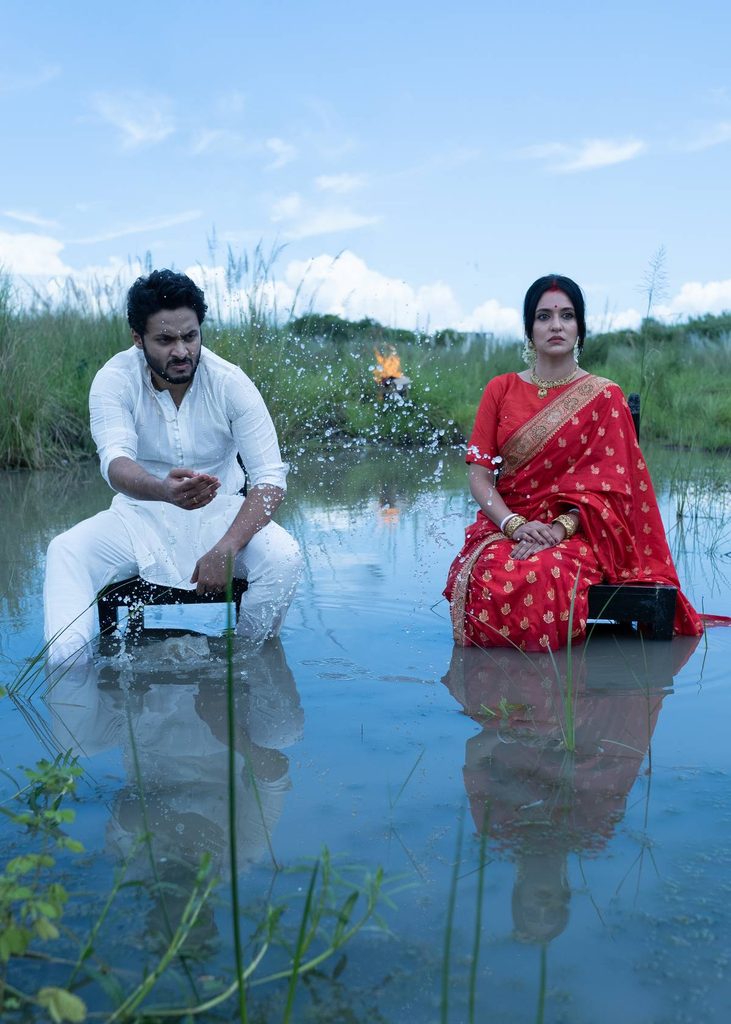
Sanjoy and Urmi are positioned separately beside still water, sitting on individual wooden stools rather than sharing a space. Their bodies and attention turn inward, while something burns quietly in the background.
For the actor, the image captures the danger of becoming accustomed to unhappiness.
The physical distance between the characters is obvious, but the more significant separation is emotional. The fire in the background becomes a metaphor for a problem that both people may recognise but have become too exhausted, hurt or accustomed to address.
It reflects a relationship in which conflict has stopped feeling like an emergency and has instead become part of everyday life.
Wedding Flowers Become a Symbol of What Has Changed
Another photograph takes Sanjoy and Urmi into a more damaged environment, with the couple separated within a ruined setting.
The image also contains a striking visual connection to their wedding memories: white flowers.
Majumdar sees those flowers as a reminder of how the meaning of an object can change with time. Flowers associated with celebration and togetherness can later become symbols of everything that has been lost.
The contrast suggests that memories do not disappear simply because a relationship changes. The happier version of the couple remains part of their history, even when their present is dominated by anger and distance.
What Does Maya Satya Bhram Really Mean?
The title itself became an important part of Majumdar’s interpretation of Sanjoy.
Maya Satya Bhram brings together three ideas—illusion, truth and delusion—and the actor sees these concepts as different possible interpretations of the couple’s relationship.
Was their earlier happiness an illusion that could not survive reality?
Is the bitterness between them the truth they must eventually confront?
Or could their belief that the relationship is beyond repair itself be a form of delusion, created by accumulated hurt, exhaustion and pride?
Majumdar does not suggest that Sanjoy has a definitive answer.
That uncertainty, in fact, is part of what makes the character human.
There Is No Single Moment When Love Disappears
One of the most compelling elements of Sanjoy and Urmi’s story is the absence of a single event that neatly explains their breakdown.
Neither character necessarily decides one day that the relationship is over.
Instead, the film explores the cumulative effect of unspoken feelings, unresolved disagreements and emotional withdrawal.
That is also where the idea that “they want a miracle and not a solution” becomes significant.
People in troubled relationships can sometimes hope for one extraordinary event to fix everything—a perfect apology, a sudden revelation or a dramatic reconciliation. But real relationships are often repaired through much smaller acts of honesty and communication.
For Sanjoy, the challenge is recognising that something is wrong before the damage becomes impossible to reverse.
Can Sanjoy and Urmi Still Find Their Way Back?
Majumdar does not approach the characters’ situation as a predetermined tragedy.
Instead, he leaves room for uncertainty.
The wedding photograph, the separated chairs beside the water and the ruined setting can all be viewed as different moments in the same emotional journey. One does not necessarily erase the others.
That ambiguity is central to the film’s title and, potentially, to its emotional appeal.
Maya Satya Bhram appears to ask a difficult question about long-term relationships: when two people believe they have lost their way, how can they tell whether the relationship itself has ended or whether exhaustion and resentment have distorted their perception?
The answer may not come through a grand gesture.
It may begin with something much simpler—the decision to acknowledge the distance and make the first move towards crossing it.
Maya Satya Bhram Release Date
Maya Satya Bhram is scheduled to release in theatres on August 28, according to the supplied film information.
With Soham Majumdar and Priyanka Sarkar at the centre of its relationship-driven narrative, the film appears to explore the less obvious stages of a relationship’s breakdown—where love can continue to exist alongside resentment, memories can remain alongside anger, and silence can become more damaging than confrontation.
Rather than presenting love as something that either survives perfectly or disappears completely, Maya Satya Bhram looks at the complicated space in between.